



FX rate declared by the CNB for 28/8/2026
EUR - 24.150 CZK
USD - 20.741 CZK

Inventories dampen GDP growth in 2026 Q2

The CNB comments on the GDP figures for 2026 Q2

CNB WP 12/2026 – Bounded Rationality, Monetary Policy, and the Scars of Supply Shocks

The article by Dario Bonciani, František Mašek, Paolo Nanni and Giulio Tarquini shows that bounded rationality can substantially alter the trade-offs that monetary policy face after supply shocks when productivity growth is endogenous. Under rational expectations, a stronger focus on stabilising inflation can deepen the decline in demand and innovation, leaving persistent scars on productivity and output. When households are less forward-looking, they react less strongly to expected future income losses, which mitigates the fall in demand, innovation, and productivity and allows inflation to be stabilised with smaller long-run output costs.

CNB RB 4/2026 – Demographic Change, Inflation, and Monetary Policy: The Case of Czechia

A new CNB research brief by Franta, Hromádková, and Livorová examines the effects of demographic trends and shocks on inflation and monetary policy. The authors discuss the main channels through which demographic developments affect macroeconomic variables and, in turn, inflation, illustrating these mechanisms using the case of Czechia. The study shows that population ageing and low fertility may increase domestic inflationary pressures in the future. It also finds that the inflow of Ukrainian refugees has constituted a persistent labour supply shock.

An analysis of consumer credit growth and its links with the housing market

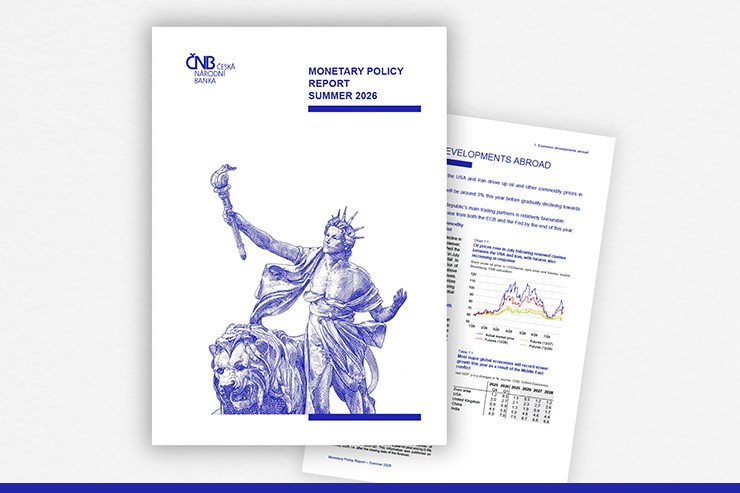
The recent rapid growth in consumer credit provided by banks raises the question of whether it reflects the usual relationship with consumption, or whether it is linked with the mortgage market recovery. This text seeks to answer the question by analysing time series, correlations and model results. Published as part of the Summer 2026 Monetary Policy Report.

Fuel prices and imputed rent increase inflation slightly in July

The CNB comments on the July 2026 inflation figures

How do banks and their clients react to changes in the CNB’s interest rates?

To illustrate the effect of changes in the CNB’s two-week repo rate on client rates, this text examines the distributions of client rates for households and corporations between the end of 2023 and June 2026. Published as part of the Summer 2026 Monetary Policy Report.

Read CNB Governor Aleš Michl’s selected speeches and interviews in which he explains how the central bank is fighting inflation and what steps it is taking to achieve price stability.
Consumer prices in the Czech Republic are going up at a rate of around 2% a year. Maintaining low, stable and thus predictable inflation is the primary objective of the Czech National Bank.

The CNB Lab innovation hub is a platform that brings together the central bank’s activities in the area of innovation and modern technologies. It provides a single point of access to information on projects focused on artificial intelligence, digital assets testing and the future of payments.

By 2028, the Czech National Bank will hold 100 tonnes of gold – the most in its history – in its international reserves, gradually rebuilding the nation’s gold reserves. Why gold?

Payments are an essential part of our daily lives, and instant payments allow you to send money without the wait. How exactly do they work, and how can they make your life easier? Read more to find out.

The CNB has prepared a web portal devoted to its financial and economic literacy activities for the public.

Key rates

2.75%

Discount rate

3.75%

2W repo rate

4.75%

Lombard rate

Inflation

1.7%

July 2026

Current CNB forecast

2.0%

Inflation 2026

2.5%

Inflation 2027

2.2%

GDP 2026

2.7%

GDP 2027

Capital buffer
rates

1.25%

CCyB rate

0.5%

SyRB rate

2.5%

O-SIIBmax rate

Limits
on credit ratios

80%

LTV

– –

DTI

– –

DSTI

Recommendations
for investment mortgages

70%

LTV Investment

7x

DTI Investment

Golden Rules for Bureau-de-Change Clients

  1. Change money only at designated bureaux de change. Before changing money, carefully read all the information given on the exchange rate list.
  2. The terms “purchase and sale of foreign currency” and the corresponding exchange rates, i.e. the information about the direction of the exchange, are given from the bureau de change’s perspective...

More about ten golden rules