Aleš Michl, CNB Governor
CzechCrunch Money Maker
Prague, 10 November 2026
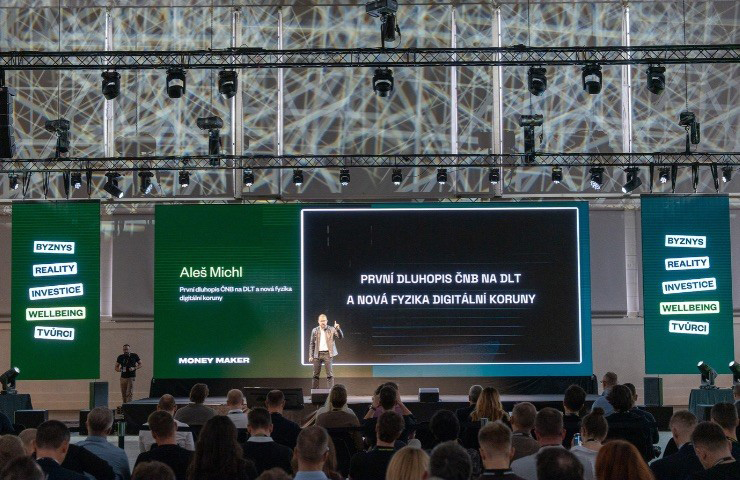
For the first time in its history, the Czech National Bank has issued DLT bonds.
Test bonds.
We tested purchases, sales and interest payments.
We also tested repo transactions: lending against a DLT bond as collateral.
It worked.
We are announcing it today, 10 November. Here, and simultaneously in a press release.
The transactions ran on the DLT platform operated by the Prague Stock Exchange’s Central Securities Depository.
The counterparty was Česká spořitelna.
Each bond had a nominal value of CZK 10,000. We started small.
This is another CNB Lab project. A year ago, it was a digital portfolio: bitcoin, a USD stablecoin and a tokenised deposit. Today, it’s a DLT bond. Another step forward.
Why are we doing this? We want to be conservative in monetary policy and innovative in everything else.
We want low inflation and a strong koruna. A strict anti-inflationary policy.
And we are preparing for the future. We think long term. That’s why we innovate.
We want the koruna to be respected worldwide.
The new physics of the digital koruna will be crucial.
A small country’s currency has a future in the digital world if it rests on two factors:
A functioning market for koruna-denominated assets.
And a high-quality domestic settlement infrastructure.
Neither is enough on its own.
Think of a currency as a shop, with goods on the shelves and checkouts.
The one with the best-stocked shelves of securities has enormous strength. Internationally, that’s the dollar.
But increasingly, the checkouts will matter too: how quickly and reliably you can pay.
Give a small but strong currency fast checkouts and its market will grow faster.
Potentially even at the expense of a larger currency.
That’s why we introduced instant payments. Thanks to the excellent team at the CNB, money now moves instantly from one account to another. In the past, it could take up to two days.
And now we are taking another step forward: we have tested the next generation of checkouts: DLT. A possible platform for the future.
DLT, loosely speaking, is a shared ledger.
Today, everyone keeps their own records and then spends ages reconciling them. In DLT, there is a single record. The same for everyone.
The rules are written directly into the bond and execute automatically. Transactions can be settled 24/7.
This form of DLT takes what is useful from bitcoin and discards what regulated finance cannot use. No miners. The record is visible only to the counterparties.
The central bank must be involved from the outset, so that settlement has central bank money at its core, not private money such as stablecoins.
The goal is to create a large market for koruna-denominated assets that are easier to buy and sell than German Bunds.
And above all this stands artificial intelligence. One day, your digital koruna will be managed by an AI agent. It will collect your salary and negotiate your mortgage. At night, it will move your savings between three banks to earn a few extra basis points. It will not wait for opening hours. Ninety-five per cent of the koruna market could well consist of machines talking to machines. This is the future we are preparing for.
To sum up: the physics of the koruna tells us what supports it: shelves and checkouts, and below them trust in the Czech National Bank. Physics is about forces.
Today’s DLT bond is the first piece of that future. A shelf and a checkout at the same time.
And now for the mathematics. It tells us how the forces combine. Mathematics is about the equation.
A model presented at this year’s Jackson Hole conference did the maths: these two factors do not add up. They multiply. Shelves times checkouts equals the currency of the future.
Multiplication has one hard rule: if one factor is zero, the whole result is zero.
A strong currency grows by ensuring that no factor falls to zero.
Koruna-denominated shelves. Fast checkouts. AI above. Trust below. Cash alongside as an offline backup.
The Czech National Bank’s first DLT bond is still a small number in that equation.
But it’s a number, not a zero.
Thank you.
References
Adam, T., & Michl, A. (2025). First test portfolio of digital assets at the CNB. cnBlog – the official blog of the Czech National Bank.
Adam, T., Michl, A., & Škoda, M. (2026). Balancing volatility and returns in the Czech National Bank’s foreign exchange portfolio: Update on gold and bitcoin (Research and Policy Note No. 1/2026). Czech National Bank.
Adam, T., Michl, A., & Švéda, J. (2025). First use of AI in inflation forecasting at the CNB. cnBlog – the official blog of the Czech National Bank.
Blaha, F., Botka, J., Švéda, J., & Michl, A. (2026). AI-based forecasting of Czech inflation: Quantile regression forests with dynamic weights (Working Paper No. 9/2026). Czech National Bank.
Botka, J., Michálek, O., Michl, A., & Šarboch, M. (2026). Vyhodnocení přesnosti AI modelů nowcastingu HDP (An assessment of the accuracy of AI models for GDP nowcasting, in Czech only). cnBlog – the official blog of the Czech National Bank.
Brunnermeier, M. K. (2026). Artificial intelligence and the brave new world in finance. Paper presented at the Federal Reserve Bank of Kansas City Economic Policy Symposium, Jackson Hole, USA.
Du, W. (2026). Three myths about payment innovation. Panel remarks presented at the Federal Reserve Bank of Kansas City Economic Policy Symposium, Jackson Hole, USA.
Duffie, D. (2026). Tokenized finance and the perimeter of central banking. Paper presented at the Federal Reserve Bank of Kansas City Economic Policy Symposium, Jackson Hole, USA.
Hassabis, D. (2026). A framework for frontier AI and the dawning of a new age. Substack. 14 July 2026.
Liao, G., Prasad, E., & Zhang, T. (2026). Financial innovation and the international monetary system. Paper presented at the Federal Reserve Bank of Kansas City Economic Policy Symposium, Jackson Hole, USA.
Michl, A. (2025). Imagine a world where algorithms and technology assist us, but our values keep us firmly grounded. CNB Discussion Forum 2025, Faculty of Economics, University of West Bohemia.
Michl, A. (2026). Aleš Michl: AI nám pomůže uklidit barák a dělat naši práci lépe než dosud (Aleš Michl: AI will help us tidy the house and do our jobs better than ever before, in Czech only). Interview by Lukáš Voženílek. Seznam Zprávy, 20 May 2026.
Michl, A. (2026). A central bank. And bitcoin. Las Vegas: The Bitcoin Conference 2026.
Michl, A. (2026). Governor’s lecture at MIT: Forever hawkish and AI-based forecasting. Guest Lecture at MIT Sloan, Cambridge, MA, USA.
Michl, A. (2026). Konzervativní v boji proti inflaci, odvážní v tvorbě budoucnosti (Conservative in combating inflation, bold in shaping the future, in Czech only). Forbes Business Fest, Prague, 3 June 2026.
Michl, A. (2026). Konzervativní v boji proti inflaci, odvážní v tvorbě budoucnosti (Conservative in combating inflation, bold in shaping the future, in Czech only). MIT Sloan Management Review Česko (summer 2026).
Michl, A. (2026). Stavíme ČNB s AI v základech a digitální korunou (We are building the CNB with AI at its core and a digital koruna, in Czech only). Meltingpot, Colours of Ostrava, Ostrava, 16 July 2026.
Michl, A. (2026). Governor’s talk at UChicago: In the spirit of Friedman. Conversation with Ľuboš Pástor. University of Chicago Booth School of Business, 10 February 2026.
Michl, A. (2026). The central bank. Trust. Daft Punk. The future is personal, Prague, 12 October 2026. Forbes Better Czechia, Karlovy Vary, 15 October 2026.
Parlour, C. A., Rajan, U., & Zhu, H. (2026). Stablecoin risk. Paper presented at the Federal Reserve Bank of Kansas City Economic Policy Symposium, Jackson Hole, USA.
Ryu, J., Shin, H. S., Sung, J., & Yun, S. G. (2026). A unified ledger in practice: Lessons from Project Hangang. Paper presented at the ECB Forum on Central Banking, Sintra, Portugal.
Trubelík, I., Karhánek, T., Malovaná, S., & Michl, A. (2025). Instant payments in Czechia: Adoption and future trends (Working Paper No. 4/2025). Czech National Bank.