Inflation at the 2% target
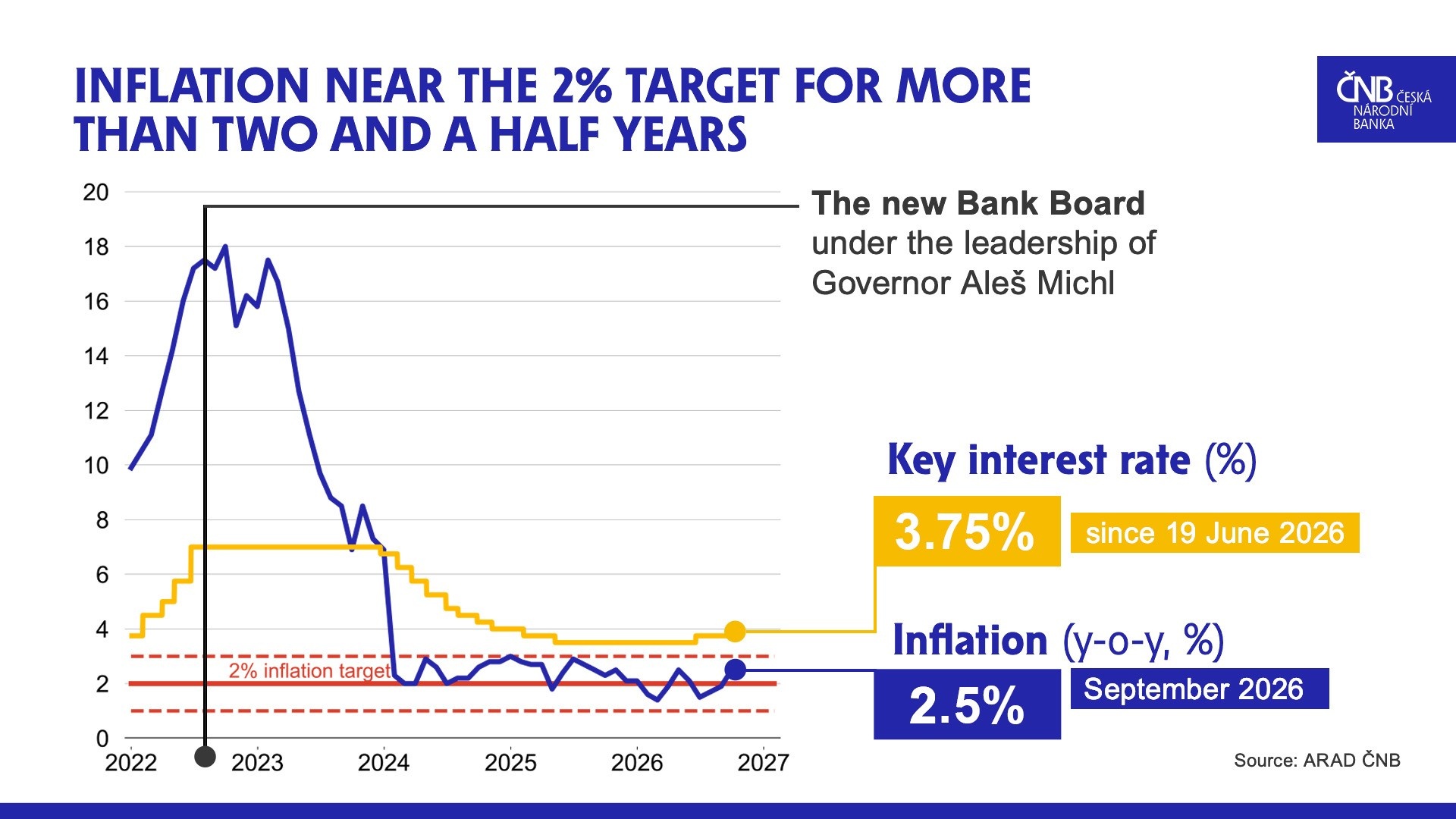
Consumer prices in the Czech Republic are going up at a rate of around 2% a year. Maintaining low, stable and thus predictable inflation is the primary objective of the Czech National Bank.
In the current environment of exceptional uncertainty, the CNB will maintain relatively tight monetary policy to ensure that inflation continues to remain close to the 2% target.
The inflation target: 2%
The CNB aims to keep inflation close to 2% by setting interest rates. Low, stable and predictable inflation is a prerequisite for long-term sustainable economic growth. It helps people to spend, firms to invest and demand for goods and services to grow at the right rate. This has a positive effect on employment, living standards and overall economic growth. The inflation target of 2% is in line with the practice of the central banks of advanced economies.
What is inflation?
Inflation means growth in the level of prices over time. It involves a decline in the real value (i.e. purchasing power) of a currency relative to the goods and services that the average consumer buys – you get less than before for the same amount of money.
Year-on-year inflation rate (September 2026): 2.5%
Explanation: In September 2026, prices of goods and services consumed by the average Czech household were 2.5% higher than in the same month of 2025.
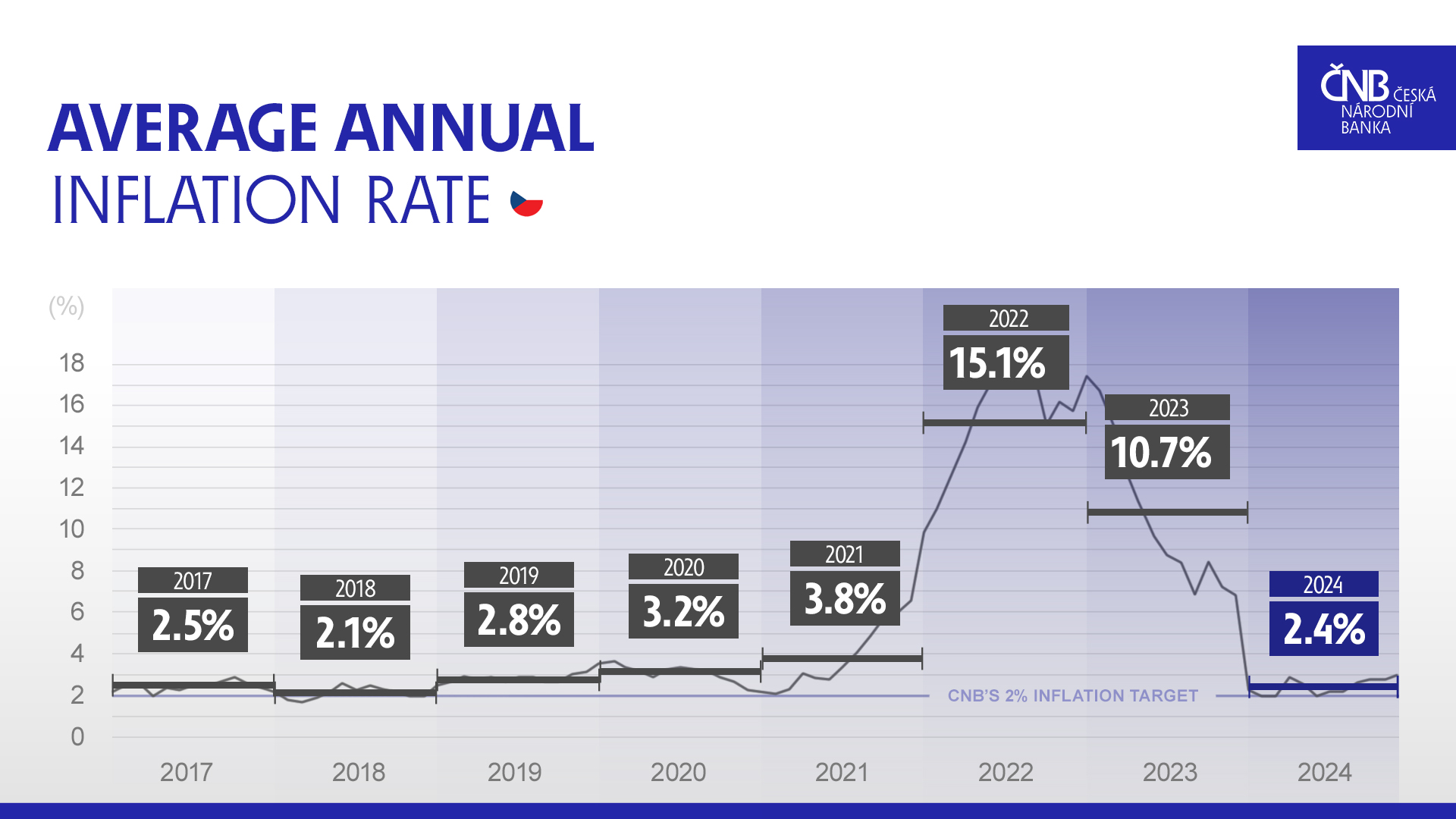
Average annual inflation rate in 2025: 2.5%
Explanation: In 2025, prices of goods and services consumed by the average Czech household were 2.5% higher on average than in 2024.
Sources: CZSO, CNB ARAD
Wage growth
Not only do prices go up over time, but so do the rewards for work done. According to data from the Czech Statistical Office, the average nominal wage in the Czech Republic was CZK 31,885 in 2018 and reached almost CZK 52,000 in the second quarter of 2026.
The low inflation and rapid growth in nominal wages are fostering growth in real wages, i.e. wages adjusted for inflation. Year on year, real wages increased by 4.3% in the second quarter of 2026. According to the CNB forecast, annual wage growth will gradually slow, but will remain above average in the long term.
Q&As
Consumer price inflation in the Czech Republic is measured by the Czech Statistical Office as the increase in the consumer price index (CPI). The most common measure is the inflation rate expressed as the increase in the CPI relative to the same month of the previous year. There’s also the average annual inflation rate, which is used primarily to calculate pensions and real wages.
Interest rates are the CNB’s main monetary policy instrument. The Bank Board decides on their settings at its monetary policy meetings. Its decisions are aimed at ensuring that headline inflation is close to the 2% inflation target in the long term.
The CNB’s key rate is currently 3.75%. Real interest rates are positive and are dampening lending activity and hence the creation of money in the economy and, in turn, long-term inflation. The Bank Board confirms its determination to continue its monetary policy in order to maintain inflation near the 2% target in the long term. At present, this still requires relatively tight monetary policy.
Price stability has been restored in the Czech Republic. This is confirmed by recent statistics and forecasts. The current CNB forecast expects headline inflation to reach 2.0% in 2026.
The Czech National Bank asks analysts at major banks and brokerage firms every month where they think inflation will be in 12 and 36 months’ time. The results of the surveys are available in the Financial Markets section of the CNB website.
The Czech Statistical Office versus Eurostat
The inflation figure published by the Czech Statistical Office (the year-on-year change in the consumer price index, CPI) may differ from that published by Eurostat (the year-on-year change in the harmonised index of consumer prices, HICP). When comparing inflation in the Czech Republic and other EU countries, it is therefore necessary to use the data published by Eurostat.
The main difference between the CPI and the HICP stems from a different approach to “imputed rent”, which reflects the cost of owner-occupied housing and partly therefore the evolution of house prices. Imputed rent is assigned a relatively high weight in the Czech national CPI (more than 10% of the consumption basket) but is absent from the HICP.
The methodological differences between these two ways of measuring the price level are discussed in more detail in a box in our Autumn 2021 Monetary Policy Report: Differences in the measurement of consumer price inflation from the point of view of the national consumer price index (CPI) versus the EU harmonised index (HICP).