The Czech Republic’s international investment position and external debt
as of 30 June 2026
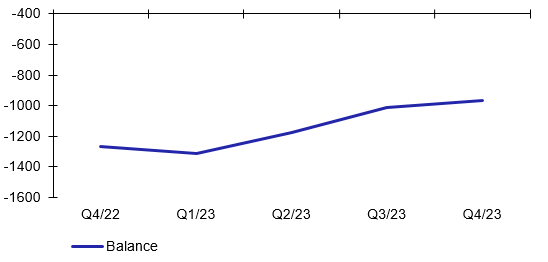
In 2026 Q2, the Czech Republic’s international investment position (i.e. the balance of its financial assets and liabilities in respect of non-residents) saw the deficit decrease by CZK 246.9 billion to CZK 519.9 billion. The deficit dropped by CZK 324.4 billion in year-on-year terms and represented 5.9% of GDP at current prices. The gross external debt of residents of the Czech Republic amounted to CZK 6,101.2 billion at the end of Q2 (i.e. 69.6% of GDP). It recorded a year-on-year increase of CZK 739.8 billion. The net external debt of residents of the Czech Republic amounted to CZK −404.6 billion at the end of Q2. Net external debt is the difference between external debt liabilities and assets. A negative value thus indicates that residents of the Czech Republic were in a net creditor position vis-à-vis the rest of the world (4.6% of GDP). The international investment position and external debt in Q2 were strongly affected by the statistical recording of the relocation of the headquarters of a large domestic business group from abroad to the Czech Republic and by a significant revaluation of cross-border assets and liabilities.
Chart 1 – International investment position
(CZK billions, end-of-period balance)
External assets increased by CZK 143.5 billion to CZK 11,493.7 billion in Q2. The assets rose by CZK 1,567.2 billion year on year.
Chart 2 – Structure of investment position assets
(CZK billions, end-of-period balance)
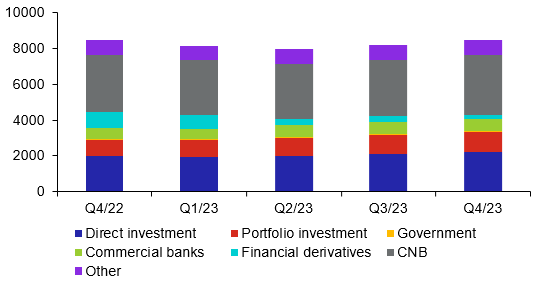
The value of residents’ holdings of foreign securities within portfolio investment increased by CZK 204.3 billion in Q2, driven mainly by price changes (CZK 151.4 billion) and purchases of investment fund shares and units (CZK 37.2 billion) and accounted for 17.4% of total investment position assets.
The external assets of other sectors (including foreign direct investment, but excluding the government and banking sectors, portfolio investment and derivatives) decreased by CZK 178.9 billion in Q2, due mainly to revaluation and other changes in the volume of foreign direct investment assets. This decline was partly offset by transactions related to acquisitions of foreign subsidiaries. The external assets of other sectors accounted for 39.5% of total investment position assets.
The external assets of the banking sector (including the CNB and excluding portfolio investment and derivatives) increased by CZK 130.7 billion in Q2, constituting 40.5% of total assets. This was driven mostly by growth in the Czech National Bank’s assets, which increased by CZK 130.4 billion, mainly as a result of revaluation and transactions.
The positive fair value of derivatives declined by CZK 21 billion in Q2.
The external assets of the general government sector (excluding portfolio investment and derivatives) increased by CZK 8.5 billion in Q2.
Investment position external liabilities fell by CZK 103.5 billion in Q2 to CZK 12,013.5 billion at the end of June 2026. In year-on-year terms, the liabilities increased by CZK 1,242.8 billion.
Chart 3 – Structure of investment position liabilities
(CZK billions, end-of-period balance)
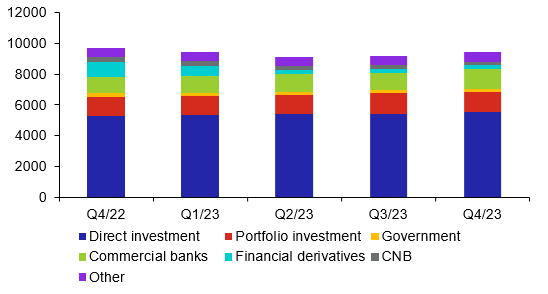
Direct investment liabilities decreased by CZK 307.1 billion in Q2, accounting for 56.9% of total external liabilities. As on the asset side, a significant decline in direct investment liabilities was due mainly to price changes and other changes in the volume of liabilities.
The external liabilities of the banking sector (including the CNB and excluding portfolio investment and derivatives) increased by CZK 137 billion in Q2, constituting 16.7% of total liabilities.
Portfolio investment liabilities were affected by price changes and by non-residents’ purchases of domestic debt securities issued by central government and other sectors. The resulting volume of liabilities increased by CZK 59.1 billion, with portfolio investment representing 17.8% of total liabilities.
The negative fair value of derivatives declined by CZK 34.1 billion in Q2, accounting for 1.2% of total liabilities.
The Czech Republic’s external debt (the sum of its liabilities with stipulated maturity) rose by CZK 255.9 billion to CZK 6,101.2 billion at the end of June 2026. In year-on-year terms, the debt increased by CZK 739.8 billion. As regards the time structure of the external debt, the share of liabilities with original maturities longer than one year was 49.1% of total debt liabilities.
Chart 4 – External debt by debtor
(CZK billions, end-of-period balance)
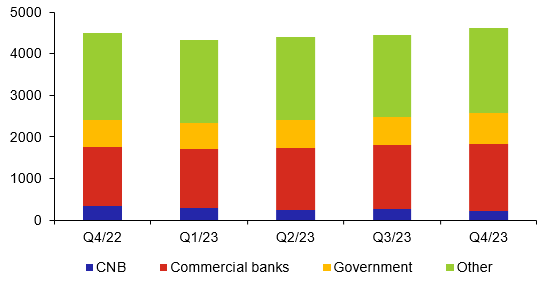
External debt in the banking sector, including the CNB, increased by CZK 141 billion in Q2. The banking sector, including the CNB, accounted for 41.6% of the total external debt.
In Q2, debt in other sectors increased by CZK 101.8 billion, due mainly to growth in loans and trade credits of other sectors vis-à-vis non-affiliated enterprises abroad (CZK 51.4 billion), debt securities liabilities (CZK 27.7 billion) and inter-company loans (CZK 25.1 billion). Other sectors accounted for 43.5% of the total external debt.
General government external debt rose by CZK 13.1 billion in Q2 and its share in total external debt amounted to 14.9%.
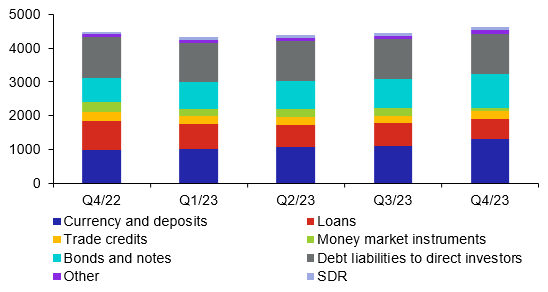
Turning to the breakdown of the external debt by instrument, deposits from non-residents and loans from foreign parent, affiliate and subsidiary companies are the most frequently used forms of debt financing (together accounting for 55.3% of the external debt).
Chart 5 – External debt by instrument
(CZK billions, end-of-period balance)
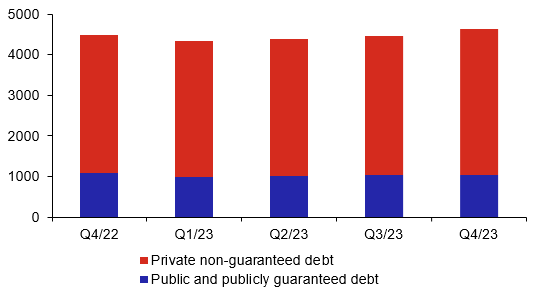
The external debt of the private sector accounted for 76.3% of the total external debt. Public sector liabilities accounted for the rest (23.7%). They comprise general government liabilities, liabilities of private entities guaranteed by the government and liabilities of public entities classified outside the general government sector.
Chart 6 – External debt of public and private sectors
(CZK billions, end-of-period balance)
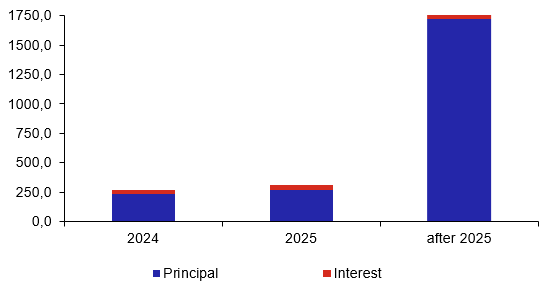
The projected debt service payments of principal and interest on long-term external liabilities from July 2026 to June 2027 amount to CZK 573.5 billion (of which principal amounts to CZK 519.4 billion and interest to CZK 54.1 billion). From July 2027 to June 2028, total debt service payments of CZK 418.1 billion (including interest) are planned, with a total of CZK 2,300.3 billion scheduled for the following years.
Chart 7 – Debt service on medium- and long-term external debt liabilities
(CZK billions)