Aleš Michl, Governor
A foreword by Governor Aleš Michl to the publication Proceedings of the Czech National Bank Workshop on Monetary Policy: Inflation Targeting Frameworks Under Review summarises insights regarding the CNB’s approach to monetary policy during a period of elevated inflation and the measures taken to reduce it.
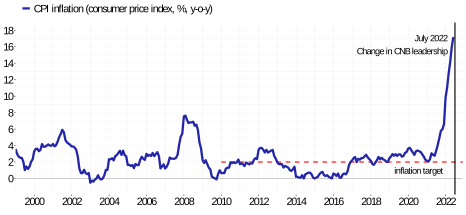
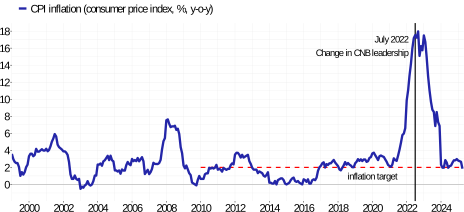
I became Governor of the Czech National Bank in July 2022. At that time, inflation stood at 17.5%. Two months later, it peaked at 18%. This was the highest inflation rate in the history of the Czech Republic, with the exception of the price liberalisation after the Velvet Revolution in the early 1990s. In February, March and June 2024, the annual inflation rate reached 2% – precisely our target. The average inflation rate in 2024 was 2.4%, the lowest annual figure since 2018.
Chart 1 shows data from the Czech Republic, starting in 2010 and ending when I became Governor.
Chart 1 – Inflation in the Czech Republic
Source: Czech Statistical Office
When I was appointed, the CNB’s key interest rate stood at 7% – a very high level. In the ten years before the Covid pandemic, the average interest rate had been just 0.6%. When inflation started to accelerate in the Czech Republic, the CNB switched from extremely low to very high interest rates. Yet even with a key rate of 7%, it was not able to bring inflation down quickly.
The Bank Board in our country consists of seven members, including the Governor. The Board was almost completely replaced by the President within a short period of time because the terms of office of the previous members had expired (denoted as “change in CNB leadership” in the chart). We formed a new team. In my very first speech when I was appointed, I promised the public that we would bring inflation down from 18% to the inflation target of 2% within two years (Michl, 2022a).
How we thought about inflation
We made two key assumptions about the causes of inflation:
(1) First, we assumed that most of the inflation was driven by the rising cost of imported energy and goods. In a small open economy like ours, higher interest rates can neither lower European energy prices nor resolve problems in global supply chains (Dědek and Michl, 2021). According to our DSGE model, we should have raised interest rates from 7% to 8%, 9%, 10% or even higher to lower inflation expectations and inflation. But we assumed the DSGE projections could be wrong. For example, they didn’t take into account that companies had started to borrow in euros instead of koruna due to the wide interest rate differential. This weakened our transmission mechanism.
We introduced our new strategy:
i) Interest rates would remain at 7% until we were confident that inflation was on track to return to our target.
ii) Our guidance was that we wanted to keep interest rates higher for longer.
iii) And we started to fight inflation by stressing the need for a strong exchange rate. This would quickly make all imports, especially commodities, cheaper. I presented the strategy in November 2022 in the “Policy for a strong koruna” speech (Michl, 2022b).
Initially, several local economists publicly claimed that our approach was wrong. At the same time, our DSGE model was indicating that the Czech koruna would only appreciate if we continued to raise interest rates. We went against the mainstream opinion.
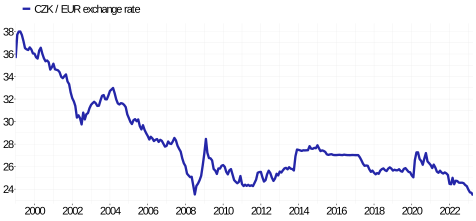
Despite the claims of our opponents, we earned the trust of investors. The koruna started to appreciate against the euro. Within a few months, in spring 2023, it reached its strongest level in history. This appreciation was driven by the market; we were not active on the foreign exchange market.
Chart 2 – Czech koruna exchange rate until spring 2023
Source: CNB ARAD
An interest rate of 7% and the strongest koruna in history together resulted in the tightest monetary conditions in 20 years. That was when monetary policy had its full effect. I delivered three additional major public speeches in 2023. I called them “The Road to the Target I, II and III” to show that we had a plan to lower inflation (Michl, 2023a, 2023b, 2023c). I explained how the plan would work. I gave several television interviews and wrote articles explaining our policy. For example, I gave interviews to both Bloomberg and the largest Czech tabloid to explain our approach. We wanted to reach both market participants and the general public – that’s why we used all channels. By “all channels” I mean that we also used Instagram, Facebook and X. My fellow Board members were also actively involved in communicating with the public.
Over time, the data began to confirm that the strong exchange rate had helped lower inflation. We calculated inflation momentum indicators to capture the current trend in prices. These dynamics were not influenced by prices from a year ago (base effects). We defined them as the three-month moving average of monthly changes in the price index. We communicated that while year-on-year inflation remained high, the underlying momentum was already slowing. Our policy was beginning to take effect.
Then the extremely high global prices of commodities and goods began to ease. That was crucial to our “Road to the Target”. I made a video comparing the situation to a ketchup bottle and shared it on the social network X. That’s not typical of a conservative banker, but neither was the overall economic situation. The video explained the bottleneck effect: During the Covid lockdown, part of production was stopped. After the end of the lockdown, demand jumped, but the goods were not yet ready. It was like turning over a new ketchup bottle and waiting for something to come out – only to have it stuck. This shortage of goods led to rising prices. When the problems in the supply chain were solved and demand normalised, there was a surplus of goods. Similar to when the ketchup finally flows out of the bottle, but much more than you wanted. We then observed an easing of the bottlenecks and disinflation in tradable goods.
To keep an eye on the risk of demand-driven inflation, we tracked the development of demand in the economy practically in real time by creating an index of high-frequency indicators. My colleagues and I wrote a working paper on its construction and performance (Adam et al., 2021). The index aggregated high-frequency data such as electricity consumption, toll revenue collected on motorways, and Google searches for unemployment benefits. Based on this measure, we concluded that demand in the economy remained subdued throughout 2023.
We also stressed how important it was to avoid a wage-price spiral so that cost inflation did not turn into demand inflation. Our aim was to lower inflation expectations. I warned against a wage-price spiral in every speech, in every conversation. And we mentioned it in every statement after the monetary policy meetings. I called for wage restraint everywhere, and in order to gain the public’s trust, we had to show that the CNB itself was operating properly and responsibly.
The salaries of the Board members and all Board−1 managers were frozen in 2023. The salaries of other employees increased by an average of 4.5%, although the inflation rate for the year as a whole was 10.7%. Overall, we focused on the bank’s income statement and started with operations, as it could be tackled immediately. In 2023, we reduced the number of Board−1 managers from seventeen to fourteen and achieved cost savings in all departments. The number of jobs at the CNB fell by 5.1% in 2023, representing the first major job cuts at the central bank in 10 years.
Table 1 – Cost cutting at the CNB during periods of high inflation
| 2022 | 2023 | Year-on-year change (%) | |
|---|---|---|---|
| Number of positions | 1,516 | 1,439 | -5.1 |
| Number of Board–1 executives | 17 | 14 | -17.6 |
Source: CNB
Table 2 – Wage restraint at the CNB during the high-inflation period in 2023
(year-on-year change)
| Inflation | 10.7% |
| Wage growth of Board members | 0% |
| Wage growth of Board–1 level executives | 0% |
| Average wage growth | 4.5% |
Source: CNB
In the end, our efforts paid off: inflation expectations began to fall towards our target. And inflation started to decline even in year-on-year terms. By the end of 2023, we were able to lower interest rates slightly because we were confident that inflation was heading towards our target in 2024.
Chart 3 – Inflation in the Czech Republic
Source: Czech Statistical Office
Chart 3 illustrates the outcome: inflation was back near the target in January 2024. When the low inflation was announced, I made a public statement on our website and sent a letter to CNB staff telling them that they should be proud of working together for the good of the country. However, I pointed out that there would be no celebrations or press conferences because we would be judged by our long-term results, not short-term ones.
Over time, it became clear that most of the inflation was actually imported or due to external cost pressures. Our DSGE model did not predict this situation. A working paper written by staff at the Bank for International Settlements (Auer et al., 2024) analysed inflation in 56 countries between 2000 and 2023. They found that 85% of inflation fluctuations in the Czech Republic were due to global factors. This was because we are a small open economy, closely integrated into global value chains and strongly linked to the German economy. This confirmed the first of the two key assumptions we had made early on about the causes of inflation.
(2) The second assumption was that another part of the inflation had been caused by too much money in the economy and by high government deficits. This type of inflation was more difficult to fight. All countries were facing rising costs, especially energy prices. However, the Czech Republic had the highest inflation in the European Union at the time, even adjusted for this cost shock. From November 2021 to October 2022, we had the highest core inflation in the EU, which suggested that some mistakes had been made in our country in the past.
Since 2017, headline inflation had remained above the target most of the time. The CNB’s key policy rate had been below inflation for more than ten years. In other words, real interest rates had been negative for more than 10 years (Table 3). This was not a forward-looking anti-inflationary policy.
Table 3 – Real interest rates before the Great Inflation
| Period | Rel ex ante interest rate (%) |
|---|---|
| 2009–2019 | -1.4 |
| 2000–2019 | -0.8 |
Note: Real rate = repo rate – inflation expectations of financial markets (1-year horizon), %.
Source: CNB ARAD
A specific problem in the Czech Republic was the central bank’s exchange rate depreciation policy. Between 2013 and 2017, the CNB had intentionally depreciated the Czech koruna to trigger inflation. This appears paradoxical in retrospect. In late 2016 and early 2017, speculation on the koruna had forced the central bank to buy euros and massively sell koruna. This led to excessive growth in the banking sector’s money supply in korunas. Free liquidity in the banking sector doubled during this short period (Table 4).
Table 4 – Excess liquidity in the banking sector
| IX/2016 | XII/2016 | I/2017 | II/2017 | III/2017 | IV/2017 | |
|---|---|---|---|---|---|---|
| Excess liquidity (CZK billion) | 1,196 | 1,331 | 1,591 | 1,854 | 2,138 | 2,395 |
| Increase compared to September 2016 (%) | 11.3 | 33.1 | 55.1 | 78.8 | 100.3 |
Note: Excess liquidity is defined as the total volume of liquidity absorbed through repo operations and other overnight sterilisation instruments. The percentage increase is calculated relative to the baseline level in September 2016.
Source: CNB ARAD
Such an increase in base money or liquidity, together with the central bank’s zero interest rate, had no immediate impact on the consumer basket used to calculate the CPI. Instead, the increased money supply and the rising wealth of the middle and upper classes mainly drove up asset prices such as property, company valuations and other investments. For example, property prices in the Czech Republic rose by 110% between 2016 and 2022, the second largest increase in the EU (after Hungary). Inflation was underestimated by the CPI measurement. Interest rates should have been higher than inflation at that time.
Reducing the government budget deficit also played an important role. Milton Friedman (Friedman and Schwartz, 1963) stated that a restrictive monetary policy does not require the support of fiscal policy. But this claim was formulated for a situation with limited bank liquidity. Our situation was different – we were operating in an environment of excess liquidity. It was easy for banks to finance government debt. It was easy for governments to issue new bonds. This could easily have led to further inflation.
That was why I stated at the press conferences after all our monetary policy meetings that reducing government deficits was another important precondition for reducing inflation in the long term (see also Cochrane, 2023, for example). As a board, we also communicated that if budget deficits remained high, we would need to maintain higher interest rates to keep inflation at 2%.
Lessons and current strategy
That was the story and development of the second assumption we made at the beginning about the causes of inflation. This type of demand- or money-induced inflation proved to be more persistent. It had been a mistake to keep real interest rates negative for so long and to believe that when inflation arrived, it could be quickly reversed by raising rates. More focused, less interventionist central banks would likely deliver better outcomes. For central banks, less is more. We therefore communicated as a part of our strategy that we expected interest rates to remain higher than we had been used to over the last decade or more. The economy needs to be based on savings, not debt. If we remain strict (Table 5), we can ultimately prevent major inflation.
Table 5 – Real interest rates in the disinflation period
| Period | Real ex ante interest rate (%) |
|---|---|
| 2022 2nd half – 2025 1st half | 2.5 |
Note: Real rate = repo rate – inflation expectations of financial markets (1-year horizon), %.
Source: CNB ARAD
Overall, we learned our lessons. The CNB must admit its past mistakes. In January 2024, we chose three independent teams to review our monetary policy framework. No one had ever done this in the CNB’s history. We did it because we want to be open – and better.
The review consisted of three independent parts. A team led by two professors from the University of Economics in Prague (Martin Mandel and Karel Brůna) focused on our core model as well as on the interaction between the central bank’s monetary policy and government fiscal policy. John Muellbauer from the University of Oxford reviewed the model and subsequent monetary policy recommendations. Finally, Roman Šustek from Queen Mary University of London focused on the individual parts of the model and discussed whether it was appropriate to have only one core model.
After ten months, the reviews were finished. In November 2024, we published everything on our website. In April 2025, we organised an international conference on the monetary policy review. This volume summarises the contributions of my excellent colleagues from the Bank Board, the authors of the review, and the conference panellists.
The importance of such reflection was underlined by Claudio Borio’s (2025) keynote speech at our April 2025 conference. He cautioned that central banks have sometimes overreacted to moderate shortfalls from inflation targets, driven by an exaggerated fear of deflation – the so-called “deflation bogeyman”. This mindset can lead to policies, like the CNB’s 2013–2017 exchange rate depreciation, that fuel asset price inflation and excess liquidity. Such interventions may reduce the room for future policy manoeuvre – a risk we clearly experienced when real interest rates in the Czech Republic remained negative for more than a decade. Monetary policy should not be relied upon as the only engine of growth. It is innovation and productivity that fuel growth, not negative real interest rates. More focused, less interventionist central banks are better equipped to deliver long-term price and financial stability.
Our mandate is price stability. We want to keep inflation close to 2%. All our actions will lead to this goal, including not repeating the mistakes of the past, learning from them, and thinking about the future of our country.
References
Adam, T., Michálek, O., Michl, A., and Slezáková, E. (2021). “The Rushin Index: A weekly indicator of Czech economic activity,” Czech National Bank Working Paper 4/2021.
Auer, R., Pedemonte, M., and Schoenle, R. (2024). “Sixty years of global inflation: A post-GFC update,” Bank for International Settlements Working Paper 1189.
Borio, C. (2025). “Adjusting inflation targeting frameworks,” in Proceedings of the Czech National Bank Workshop on Monetary Policy: Inflation Targeting Frameworks Under Review, Czech National Bank.
Cochrane, J. H. (2023). “The Fiscal Theory of the Price Level”, Princeton University Press, Princeton.
Dědek, O., and Michl, A. (2021). “Krotitelé nákladové inflace [Tamers of cost inflation],” Mladá fronta DNES, p. 9, Názory, 13 October 2021.
Friedman, M., and Schwartz, A. J. (1963). “A Monetary History of the United States, 1867–1960”, National Bureau of Economic Research.
Michl, A. (2022a). “Speech given by Aleš Michl on his appointment as Governor,” Appointment of CNB Governor, Prague, 11 May 2022.
Michl, A. (2022b). “Policy for a strong koruna,” speech at the CNB Discussion Forum, Faculty of Economics and Administration at Masaryk University, Brno, 23 November 2022.
Michl, A. (2023a). “Inflation: The road to the target,” speech at the University of Economics and Business, Prague, 15 May 2023.
Michl, A. (2023b). “The road to the target II,” speech at the CBA Assembly of Members, Czech Banking Association, Prague, 15 June 2023.
Michl, A. (2023c). “The road to the target III,” speech at the CNB Discussion Forum 2023, Tomas Bata University, Zlín, 17 October 2023.