I’ll start broadly: if you intend to invest in crypto assets, exercise extreme caution. The market is still in its infancy. I remember the 1990s in our country, when the transition from socialism to capitalism saw the birth and simultaneous collapse of many investment funds. The crypto asset market will experience similar failures and successes. So, only invest money in things you understand and are willing to accept the risk of potentially losing your entire investment.
Bitcoin, however, is a different story. It should not be lumped together with other crypto assets. We central bankers should study it and explore the technology it is built on. Studying bitcoin won’t harm us – on the contrary, it will strengthen us.
At the CNB Bank Board meeting on 30 January 2025, I tabled a proposal to analyse the possibility of creating a bitcoin test portfolio. This step is motivated by a desire to learn about and try out this highly risky alternative asset. I emphasised the need to adapt to changing conditions in the financial markets and to explore new reserve management options.
I stated that bitcoin is highly volatile and could one day be worth one of two extremes – either zero or a huge amount. I also stressed that bitcoin is a high-risk asset for professional investors who are aware of all the risks.
The Bank Board approved a proposal to analyse the options for investing in additional asset classes. Based on the results of the analysis, the Bank Board will then decide how to proceed further. No changes will be implemented in this area until then.
It is important to emphasise that this is the initial stage of the analysis and discussion. The final decision will depend on the outcome of the analysis and the subsequent decision of the Bank Board.
Statement by Governor Aleš Michl on X on 29 January 2025

Statement by Governor Aleš Michl on X on 30 January 2025

Interview with Aleš Michl, Governor
Raphael Minder (Financial Times 29. 1. 2025)
The head of the Czech National Bank wants to plough billions of euros’ worth of the country’s reserves into bitcoin, a groundbreaking move that could make it the first western central bank known to hold crypto assets.
Governor Aleš Michl told the Financial Times that he would present a plan to the board to invest in bitcoin as a way of diversifying the CNB’s reserves at a meeting on Thursday. Should the board approve this, then the CNB could eventually hold as much as 5 per cent of its €140bn of reserves in bitcoin, he said.
While acknowledging bitcoin’s “extreme volatility” and limited record, Michl highlighted wider investor interest in bitcoin since BlackRock and other companies last year launched bitcoin exchange traded funds.
He also pointed to US President Donald Trump’s pledges on deregulation and the growing influence of cryptocurrency executives over his administration. In an executive order last week, Trump set up a working group to evaluate the creation of a national digital asset stockpile.
“For the diversification of our assets, bitcoin seems good,” Michl said in an interview. “Those [Trump] guys can now kind of create some bubble for bitcoin, but I think the trend would be an increase without those guys as well, because it’s an alternative [investment] for more people.”
Federal Reserve chair Jay Powell confirmed in December that the US central bank did not hold any bitcoin as it was not in the list of assets Congress allowed it to purchase. “We are not looking for a law change at the Fed,” Powell said at the time.
Central banks have traditionally parked their reserves in conservative assets such as US Treasuries and other forms of highly rated bonds. Some have holdings in equities, but almost none have publicly ventured into crypto.
Michl said he had “a totally different philosophy” about bitcoin to his counterparts.
“Of course, if you compare my position with other bankers, then I’m the one entering the jungle, or the pioneer,” Michl said. “I used to run an investment fund, so I’m a typical investment banker I would say, I like profitability.”
Among central bankers to have warned about the risks of investing in cryptocurrencies is the governor of the Bundesbank, Joachim Nagel, who this month compared bitcoin to “digital tulips”, a reference to a 17th century speculative bubble and then collapse in the price of the bulbs.
European Central Bank officials wrote last year that “the fair value of bitcoin is still zero”, adding that “bitcoin is not suitable as means of payment or as an investment”, while former ECB official Benoît Couré has previously referred to bitcoin as the “evil spawn of the financial crisis”.
El Salvador has been a rare, prominent backer of crypto, making it legal tender in 2021. The government holds 6,048 bitcoins in its treasury, worth about $621mn, according to its National Bitcoin Office. But the Central American country scaled back its crypto ambitions late last year to reach a funding deal with the IMF.
In addition, some central banks are piloting digital currencies, partly in response to the threat posed by cryptocurrencies.
Michl said more central banks could follow his lead within the next five years, just as several funds and commercial banks had recently changed tack and added crypto to their portfolios. Some pension funds have begun investing in crypto.
However, he added that the investment could prove to be worthless.
“It’s possible to have a big range of outcomes, that bitcoin will have a value of zero or an absolutely fantastic value … but in our history we have also had some stocks like Enron or the payment company Wirecard, so we have some experience with bad investments, so, yes, I’m ready [for a possible Bitcoin collapse],” he said.
“But I’m saying that my goal is to diversify the portfolio, so if bitcoin is good [for that], then let’s have it.”
If the Czech bank had held 5 per cent of its foreign reserves in bitcoin over the past decade, its annual returns would have increased by 3.5 percentage points, but would have also doubled in volatility, according to the CNB.
Michl said any large investment by a central bank in a bitcoin ETF could in itself impact the coin’s price. “Five per cent [of our assets] is a lot of money, even for the bitcoin market,” he said.
The central bank’s €140bn in foreign exchange reserves are equivalent to about 45 per cent of the Czech Republic’s GDP. The CNB already stands out among central banks because 22 per cent of its portfolio is in equities, and Michl wants half of that to be in US shares in about three years’ time, up from 30 per cent currently.
“We are buying gradually and in very small steps because the [US stock] prices are the highest in history,” he said.
The Czech Republic is one of seven EU countries to have stayed outside the Eurozone, but in his New Year’s address to the nation President Petr Pavel revived the debate by urging a switch to the euro. He argued that “it would certainly promote our future prosperity if [salaries] were to be paid in the European currency, just as they are in Germany.”
However, Michl dismissed this idea, saying there was not enough price convergence or public support to abandon the Czech koruna in the foreseeable future.
“Our president is a military strategist and I’m an economist,” Michl said, referring to Pavel’s background as a Nato commander. “If you have political problems, it can be good to have the euro, but being independent and having an independent voice on monetary policy seems good for us to fight inflation.”
He added it was “very likely” that his bank would cut interest rates by 25 basis points next week from 4 per cent, resuming a cycle of rate cuts that began in December 2023.
Bitcoin Musings Draw Scrutiny Over Czech Central Bank Governor
Interview with Aleš Michl, Governor
Peter Laca and Kryštof Chamonikolas (Bloomberg 6. 2. 2025)
The Czech central bank governor’s bid to invest a portion of the country’s reserves into Bitcoin managed to draw more attention to the central European nation’s monetary policy than any of his predecessors.
The proposal last month by Ales Michl spurred instant buzz in a cryptocurrency community eager for validation. The reaction among decision makers was different. European Central Bank President Christine Lagarde diplomatically dismissed the idea. But Michl, a one-time commercial-banking strategist who co-founded an algorithmic trading fund, has given little indication that he’s been moved by the disapproval. On the contrary, he framed the reaction as a debate on how central bank planners should adapt to sweeping technological change.
“The world, the economy and people’s behaviour are constantly changing and I think we should be prepared to reflect that in how we think and what we do,” Michl said in an interview on Wednesday in Prague. “Part of that is having discussions about issues that may seem outside the conventional idea of the role of central banks.”
The 47-year-old governor of the Czech National Bank has had a penchant for courting controversy since he took the top job two and a half years ago. One of his first moves was to halt interest-rate hikes in the midst of the most severe inflation crisis in decades. The bet, which went against the suggestions of the bank’s own forecast, eventually worked out. Others have also raised eyebrows, including a bid to make the central bank profitable by investing more in equities — and an ambition to boost the institution’s gold stockpile.
Possible Reserve Asset
But the Bitcoin foray may have pushed the boundaries. Lagarde, speaking after the ECB’s Jan. 30 rate-decision meeting, signaled that Michl’s crypto musings had been addressed — and discussed with Prague, even though the Czech Republic isn’t a member of the euro area.
Frankfurt’s view was that “reserves have to be liquid, that reserves have to be secure, that they have to be safe, that they should not be plagued by the suspicion of money laundering or other criminal activities,” Lagarde said, laying out the consensus of euro-area policymakers.
The investment community was also thrown off balance. Monetary policy authorities have to focus on ensuring monetary and financial stability, said Elias Haddad, senior markets strategist at Brown Brothers Harriman & Co. in London — not on maximizing profits. “Michl is mixing up the role of a central banker with that of a portfolio manager,” Haddad said. “Bitcoin is too volatile to be considered as a store of value. He should stick with gold.”
Small Exposure
There are indications that Michl’s initial suggestion of investing as much as 5% of reserves in Bitcoin, floated in an interview with the Financial Times, may come up short. The governor is prepared to accept the outcome of a central bank analysis of the option, which may take months to conduct, according to people familiar with the matter who spoke on condition of anonymity.
Even if the study, commissioned by the board last week, opens a path for buying the cryptocurrency, Michl realistically envisages exposure that would represent less than a percent of total reserves, the people said.
As much as Michl has sought to separate himself from the starchy pack of central bank peers, he’s insisted that his main mission is to keep inflation under control. He and the CNB board are expected to resume interest-rate cuts at a meeting on Thursday after bringing a year-long easing campaign to a halt in December amid lingering price concerns.
Michl said the reasoning behind the initiative is to explore the risks and benefits of holding Bitcoin as the central bank seeks to boost profitability and diversify assets. Another motivation is to gain first-hand experience to identify regulatory pitfalls around digital assets as they become more common.
Michl also pointed to his bid to increase stock holdings, saying the notion was unthinkable two decades ago. The Czech institution only began to invest in equities in 2008 — and now aims to boost the level of stocks to 30% of reserves. The governor said he’s “no crypto-fanatic” — and has no such personal investments. But his embrace has already given him credentials among digital-asset backers. He’s received a VIP invitation to the largest Bitcoin conference, whose past speakers included President Donald Trump.
Michl has referred to Trump’s pledges to ease regulation of the digital-asset industry as an inspiration for his own thinking. But he doesn’t intend to attend the convention in Las Vegas in May, the people familiar with his plans said.
First test portfolio of digital assets at the CNB
cnBlog post by Governor Aleš Michl and Tomáš Adam (13. 11. 2025)
The CNB has launched a historic project from the central banking perspective: a test portfolio of digital assets. The portfolio includes bitcoin, US dollar-pegged stablecoins and a tokenised dollar deposit. The total purchase price of the portfolio is USD 1 million, or around 0.0006% of the CNB’s assets. The portfolio was created in the CNB Lab innovation hub. It does not form part of the international reserves, and the purchases certainly do not represent any sort of investment advice on our part. Why create the portfolio? We want to be prepared for the future. The test portfolio will allow us to gain knowledge and practical experience that will prepare us for tokenisation- and digitalisation-related changes in the financial system. This will ensure we remain able to fulfil our duties arising from the Act on the CNB – that is, to supervise the financial market, to contribute to financial stability and the sound operation of the financial system, to administer payments and to conduct monetary policy, including managing our international reserves. What comes next? The project will be assessed in two to three years. Until then, the volume of the portfolio will not be increased.
Introduction
The Czech National Bank today launched a test portfolio of blockchain-based digital assets, one of them being bitcoin. The portfolio does not form part of the international reserves. It was created in the CNB Lab innovation hub. In accounting terms, it is classed as an intangible asset of the bank.
The test portfolio includes bitcoin, US dollar-pegged stablecoins and a tokenised dollar deposit. It has a total acquisition value of USD 1 million, or 0.0006% of the CNB’s assets. The whole project will be assessed in two to three years. Until then, the CNB will not increase the portfolio by freeing up more money for further purchases. Changes in the value and composition of the portfolio will be a result of movements in the market value of bitcoin or of only small test trades. Our reserves management and risk management teams now have a mandate to make portfolio decisions.
The Governor came up with the idea of creating a test portfolio in January 2025. The aim was to test decentralised bitcoin from the central bank’s perspective and to evaluate its potential role in diversifying the international reserves (see Michl, 2025). The Bank Board then decided to have an analysis prepared. Subsequent internal discussions broadened the scope to include the future of payments and the tokenisation of assets. As a result, stablecoins and tokenised deposits were included alongside bitcoin.
The koruna is and will be our legal tender (until politicians decide to adopt the euro). The CNB will continue to strive to keep inflation low and the koruna strong. However, new ways of paying and investing will emerge rapidly in the years ahead. Thanks to the CNB, everyone now has access to instant payments (Michl et al., 2025) and can therefore pay quickly and digitally. What direction might future developments take? It is realistic to expect that, in the future, it will be easy to use the koruna to buy tokenised Czech bonds and more besides – with one tap an espresso; with another an investment such as a bond or another asset that used to be the preserve of larger investors.
This purchase of bitcoin, stablecoins and a tokenised deposit for testing purposes is a historic move by the central bank. That’s why we explain everything in the following blog post. We plan to update the post regularly and share our test findings in it.
Why is the CNB entering the world of digital assets?
Central banks need to gain first-hand knowledge of crypto and DeFi and the risks and opportunities they present to the financial system.
BIS (2023)
First and foremost, we emphasise that bitcoin is highly volatile. Its price can swing sharply –all the way down to zero or up to dizzying heights in the extreme case. This makes it a highly risky asset, suitable only for investors who fully understand the risks involved. We distinguish bitcoin from other crypto-assets (such as other cryptocurrencies, tokens and NFTs). Investing in these crypto-assets is a highly risky business – you can lose all your money. The CNB is recognised in the EU as an integrated supervisory authority that performs strict microprudential supervision, pursues active macroeconomic policy and applies a consistent approach to consumer protection in the financial market. Within the scope of our statutory powers, we will rigorously supervise crypto-asset service providers. However, supervision cannot avert every collapse and prevent every fraud; some projects and funds may flounder or fail in the future. People should therefore be aware of the risks associated with these assets, even when the provider is licensed by the CNB or another European regulator. In addition, the test portfolio does not represent any sort of investment advice on our part.
The purpose of the testing:
In the testing, we want to explore for ourselves the options of working with blockchain-based assets. Instead of lagging behind the financial market, we intend to look well into the future at potential new types of assets. The goal is to gain experience and learn to work with these assets and the blockchain. Bitcoin (and bitcoin ETFs), stablecoins and tokenised assets are gradually becoming a new class of assets, one in which central banks may also invest in the future. The test purchase supports the fulfilment of the central bank’s duties set out in the Act on the CNB, especially in the areas of supervision and financial stability (the safe and sound functioning of the financial system) and monetary policy (international reserves management). Specifically, we need to test opening accounts, AML issues, custody services, purchases/sales, holding various forms of assets, reporting, audit and all the other related aspects.
It is important for the CNB to understand new technologies. This may play a role not only in supervision and financial stability, but also in the management of international reserves. Experiments with asset tokenisation are already under way (EIB, 2024, Aldasoro et al., 2025). Large countries and companies, whose securities the CNB currently holds in its reserves, may also issue tokenised bonds and shares in the future.
As part of our regulatory activities, we supervise crypto-asset providers and monitor developments in the payments area. In the future, payments may be partly based on blockchain technology (see the BIS Project Agorá and the ECB’s Pontes and Appia projects). It is therefore crucial to develop practical expertise that will enable us to understand these changes properly and take advantage of them in the course of our duties.
Bitcoin as a diversifier of international reserves?
Our analysis shows that the CNB could purchase bitcoin into its international reserves in the form of ETFs (exchange-traded funds). An ETF is an investment instrument that tracks the price of an underlying asset – in this case bitcoin – and enables investors to hold exposures to that asset without the need to own it directly.
To decide on the suitability of such a step, we can use common quantitative instruments (such as correlation and mean-variance frontier/optimisation), while assuming that the bitcoin return distribution will have similar characteristics as in the past. This approach, of course, carries risks, because returns and correlation coefficients are generally variable – especially so in the case of bitcoin.
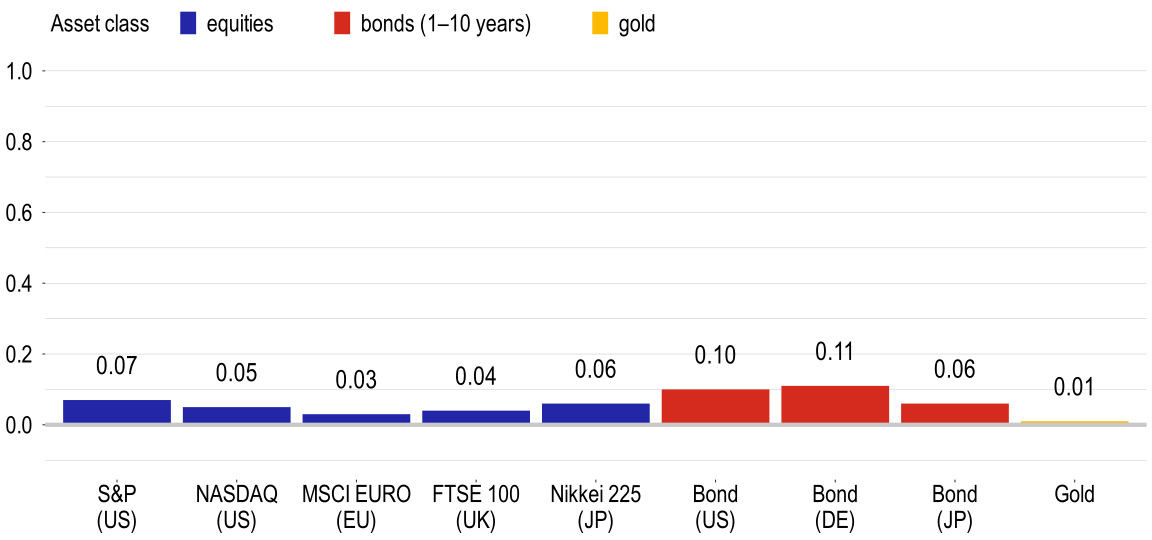
The correlation between bitcoin and other asset classes commonly held in international reserves – equities, bonds and gold – was very low in 2011–2025. At first glance, therefore, bitcoin may appear to be a good diversifier.
Chart 1 – Correlation coefficients: bitcoin versus other assets
(data for 01/11–10/25; in local currencies; monthly frequency)
Source: Bloomberg data, CNB calculations
However, there are two problems:
1. A short time series and time-variability of return characteristics
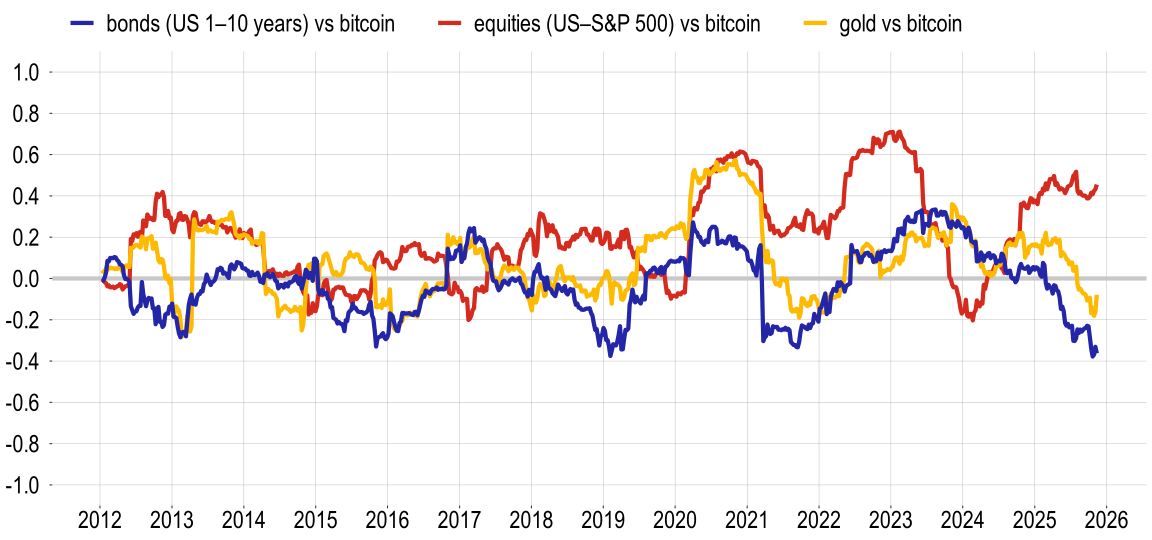
The annual correlations with equities, gold and bonds ranged from highly positive to highly negative during this period (2011–2025). We meanwhile observed only a few major episodes of financial stress – for example, the “taper tantrum” in 2013 (a surge in volatility following the Federal Reserve’s announcement that it would taper its quantitative easing), Brexit in 2016, the Covid shock in 2020 and the introduction of tariffs in 2025.
Given the limited length and the nature of the time series, it is difficult to derive stable patterns in bitcoin’s behaviour during periods of stress and hence to assess whether it is a suitable diversifier.
Chart 2 – Correlation coefficients
(1Y rolling correlations)
Source: Bloomberg data, CNB calculations
2. Disputed impacts of bitcoin purchases on the total reserve portfolio
The CNB’s international reserve portfolio is now well-diversified and generates a solid expected return at an acceptable level of volatility (Adam, Michl and Škoda, 2023).
Internal calculations show that if the CNB had held 5% of its reserves in bitcoin over the past 10 years, the annual expected return would have been 3.5 percentage points higher, but the volatility of the portfolio would have approximately doubled.
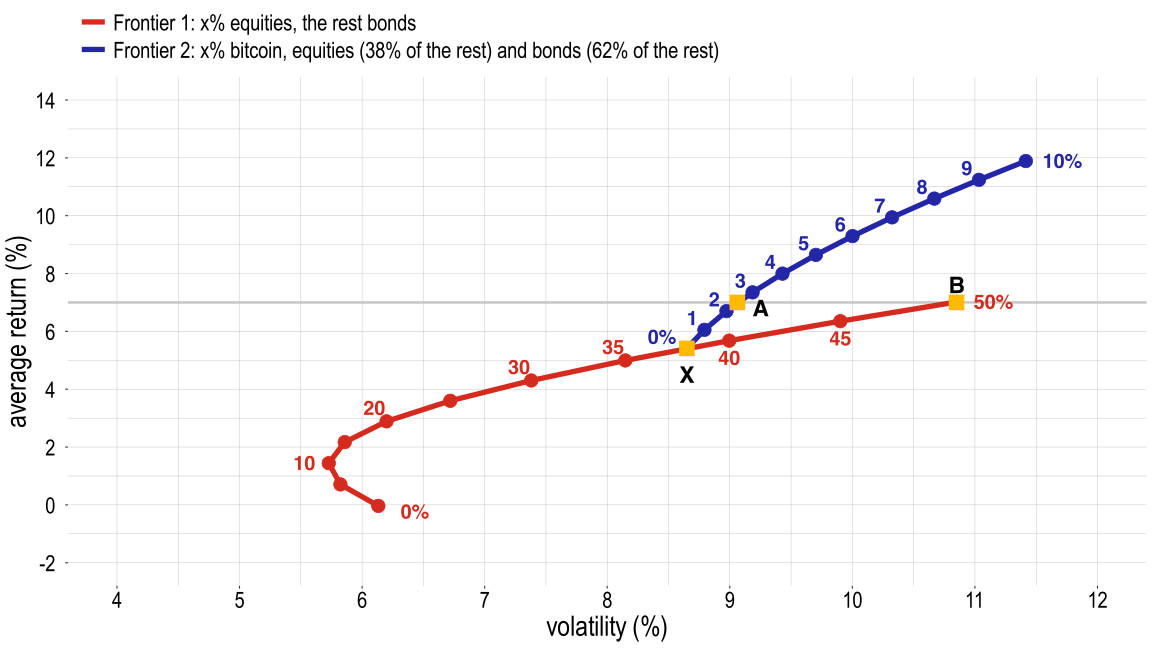
The study contains a more detailed analysis of the past five years, by which time bitcoin had gone through its initial period of exponential growth. Chart 3 depicts the risk-return frontier, which shows how the average annual return and volatility of the US part of the portfolio changed in 2020–2025 for different asset compositions. The red curve illustrates the impact of changes in the share of equities in the CNB portfolio (according to the methodology of Adam, Michl and Škoda, 2023), while the blue curve shows the impact of adding bitcoin. The initial portfolio is marked by the point X (38% equities and 62% bonds).
The analysis shows that even a small bitcoin holding significantly affects the overall characteristics of the portfolio – the risk rises as the share of bitcoin increases. We can see a similar relationship for equities, where both the expected return and volatility grow as the share of equities increases.
Interestingly though, bitcoin offered a better risk-return ratio than equities in the period under analysis. Therefore, if the Bank Board were to seek a further increase in the expected return on the portfolio, the analysis indicates it would be better to include around 2.5% of bitcoin ETFs (point A) than to increase the share of equities to 50% (point B). In such case, the increase in volatility would be significantly smaller. On top of that, more highly liquid US bonds would remain in the portfolio.
However, it should be emphasised that these results are based on a statistical analysis of historical data. On shorter time series, and with time-varying return characteristics (see problem 1), the conclusions may be less reliable.
Chart 3 – Risk-return characteristics of the CNB’s US portfolio
(2020–2025 data, average annual return and volatility in %; initial portfolio X (38% equities, 62% bonds), portfolio with 2.5% bitcoin A, portfolio with 50% equities B)
Source: Bloomberg, CNB calculations
As with simple correlations, the choice of analysis period is also important. The published study shows that different analysis periods lead to diametrically different results. This was one of the reasons the Bank Board decided not to include bitcoin in the international reserves for now, but to start gradually – initially by testing and then revisiting the issue in two to three years’ time.
Conclusion
Digital assets are undergoing rapid institutionalisation. Commercial banks (e.g. Intesa Sanpaolo, JPMorgan), investment funds (e.g. BlackRock) and sovereign wealth funds (e.g. Luxembourg) are entering their ecosystem, and the world of digital finance is becoming interconnected with the regulated financial system. Regulatory change is also a contributory factor. The European Union is implementing the MiCA regulation, Switzerland has opened a consultation to strengthen its framework for crypto-assets and stablecoins, and the Bank of England has launched a consultation on a new regime for systemic stablecoins. Meanwhile, a federal law on stablecoins and other digital assets (the GENIUS Act) has been passed in the United States. These steps are moving the market from experimentation towards more transparent services in the real economy, although risks remain.
On the supply side, central bank initiatives are also contributing to the development of this segment, particularly projects focused on payment systems using blockchain and on supporting the tokenisation of financial assets (the ECB and Eurosystem central banks, and the BIS; see the links above). The European Investment Bank has already issued several digital bonds in cooperation with Banque de France and other Eurosystem banks. If large governments and corporations also start issuing tokenised products, their inclusion in central bank reserves will become inevitable.
Bitcoin itself may eventually serve as a decentralised alternative and a potential diversifier in large portfolios. Market liquidity may increase with the entry of new players. This could help dampen the volatility of this asset. However, the risks – operational, custody, cyber and cryptographic – will not disappear. Experience from the test portfolio will show whether the risk-benefit ratio fits into this framework.
In this situation, the CNB has chosen a prudent yet active approach. The test portfolio of digital assets should give us practical experience with holding and settling tokenised instruments, measuring risks and configuring processes in an environment where asset values fluctuate 24 hours a day, seven days a week.
In two to three years, we should be able to assess whether – and in what form – digital instruments could be relevant for the public sector and for reserve management. If regulatory and technological change continues at its current pace, we can expect wider use of digital assets in several areas – from the money market, including repo operations, through stablecoins to tokenised bonds and equities.
Experience with the test portfolio will ensure that the CNB – and with it the Czech Republic – is ready for the coming era of digital assets and their role in the financial system.
References
Adam, T., Michl, A., & Škoda, M. (2023). Balancing volatility and returns in the Czech National Bank’s foreign exchange portfolio. CNB Research and Policy Note 1/2023. Czech National Bank.
Aldasoro, I., Cornelli, G., Frost, J., Koo Wilkens, P., Lewrick, U., & Shreeti, V. (10 July 2025). Tokenisation of government bonds: Assessment and roadmap (BIS Bulletin No. 107). Bank for International Settlements. https://www.bis.org/publ/bisbull107.htm
Bank for International Settlements (2023). Project Atlas: Mapping the world of decentralised finance. https://www.bis.org/publ/othp76.htm
European Investment Bank (15 October 2024). EIB wrap-up on its contribution to the ECB trials (press release fi-2024-15). https://www.eib.org/en/investor-relations/press/all/fi-2024-15-eib-wrap-up-contribution-to-ecb-trials
Klesla, J., & Michl, A. (31 August 2017). Blockchainová republika, přestavme Česko na odvážné technologii (Blockchain Republic: Let’s transform the Czech Republic with bold technology, in Czech only). Lidovky.cz. https://www.lidovky.cz/nazory/blockchainova-republika-prestavme-cesko-na-odvazne-technologii.A170823_125234_firmy-trhy_jakl
Michl, A. (2025). Governor Michl’s thoughts on bitcoin – a test portfolio in CNB’s foreign exchange reserves. Czech National Bank. https://www.cnb.cz/en/public/media-service/interviews-articles/Governor-Michls-thoughts-on-bitcoin-a-test-portfolio-in-CNBs-foreign-exchange-reserves/
Michl, A., Malovaná, S., Karhánek, T., & Trubelík, I. (2025). Instant Payments in Czechia: Adoption and Future Trends. CNB Working Paper No. 4/2025. Czech National Bank.