The Czech National Bank hereby draws attention to the risks associated with investing in crypto-assets offered to the public on the basis of crypto-asset white papers under the Markets in Crypto-Assets Regulation (MiCA).[1]
This notice is intended to provide investors with information on what a white paper is, which categories of crypto-assets are required to be notified to, or approved by, the Czech National Bank, and what risks may arise in these situations.
What is a crypto-asset white paper?
MiCA distinguishes between three main categories of crypto-assets:[2]
- electronic money tokens (EMTs) (Article 48 et seq. MiCA),
- asset-referenced tokens (ARTs) (Article 16 et seq. MiCA),
- crypto-assets other than ARTs and EMTs (Article 4 et seq. MiCA).
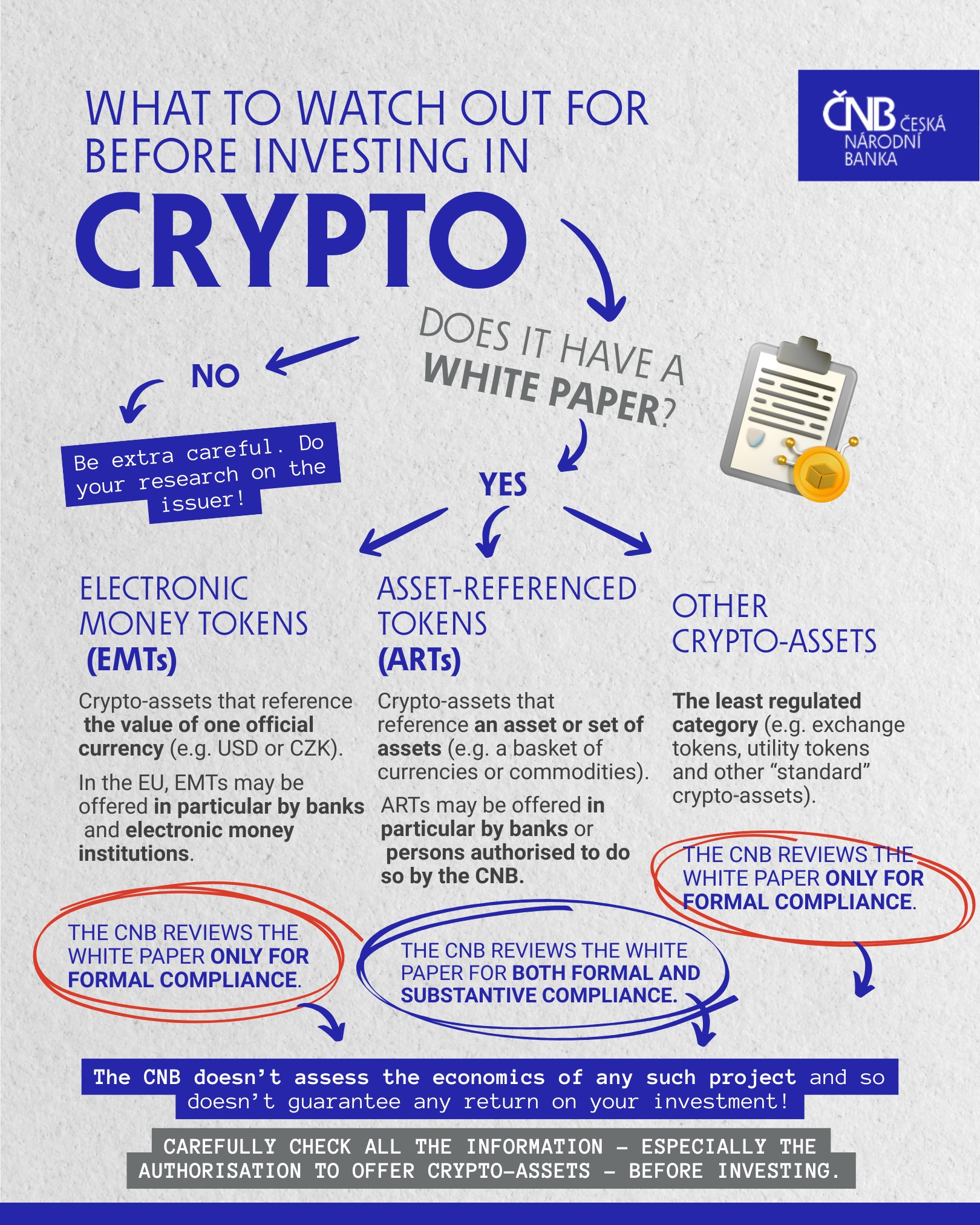
For all these categories of crypto-assets, a white paper must be published before the starting date of the offer to the public. A white paper is an information document containing clear information on the issuer, on the technology used, on the risks associated with the crypto-asset, on the rights attached to the crypto-asset and on the economic model of the crypto-asset. The content of the white paper and the extent to which it is reviewed by the Czech National Bank[3] differs substantially depending on the type of token:
- Electronic money tokens (EMTs)
EMTs are crypto-assets that reference the value of one official currency (e.g. USD or CZK). In the EU, EMTs may be offered in particular by banks and electronic money institutions. The offeror notifies the white paper to the Czech National Bank, but the content of the white paper is not subject to approval or substantive review. Publication of the white paper therefore does not mean that the Czech National Bank has verified whether the information is accurate or the offeror is trustworthy. Investors should therefore regard the offeror as being responsible for the content of the white paper. - Asset-referenced tokens (ARTs)
ARTs reference an asset or set of assets (e.g. a basket of currencies or commodities) and may be offered in particular by banks or persons that have obtained authorisation to do so from the Czech National Bank. The application for such authorisation must include a white paper, the content of which must comply with the requirements of MiCA. The Czech National Bank assesses the white paper not only in terms of its compliance with the formal requirements, but also in terms of its substantive content. ARTs are therefore the only crypto-assets for which the Czech National Bank carries out a substantive review of the white paper before it is published. - Crypto-assets other than ARTs and EMTs
For this broadest and least regulated category (e.g. exchange tokens, utility tokens and other “standard” crypto-assets), similarly to EMTs, it is sufficient in the case of a newly offered crypto-asset for the offeror to notify the white paper to the Czech National Bank, which only reviews the formal aspects of the notification. The content of the white paper is not subject to substantive review or approval, and, as in the case of EMTs, its publication does not mean that the Czech National Bank has verified whether the information is accurate or the offeror is trustworthy.
Bear in mind that, for most crypto-assets, the content of the white paper is not subject to approval by the Czech National Bank. The information contained in white papers may therefore be biased, or even false and misleading, and investors should assess it critically. Regardless of the extent to which it reviews the white paper, the Czech National Bank does not assess the economics of the project and therefore does not guarantee any return on the investment.
Lists of white papers for the various types of crypto-assets under MiCA, issuers of crypto-assets and crypto-asset service providers are available on the website of the European Securities and Markets Authority (ESMA).
Some offers to the public of crypto-assets may exhibit characteristics of fraudulent schemes or Ponzi schemes, where the profits promised to new investors are financed from the contributions of earlier investors. Such conduct may constitute fraud or another criminal offence. In such cases, the Czech National Bank cooperates with law enforcement authorities.
The Czech National Bank issues notices of fraud involving fake investment opportunities, fraudulent websites and vishing attacks in which fraudsters misuse the name of the Czech National Bank to obtain sensitive data. These notices are published on the CNB’s website in the section “Notices about activities” and via social media. However, bear in mind that this list is not and cannot be exhaustive, as it only includes suspicious activities that the Czech National Bank becomes aware of.
[1] Regulation (EU) 2023/1114 on markets in crypto-assets.
[2] However, non-fungible tokens (NFTs) are excluded from the scope of MICA, as are crypto-assets that qualify as investment instruments, deposits and so on, which are regulated by other financial market regulations (see Article 2(3) and 2(4) MiCA).
[3] The following text primarily covers offers of crypto-assets in the Czech Republic. However, crypto-assets from other Member States may also be offered, in which case a formal – or, in exceptional cases, substantive – review would be carried out by the home supervisory authority of the offeror from the other Member State.