Aleš Michl, CNB Governor
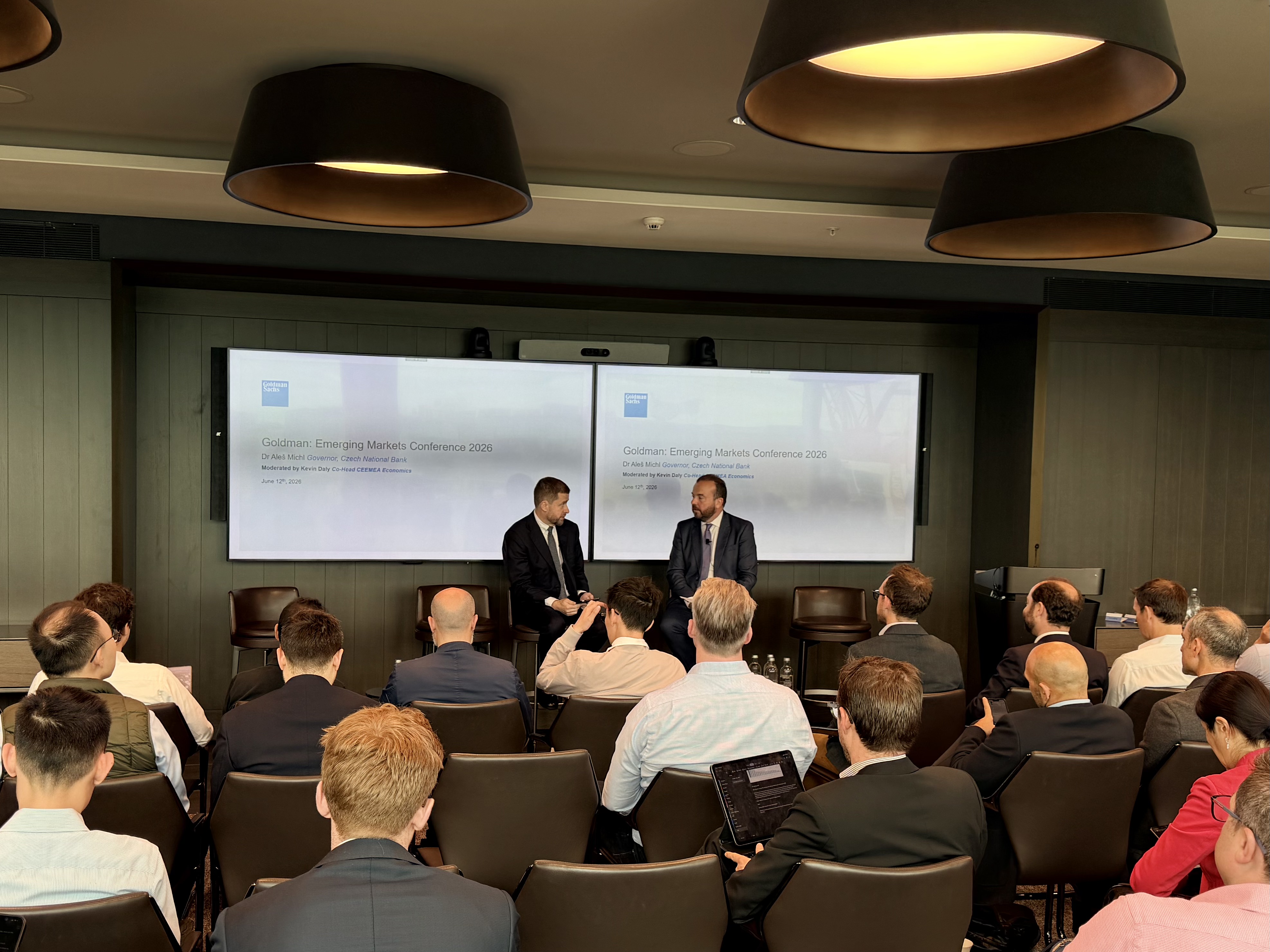
A fireside chat: Aleš Michl with Kevin Daly, Co-Head of CEEMEA Economics at Goldman Sachs, at the Goldman Sachs London Emerging Markets Conference 2026
12 June 2026, London
I am currently reading a very good book by Wolfgang Münchau about why the German economy is not performing well. The book is called Kaput. In English, it means that something is broken.
Our story is similar. We are good at manufacturing. But the trend in global trade is now services, IT, cyber risks and AI. And we are not very good at these things.
For example, Škoda is very good at manufacturing cars. But their software feels like an old iPod with a screen. An iPod, not an iPad – an old iPod with a click wheel.
I expect the updated forecast to lower this year’s GDP growth estimate.
I am happy to be here because this year marks 100 years since the central bank was founded in the former Czechoslovakia.
I am here to support independent central banking in the Czech Republic and the Czech koruna.
When I became Governor of the Czech National Bank in July 2022, inflation was near 20%. We reduced it to around 2%. For more than two years now, inflation has been close to our target. We restored price stability, and we will protect it.
In February 2026, inflation was 1.4% year on year. In April, after the oil shock, it was 2.5%. Fuel prices alone have added around 0.9 percentage point to inflation so far. We expect May inflation to be around 2%.
We cannot lower global oil prices. But we can prevent temporary inflation from becoming persistent.
For me, persistence means upward pressure on core inflation. What the CNB can do for the long-term prosperity of my country is to remain hawkish to keep inflation low.
Core inflation is now 2.9% year on year. The three-month average momentum in core inflation is 3.8%. There are upside risks to core inflation. We need to slow the increase in the money supply. This increase is driven by rising household credit and by the fiscal deficit. The case for a rate hike has strengthened. A June move is now a real possibility.
Household consumption is now above its pre-Covid level and is going up. This is very different from 2021, when household consumption was below its pre-Covid level and was going down.
So monetary policy needs to remain restrictive. And we are ready to tighten monetary policy if our core inflation outlook is revised upwards.
Our big advantage is that our key rate is 3.50%. Our policy is already tight. So we are not deciding whether to switch to a tight policy. We are already there. We are deciding how tight policy should be.
The ECB decision is not a game changer for us. Our next step will be based on our assessment of risks. Since I took office in mid-2022, we have been much more hawkish than the ECB.
And we still are. Our key rate has been 3.50% for more than a year. We have not cut rates below inflation in this cycle. The reason is simple. We want to stay hawkish forever.
Long-term price stability requires responsible public finances.