Interview with Simona Malovaná, Executive Director of Research and Statistics Department
By Daniel Hinge (Central Banking 24. 4. 2026)
In 2014, Olivier Blanchard – the then chief economist of the International Monetary Fund – coined the term ‘dark corners’. Policy-makers, he said, all knew the economy could slip into situations in which it would “badly malfunction”: “But we thought we were far away from those corners and could, for the most part, ignore them.” Blanchard was referring to economists being blindsided by the world’s spiral into the global financial crisis. But since he wrote the article in 2014, economies have stumbled into many more dark corners, as risks once thought be distant materialised one after another – the Covid-19 pandemic, Russia’s invasion of Ukraine, the global inflation surge, US-imposed tariffs and now the war in the Middle East.
Central banks have thus been forced to operate for years in an environment where the economy is highly likely to deviate from their baseline forecasts. Some situations are characterised by Knightian uncertainty, where the probability of different outcomes is unknowable, says Don Coletti, adviser to the governor at the Bank of Canada. “The pandemic was a classic example, and we felt during the trade policy disruptions we were in a similar situation,” he tells Central Banking. “The ground was shifting under us on a day-to-day basis.”
Many central banks, including the BoC, are now adapting their monetary policy-making processes to reflect the new reality, guarding against the worst possible outcomes while creating methods for conveying uncertainty and risk to outside observers. The Canadian central bank chose to suspend its headline forecast temporarily after US president Donald Trump imposed his ‘Liberation Day’ tariffs in April 2025, instead publishing scenarios reflecting the most plausible outcomes.
“We think the best way for us to maintain credibility is not by insisting things are more certain than they are but by demonstrating that we’re prepared to deal with these different contingencies,” says Coletti.
Reforming frameworks to better reflect risk can require action on several fronts. Models may not be flexible enough to handle a wide range of possible outcomes. Scenario analysis can help policy-makers map the different paths the economy could take, but how should scenarios be chosen and shocks calibrated to give a useful discussion? And how much of this complex deliberation process should be revealed to the public, including the thorny question of whether to publish a forecast of the path of interest rates? Central banks are answering these questions in many different ways.
New tools
Data from the Monetary Policy Benchmarks 2025 shows scenario analysis is used widely among central banks as a tool of policy-making. Across the 47 central banks that supplied data, 89.4% use scenario analysis in at least part of the monetary policy-making process.
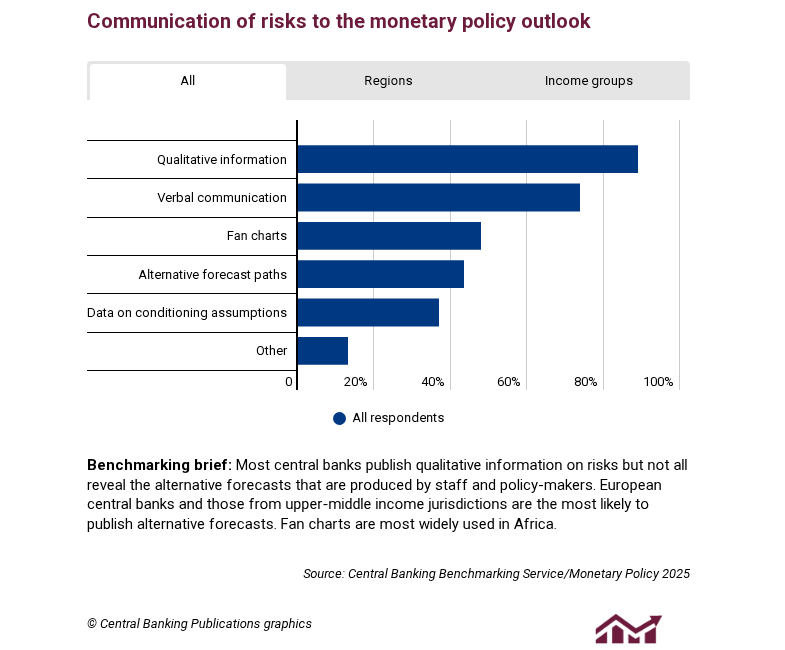
There is more variation in how central banks convey the results of their scenario analysis. Many publish qualitative information (89.1%) and verbally describe the risk outlook (73.9%) when presenting policy decisions. But less than half use fan charts (47.8%) or publish alternative forecast paths (43.5%) as a means of illustrating risk.
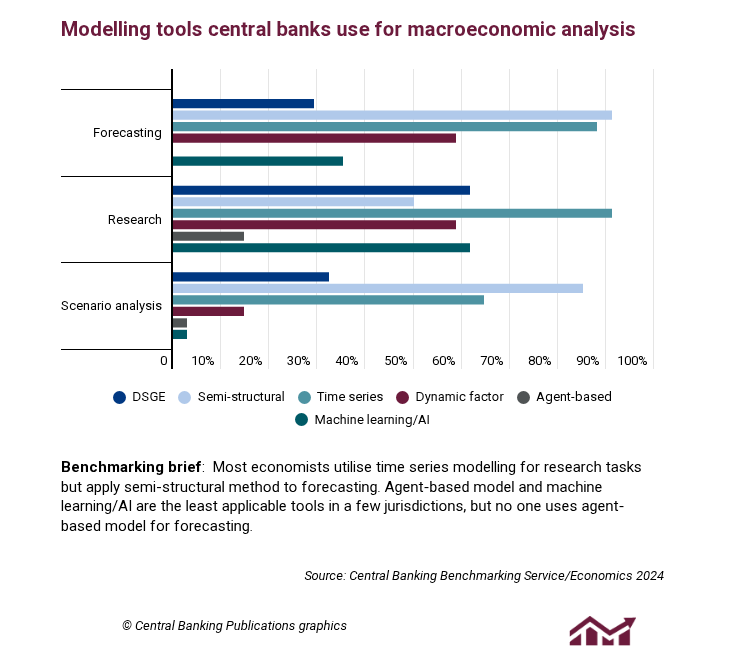
Findings from the Economics Benchmarks 2024 illustrate the modelling tools central banks use in constructing scenarios. As with producing headline forecasts, semi-structural models are the most widely-used tool for scenario analysis (at 85.3% of respondents), followed by time series models (64.7%). Dynamic stochastic general equilibrium (DSGE) models are less popular, with around 30% of central banks using them for forecasting and roughly the same share employing them for scenario analysis.
Sveriges Riksbank is, therefore, relatively unusual in using a DSGE model as its primary tool for producing both the headline forecast and additional scenarios, though Asa Olli Segendorf, head of the monetary policy department, says the bank’s Maja model is used in conjunction with empirical estimated effects and sensitivity analysis. Her team develops a range of scenarios for board members to discuss in the run-up to a policy decision by taking the baseline forecast and adding shocks. “We want to give the board the broadest picture of the complex environment we are in,” she says.
DSGE models have sometimes been criticised for their lack of flexibility and strong assumptions about elements such as consumer behaviour. But Segendorf says the bank keeps the DSGE model under review and has concluded Maja is up to the task: “We develop the model and try to adjust it to work better. But we think it actually works quite well.”
At the BoC, Coletti has been working on ‘fourth generation’ modelling tools. One goal of the project has been to develop the supply side in a new workhorse model, going beyond the demand-focused models that central banks have tended to favour. Another key aim is to develop a flexible toolkit for scenario analysis.
Economists at the BoC are now building a ‘library’ of variant models to apply in different situations. One important consideration is to not change each model too much, because policy-makers want to understand what drives differences in model output, and offering an explanation becomes “extremely complex” if the models are very different, says Coletti. “So, instead, we just change one thing about the model and see what that means. We challenge the assumptions in the core model.”
The BoC is also unusual in that economists routinely show policy-makers the inflation forecast produced by an agent-based model, as a cross-check on other model types. Coletti says more research is needed into the model type, which remains relatively new in the field of economics, but adds that agent-based models allow economists to “put in a lot of detail”. Some researchers have sought to build 1:1 representations of the economy using agent-based models, which is becoming more feasible as computing power and highly granular data becomes more available.
The Czech National Bank is in the middle of a similar process of developing its modelling kit, partly with the aim of creating more flexible tools for scenario analysis. Simona Malovaná, executive director of the research and statistics department, says the bank is currently using its main DSGE model to produce headline forecasts and scenarios, but is developing two semi-structural models – a gap model and a model drawing inspiration from the Netherlands Bank’s Delfi model. The development phase is expected to be completed this year, while the testing process is likely to extend into 2027. The CNB has yet to take a decision on which models it will maintain going forwards, but Malovaná expects the result to be a broader toolkit. “That’s definitely the endgame,” she says.
“The new models are quite flexible in terms of what you can quickly add to them,” Malovaná says. “If there is another ‘black swan’ event, you can very quickly modify them and use them in the scenario analysis.”
The model inspired by Delfi is expected to work best over the short term, giving ‘quick signals’ about particular areas of the economy that might deserve closer analysis. The gap model is likely to be more useful over a medium-term horizon. Ultimately, they will all be tested against the DSGE model for their forecasting properties and ability to tell a coherent policy story.
Constructing scenarios
Storytelling is an important element of scenario analysis. Well-chosen scenarios can help central banks clarify how they should respond to developments that knock the economy off the baseline path. The knock could be a small variation in key macroeconomic variables – a higher path of inflation, for example. Or it could be a completely different state of the world – a high tariff imposed by a key trading partner or major oil price shock.
Judging how far to deviate from the baseline requires delicate judgement. The Bank of England (BoE) adopted scenario analysis in response to Ben Bernanke’s review of forecasting, but some observers criticised the bank for not making its scenarios sufficiently different to the main forecast.
Michael Saunders, who sat on the BoE’s monetary policy committee from 2016 to 2022, defends the BoE’s approach. He notes scenario analysis can either try to map the wide distribution of possible outcomes or delve into the nuances around a finely balanced policy decision. The BoE has, so far, tended towards the latter. For example, Saunders says policy-makers might examine a scenario exploring how a 4% pay growth in the UK affects the immediate policy decision. The scenario may not map out the “full range” of possible outcomes, but it “helps MPC members to go from a sense of where the economy is, to their immediate policy choice. And that’s really useful to them”.
In a speech in May 2025, BoE deputy governor Clare Lombardelli sought to clarify what the bank’s scenario analysis was – and wasn’t – trying to achieve. The scenarios represented a “limited number of specific economic mechanisms”, she said, not a “comprehensive view of risks”. Scenarios allow economists to “explore uncertainty around key parameters of the economy”, such as the slope of the Phillips curve. Scenarios are not necessarily mutually exclusive; elements of both upside and downside scenarios could happen at once, and an MPC member might worry about both. Calibrating the scenarios “inevitably reflects judgement”, Lombardelli added.
Scenarios can flex to reflect the intensity of the current risk backdrop. The Riksbank’s Segendorf says it is “not at all easy” to decide how large the shocks should be when modelling alternative scenarios. “At the moment we are leaning towards showing how dominant risks could materialise, but sometimes it will be more relevant to have smaller adjustments to the main path,” she says.
The analysis can vary along other dimensions too. The CNB’s Malovaná says the number of scenarios produced internally tends to expand and contract depending on the riskiness of the outlook, typically varying between around two and four scenarios, some more complex and some less so. “Now we have higher uncertainty, so more scenarios are produced,” she says. At the CNB, as at other central banks, the process of developing scenarios is iterative, with staff producing a first approximation and then discussing this with policy-makers before going back to refine the results.
Risk communications
A further challenge is that scenarios are both a decision-making tool and a communication tool. Often, staff will develop many scenarios internally to highlight particular risks to policy-makers, but only a few will be published externally, often chosen to help shape a narrative around the decision. “The board consists of five people, and they are highly skilled, so it is easy to show them the risks and uncertainties using internal scenarios,” says Segendorf. “But the scenarios that are published are more thoroughly worked through; we develop them and discuss them much more.”
As an additional way of representing risks, the CNB publishes a monetary policy ‘risks scoreboard’. This sets out both a heatmap of cyclical indicators, showing whether they are in inflationary or deflationary territory, and graphs of longer-run structural trends in the economy. Malovaná says the scoreboard responds to the need to have a supporting tool that lays out risks in a “clear and systematic” way. Some elements of the scoreboard may be too complex to include in the main model but nevertheless reveal relevant information for policy. The aim is “not to produce certainty but create some structure in the discussion”, she says.
More controversial is the issue of what interest rate forecast to publish, if any. The Bank of England publishes a selection of policy rules to illustrate its scenarios, but declines to provide a forecast reflecting the real views of policy-makers or staff. The CNB publishes the baseline rate forecast produced by staff, while stressing that it is conditional and does not necessarily reflect the views of policy-makers. The Riksbank goes furthest, publishing the path of rates policy-makers expect to follow.
Central banks are often reluctant to follow the Riksbank’s approach for fear the forecast path will be interpreted as a promise. But Segendorf says the Riksbank’s efforts to educate the public – it has been publishing scenarios and rate paths since 2007 – have succeeded in getting people to understand the conditional nature of the projections. The bank’s scenarios are now discussed on the major TV news programmes. “We are aware this should not be interpreted as a promise,” Segendorf says. “The endogenous rate path is not a promise, and many shocks can happen to the economy that change the view of what happens. We are trying to show some of the complexity and uncertainty in the economy.”
The Riksbank also takes pains to explain how the actual decision played out relative to the previous scenario. Sometimes, policy-makers may have chosen to deviate from the expected path of rates, even if some variables turned out as expected. Often this is because other elements of the scenario did not evolve as expected – inflation may have gone one way and the real economy the other. “They are so complex, there are so many things happening at the same time in the scenario,” says Segendorf.
Petra Geraats, a professor of economics at the University of Cambridge, says the BoE is “going for the easy option” by publishing policy rules rather than a reflection of the MPC’s real views. She notes other central banks manage to publish a projected rate path despite differences of opinion among policy-makers: “It is not impossible at all.”
Geraats breaks down central bank policy guidance into two cases. She says there are times when time-dependent guidance – such as a commitment to keep rates lower for longer – is more useful. At other times – particularly during periods of high uncertainty – state-contingent guidance is more important. The latter shows how the central bank will react to “discrete ways” the world can evolve, such as high- or low-tariff regimes.
“Providing a projected policy path is the most time-dependent forward guidance you can think of,” Geraats says. The rate path tells observers when the central bank is likely to move and in which direction. Scenario analysis provides additional state-contingent guidance, outlining how the central bank would react to different states of the world. Combining the two “provides a great level of transparency for the public”, she says.
Saunders also thinks the BoE could do more to indicate where rates are expected to move in future, though he suggests a “general steer” might be sufficient. His proposal is to publish the median and range of views on the MPC about where rates will be four and eight quarters ahead, “maybe 12 quarters”. “I don’t think [the BoE] needs to give a figure that is overly precise,” he says. Saunders adds that households and businesses are the central bank’s most important audience, so while financial analysts might like a precise figure for where rates will be in three years’ time, most people just need a “broad brush” estimate.
Debates like this look set to continue, especially in the many jurisdictions where upgrades to the machinery of monetary policy are ongoing. Canada’s Coletti says there are several important issues still outstanding for researchers to tackle. “Probably the biggest challenge from a technical perspective is how do you take the insights from multiple scenarios, put them together and come up with one policy path that you advise a policy-maker to follow?” he says. “And how do you do it a disciplined and transparent way? There are a lot of people working on that question.”