The CNB commemorates 100 years since the establishment of the first Czechoslovak central bank
Spring 2026 marks 100 years since the National Bank of Czechoslovakia (NBC) began operations. It was the first independent Czechoslovak central bank and one of the legal predecessors of the Czech National Bank (CNB).The CNB will commemorate this significant anniversary with professional, cultural and educational events for both the general public and experts. These include a commemorative banknote and a new exhibition at the CNB Visitor Centre, unveiled on 21 January 2026.
The establishment of the National Bank of Czechoslovakia in 1926 was a pivotal step in building an independent Czechoslovak currency, ensuring monetary stability and laying the foundations of modern central banking in the former Czechoslovakia.
“The National Bank of Czechoslovakia was built on values such as independence, expertise and responsibility to society as a whole. These principles remain the foundation of today’s Czech National Bank. They underpin confidence in the koruna and in the institution that safeguards its stability,” said CNB Deputy Governor Jan Frait.
To mark the anniversary, the CNB is also honouring key figures of Czechoslovak economic thought. Visitors to the CNB Visitor Centre can explore the legacy of the first Czechoslovak Minister of Finance, Alois Rašín. A new supplementary exhibition, Alois Rašín’s Office, uses artistic projection to offer a unique insight into the life of a man who shaped Czech economic theory and was instrumental in the creation of the Czechoslovak currency.
“Alois Rašín demonstrated that without responsibility, discipline and public trust, it is impossible to build a stable currency and economy. These principles remain just as relevant today,” said CNB Bank Board member Karina Kubelková.
The CNB is also putting into circulation a new commemorative one-hundred-koruna banknote featuring a portrait of Vilém Pospíšil, the first governor of the NBC. The banknote symbolically connects the historical roots of independent central banking with its enduring values – independence, expertise and responsibility for price stability.
Further information about the anniversary and planned activities is available on the dedicated website: 100.cnb.cz.
National Bank of Czechoslovakia
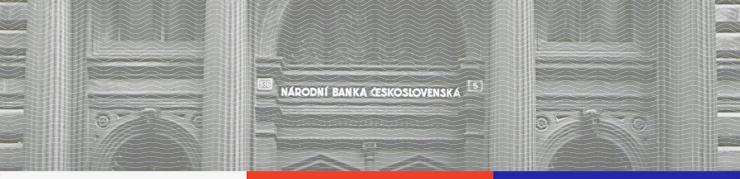
The idea of establishing an independent central bank for Czechoslovakia was conceived during the Austro-Hungarian period by Alois Rašín – a prominent politician and economist and the first Czechoslovak Minister of Finance. He envisaged that the bank would play a key role in creating a stable currency for the new state.
The first governor of the National Bank of Czechoslovakia was Vilém Pospíšil, appointed to the post by President Tomáš Garrigue Masaryk on 23 January 1926. Following its inaugural general meeting, the bank began operations on 1 April 1926 as a joint-stock company with both state and private investors. Its main task was to safeguard the stability of the Czechoslovak koruna.
Commemorative one-hundred-koruna banknote: Establishment of the Czechoslovak currency III – Vilém Pospíšil
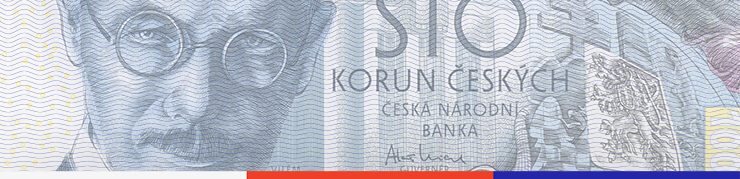
The commemorative one-hundred-koruna banknote marks the period of the establishment of the Czechoslovak currency and honours the contribution of Vilém Pospíšil, the first governor of the NBC. A total of 20,000 banknotes is available for purchase from 21 January 2026 through contractual partners for the sale of CNB numismatic material (in Czech only).
The face side of the banknote depicts a portrait of Vilém Pospíšil, complemented by a motif of the CNB building in Prague, a cornucopia with fruit, the middle coat of arms of the Czechoslovak Republic and a genius with a laurel wreath. The reverse side shows the corner of the former Městská spořitelna Pražská savings bank, a genius with a beehive and a composition of fruit.
The banknote measures 84 x 194 mm and is protected by a range of security features, including two types of watermark, a security thread, microtext and a latent image. A new feature is the use of SPARK® Flow technology in printing the denomination number 100, which creates the impression of smooth colour movement when the banknote is tilted.
The banknote was designed by Eva Hašková. It was printed for the CNB by the State Printing Works of Securities, with the SPARK® Flow element produced by Koenig & Bauer Banknote Solutions SA in Lausanne, Switzerland. The nominal value of the banknote is not its sale price.
This one-hundred-koruna note is the third and final commemorative banknote in the series dedicated to the origins of the Czechoslovak koruna. It follows the notes featuring Alois Rašín (2019) and Karel Engliš (2022).
Supplementary exhibition at the CNB Visitor Centre: Alois Rašín’s Office

Alois Rašín’s Office is a supplementary exhibition at the CNB Visitor Centre in Prague. At its core is an audiovisual projection directed by Jiří Strach, featuring actor Ondřej Vetchý in the role of Alois Rašín. The exhibition, set against the backdrop of historical events linked to the founding of Czechoslovakia, presents the main ideas of Rašín’s economic theory, particularly his emphasis on a stable currency, responsible economic policy and the creation of an independent central bank.
The design for the expansion of the CNB Visitor Centre exhibition, together with the documentation for contractor selection, was created by AV MEDIA SYSTEMS, a.s. The project was implemented by Sdružení Polarbee – 3dsense, while the audiovisual content for the supplementary exhibition was produced by Logline Production a.s.
The Visitor Centre is the CNB’s main tool for promoting financial and economic literacy. It offers the permanent exhibitions Exploring the Currency and People and Money, temporary exhibitions and accompanying programmes. Admission is free. Current opening hours and further information are available at nc.cnb.cz.
Jaroslav Krejčí
CNB spokesperson
Related links
- Dedicated website 100.cnb.cz
- Detailed description: design for production (in Czech only) and technical preparation of the commemorative one-hundred-koruna banknote
- Commemorative CZK 100 banknote – photogallery
- Alois Rašín’s Office at the CNB – photogallery
- Schedule of issuance for banknotes and coins in 2026–2030
- CNB Visitor Centre