Aleš Michl, CNB Governor
Governor’s lecture at Kyoto University
Japan, 13 November 2026
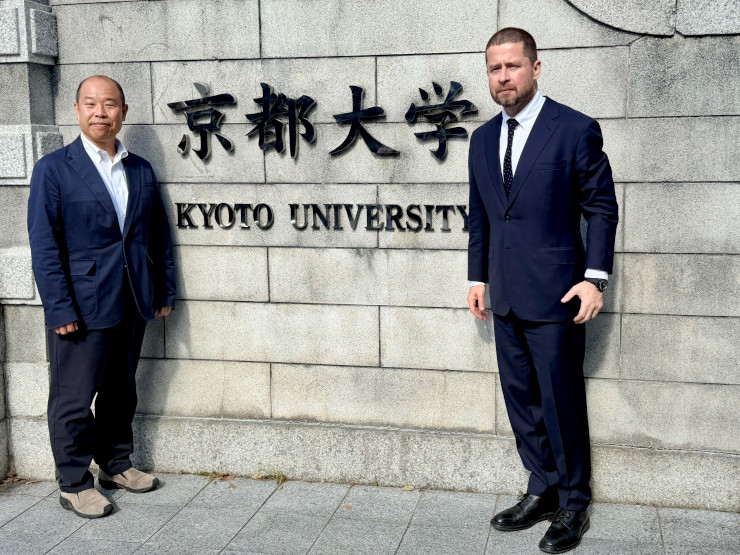
Good morning. Thank you for the invitation to Kyoto University. Many years ago, I was one of you. I was a student at the University of Economics in Prague. I spent my days in a lecture hall like this one.
I have 33 very short points for you. Like the 33 bays of Sanjūsangen-dō.
1. I always liked mathematics. I did a PhD in monetary and fiscal policy. Then I co-founded an algorithmic investment fund. It invested in US stocks. The idea was simple: a machine can make better decisions on stocks than a human.
2. At the end of 2018, the President of the Czech Republic appointed me to the Bank Board of the Czech National Bank, our central bank. It was my dream – I wanted to serve my country. I had to sell the fund and move from the market to the central bank.
3. In mid-2022, the President offered me the job of governor. I said yes. When I took office, inflation was 17.5 per cent. It was one of the hardest times in the modern history of my country.
4. On the day of my appointment, I made a public promise. I said: within two years, we will deliver inflation close to 2 per cent.
5. Fighting inflation starts at home – we led by example. We cut 5 per cent of our staff. We reduced senior managers from 17 to 14. The Bank Board froze its own salaries until inflation came down.
6. Then we defined our values at the bank. You need a team moving in one direction, with a clear task. Our ten values include independence, professionalism and teamwork. I printed them on coffee mugs for everyone at the bank – a reminder every day.
7. My inspiration for these values was Japanese culture and my visits to Toyota. Kaizen. Monozukuri. Mendomi. Toyota’s “respect for people” taught me to expect a lot from them, so they can grow.
8. We based our fight against inflation on the Chicago school of economics – above all on Milton Friedman. Inflation is always about money and debt. Too much money and too much debt today means higher prices tomorrow. (Was Japan an exception for almost 30 years?)
9. Why was inflation so high? For more than 10 years, the key rate set by the central bank was below inflation, and the goal was a weak koruna. The result: a new wave of borrowing by individuals, companies and the state – until it ended in inflation.
10. We needed to change that. Our main strategy: higher rates for longer. The key rate above inflation in the long term. Slow down the growth of money in the economy.
11. But a central bank cannot do it alone. So we ask the government to cut the budget deficit.
12. We also focused on the koruna, our currency. In April 2023, the koruna was the strongest in its history against the euro. The strong currency made our imports cheaper – an important tool against inflation.
13. We did not intervene in the market to make the koruna strong. The market trusted us to keep rates higher than before, and for a long time. We earned credibility, the koruna strengthened, and the policy started to work.
14. In February and March 2024, inflation was 2 per cent – exactly our target. We delivered this in less than two years, as promised.
15. After that, we stayed hawkish. Since the beginning of 2024, inflation has been around 2 per cent. The latest CPI is 2.4 per cent. Our key rate is 4 per cent – higher than before covid, and above inflation.
16. One more result: public trust in the Czech National Bank is the highest in almost 15 years. I wanted to serve my country and deliver results – and trust is what results bring. I am grateful for that.
17. Today, our strategy fits into two sentences: Conservative in monetary policy. Innovative in everything else. I call it conservative innovation.
18. Conservative in monetary policy means no experiments. No interest rates at zero for years. No weakening of our currency on purpose. Higher rates than before covid, for longer, and a strong koruna.
19. Innovative in everything else means operations, technology, payments and reserves. A central bank of the future should not be bigger. It should be smarter.
20. A quick example: our team completed instant payments in 2025 – 24/7 payments for everyone in the country.
21. We hold about 180 billion US dollars in foreign currency reserves – 44 per cent of our GDP. We now invest for the very long term. We doubled the share of equities to 26% and raised the share of gold. Higher potential returns mean a profitable central bank in the years ahead – and one day, a fund for future generations.
22. One of our values is innovation. The biggest brake on innovation in a central bank is its own fear of breaking something. So in 2025, we created the Czech National Bank Lab, separated from monetary policy. There we test what can change finance: AI, tokenisation, blockchain, stablecoins and bitcoin.
23. In November 2025, we launched a test portfolio: bitcoin, dollar stablecoins and a tokenised deposit. Size: 1 million dollars – 0.0006% of our assets. We are testing the technology.
24. This month, I announced the first test bond of the Czech National Bank on DLT – a digital ledger. We test everything a bond can do: buying, selling, paying interest. The goal: a safe koruna asset that is easier to trade than a German government bond.
25. We run AI inside the bank as a hybrid scheme. Our own servers with GPUs and open-source models for sensitive data. Plus the cloud – the same AI tools you use when you study. A simple rule tells our people what may go to the cloud and what must stay in-house.
26. AI also helps us forecast both inflation and GDP. One example: the forecast of GDP for the current quarter.
27. New methods of short-term GDP forecasting started during covid, when the usual data were blurred and delayed. We looked at electricity consumption and truck traffic on the highways. We built a weekly index from such fast data.
28. In 2023, we added machine learning. Every month, dozens of indicators arrive before GDP does. The models learn which of them matter, and how much. My favourite method is Random Forest: a team of a thousand simple forecasting models. Each looks at a random slice of the data – and the team beats any single model.
29. Since 2023, we have been running a fight between a machine and our economists. The fight takes place in practice, not on past data.
30. The first fighter: all our models plus the judgement of our economists. The second fighter: our best model, a single Random Forest, with no human touching it – AI alone. So in reality, it is machine alone against human plus machine.
31. The task: a GDP forecast for the same quarter, from the same data, on the same day. The result: the average error of our economists was 0.21 percentage points. The machine alone: 0.22. So close. The details are in our new CNB blog.
32. Where next? Today, AI is our engine: it turns hundreds of data series into one number. Now AI is becoming the operator: it already helps us write the code for machine learning and retrain the models. The judge remains human – but I don’t know for how long.
33. Today the machine alone is as good as our economists with all their models. Soon, I bet, it will be better.
Master the machines before they master you. Make AI your agent – but keep your own judgement.
Thank you.
Related links
- How accurate are AI models at nowcasting GDP? – updated version of the blog by authors Jan Botka, Ondřej Michálek, Aleš Michl and Matěj Šarboch on the CNB’s progress in using AI to predict economic developments.