MONETARY POLICY REPORT | SUMMER 2025 (box 2)
(authors: Jakub Matějů, Petr Sklenář)
The CNB has repeatedly drawn attention to the incomplete nature of the disinflation process and the risks stemming from the structure of inflation. Inflation hotspots have persisted in services prices, recently in the form of a rising cost of owner-occupied housing in particular. These are items with greater persistence in the consumer basket, and their growth is likely to subside only gradually. By contrast, inflation has been dampened by more volatile items such as fuel, energy and – last year – food. This year’s surge in food prices illustrates how easily such developments can reverse.
This box offers an alternative perspective on the structure of inflation and shows that price instability is a broader issue extending beyond the aforementioned services prices. With stable price developments, the distribution of price growth in the consumer basket should be roughly symmetrical around the 2% target. At present, however, more than half of the consumer basket is increasing at a rate of over 3% (see Chart 1).
Charts 1 and 2 – More than half of the consumer basket is currently increasing at a rate of over 3%
shares of consumer basket items in % growing at given rate
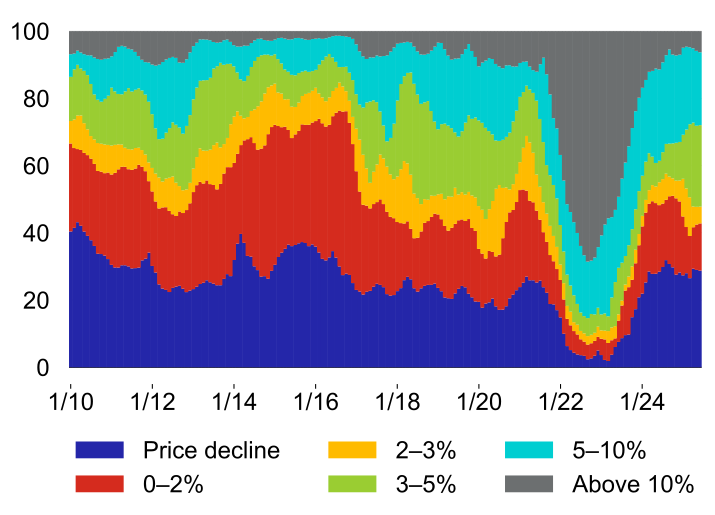
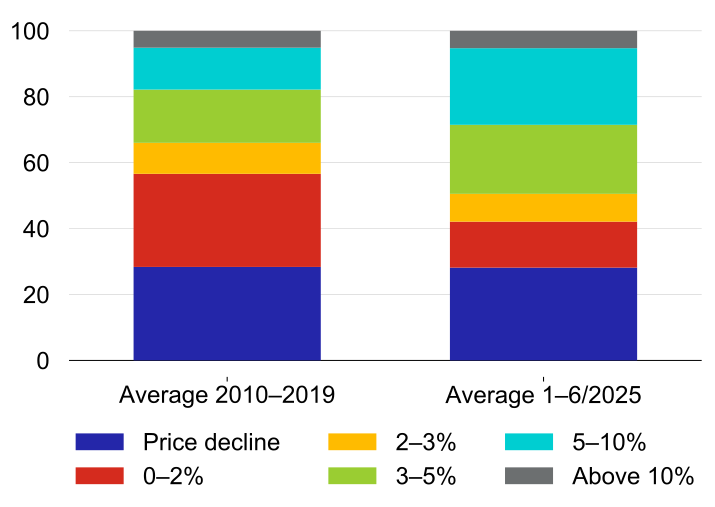
The issue does not lie in extreme price growth. The weighted share of items rising at a rate of more than 10% is very close to the historical average (see Chart 2). Likewise, the share of items showing a decline is not out of the ordinary. However, significant changes are apparent in the very low share of items growing at a modest pace of 0–2%. Between 2010 and 2019,[1] they accounted for 28% of the total on average, whereas in the year to date in 2025, they represent just 14%. A shift in the opposite direction is evident in the share of items rising by 5–10%, which averaged 13% prior to the pandemic but has been a significant 23% since the start of this year. In recent months, part of this group has moved into the 3–5% growth band. However, the combined share of these two groups showing excessive price growth (44%) remains well above the historical average (29%).
This indicates that inflation is not yet fully stabilised in terms of its distribution and is elevated in terms of its structure and simultaneously sensitive to external shocks. Overall year-on-year inflation is being moderated by several high-weight items with falling prices, notably retail energy prices (electricity and gas) and fuel prices. These are benefiting from the globally favourable trend in energy prices – a trend, however, that could reverse unexpectedly. By contrast, the price core – whether represented by core inflation as defined by the CNB (3% in June 2025), the median net inflation rate (3.8%) or (as described above) the share of the consumer basket showing excessive price growth (52% of the basket rose at a rate of more than 3% in 2025 Q2) – indicates that inflationary risks persist in the structure of inflation.
[1] This is the period from the introduction of the 2% inflation target to the period of extraordinary shocks (COVID-19, energy crisis, war in Ukraine). During this period, average inflation was 1.7%.