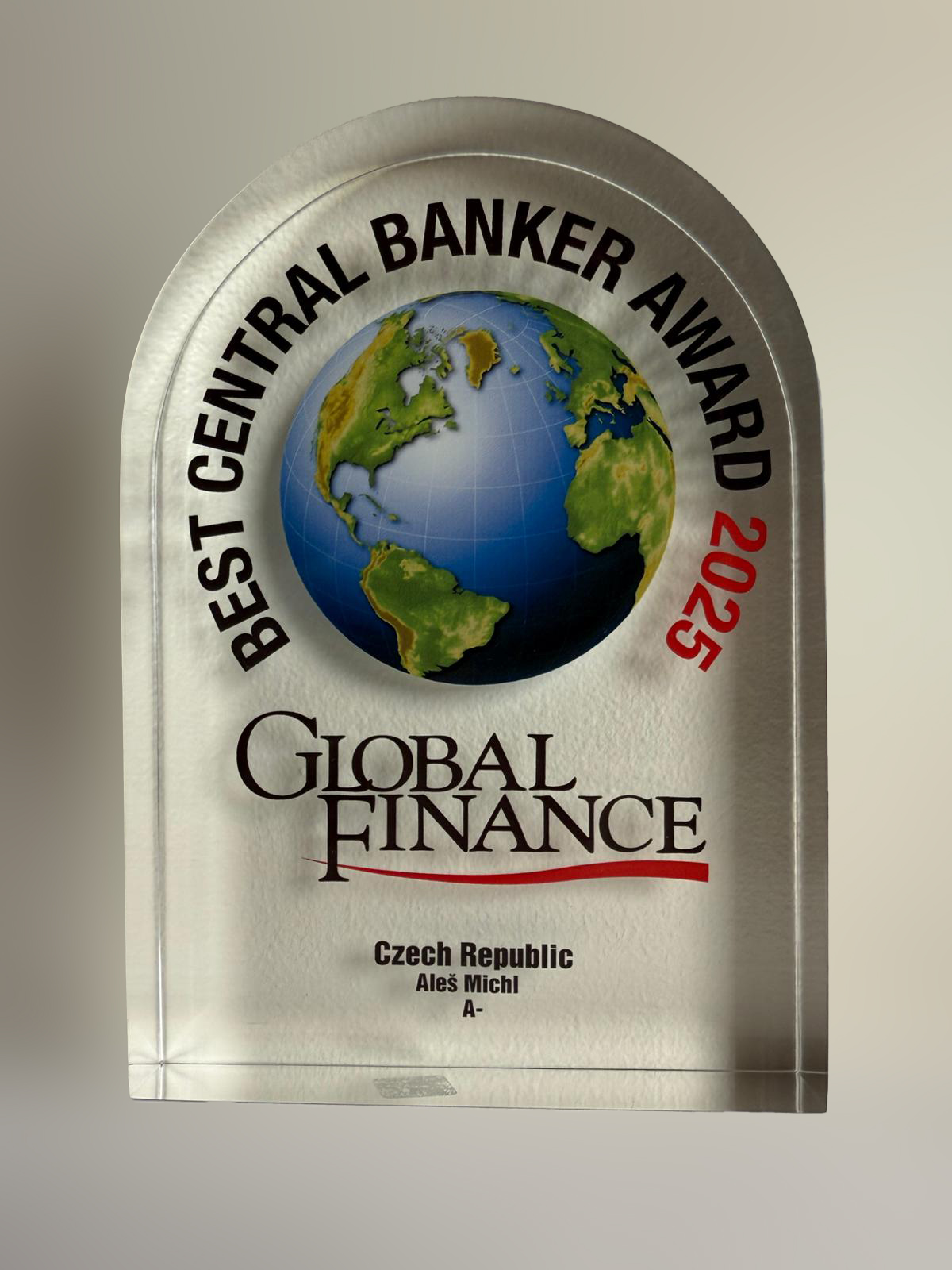
Governor Aleš Michl ranked among the top three central bankers in the EU for 2025 by Global Finance
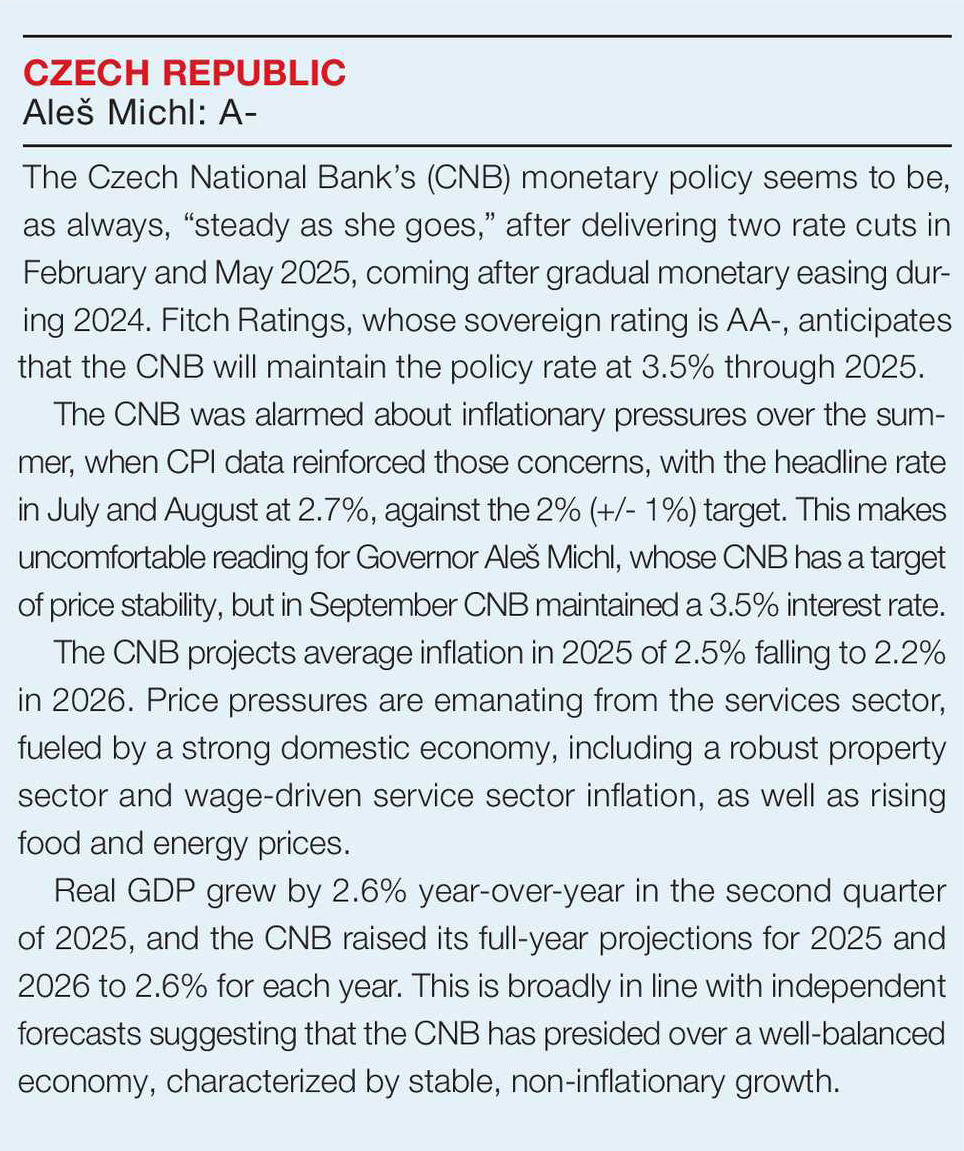
The international magazine Global Finance has ranked Czech National Bank Governor Aleš Michl among the highest-rated central bankers of 2025, awarding him an A- grade in its annual Central Banker Report Cards. Central bankers are assessed based on how effectively they fulfil their institution’s mandate, mainly in the areas of monetary policy and financial stability. The assessment also considers their ability to communicate policy decisions, as well as the transparency and political independence of their institutions.
Among EU representatives, only the Governor of the Danish National Bank, the President of the European Central Bank and the Governor of the Czech National Bank were given grades of A+, A or A- in the global ranking.
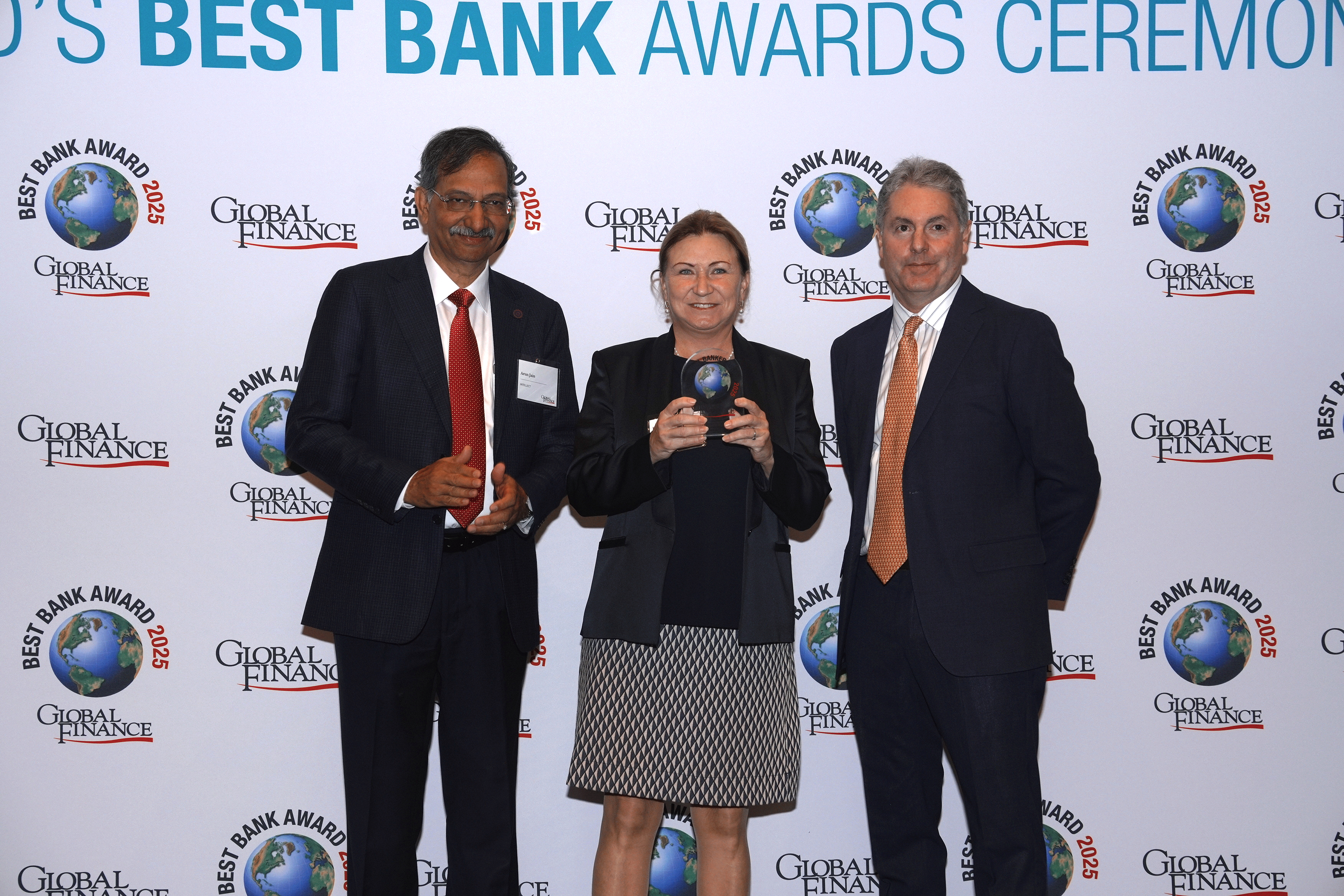
The award ceremony took place on Saturday, 18 October, in Washington, D.C., as part of the Annual Meetings of the International Monetary Fund and the World Bank. Governor Michl was represented at the event by Deputy Governor Eva Zamrazilová, who accepted the award on his behalf.
According to Global Finance, the past year has been full of uncertainty for central banks. The global economy has faced a combination of slowing growth, trade wars and persistent inflation pressures. Large central banks have adopted different approaches – the US Fed started lowering rates, while the ECB, Bank of England and Bank of Japan opted to wait and see.
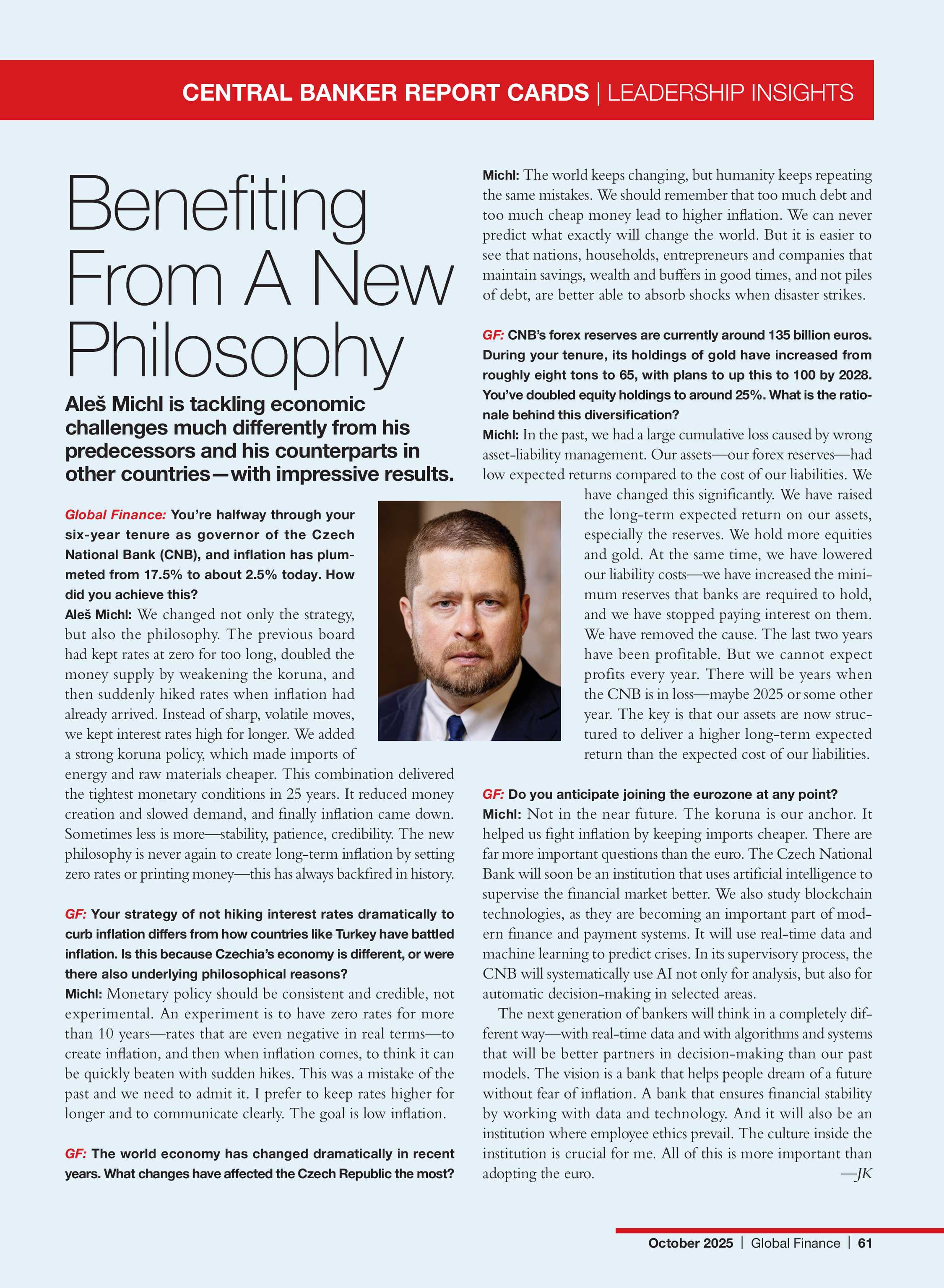
On the occasion of the award, Governor Aleš Michl gave an interview to Global Finance, reflecting on the past three years. “We changed not only the strategy, but also the philosophy,” he said. When the new CNB Board took office, inflation was 17.5%. The new strategy was based on keeping rates higher for longer and pursuing a strong koruna policy, which made imports of energy and raw materials cheaper and helped bring inflation back down towards 2%. “Sometimes less is more – stability, patience, credibility,” he added. In the interview, he also spoke about the CNB’s greater diversification of international reserves towards equities and gold and outlined a vision of a central bank that will supervise the financial market using artificial intelligence.
Central Banker Report Cards 2025
Europe
| Country | Banker | 2025 Grade | 2024 Grade |
|---|---|---|---|
| Albania | Gent Sejko | B | N/A |
| Armenia | Martin Galstyan | B | N/A |
| Belarus | Roman Golovchenko | TETS | N/A |
| Bosnia and Herzegovina | Jasmina Selimović | B | TETS |
| Bulgaria | Dimitar Radev | B+ | B |
| Czech Republic | Aleš Michl | A- | B+ |
| Denmark | Christian Kettel Thomsen | A+ | A+ |
| European Union | Christine Lagarde | A- | A- |
| Georgia | Natia Turnava | C | D |
| Hungary | Mihály Varga | TETS | N/A |
| Iceland | Ásgeir Jónsson | B- | B |
| Norway | Ida Wolden Bache | B+ | A- |
| Poland | Adam Glapiński | B | C |
| Romania | Mugur Isarescu | B- | B+ |
| Russia | Elvira Nabiullina | N/A | N/A |
| Serbia | Jorgovanka Tabaković | A- | N/A |
| Sweden | Erik Thedéen | B | A- |
| Switzerland | Martin Schlegel | TETS | N/A |
| Turkey | Fatih Karahan | B | TETS |
| Ukraine | Andriy Pyshnyy | N/A | N/A |
| United Kingdom | Andrew Bailey | B- | B+ |
* TETS (To Early To Say)
Source: Global Finance
Central banks brace for 2026 inflation risks, but lack consensus on how to tackle them
The single word that best captures the state of the global economy across every continent is uncertainty. Business leaders feel it acutely, but nowhere is it more pressing than in the deliberations of central bankers. Monetary authorities are operating in an environment where the trajectory of growth, trade, and inflation is increasingly difficult to predict, forcing them to rely on caution. With diverging approaches and contrasting trends, it is under this cloud of uncertainty that central banks around the world have been conducting policy, often struggling to anticipate the consequences of sudden shifts in the global economic order. It was in this environment that Global Finance conducted its 31st annual grading of central bankers, covering 105 countries.
Much of the turbulence traces back to January, when Donald Trump was sworn in as President of the United States. His campaign rhetoric quickly gave way to executive actions and the expansive introduction of tariffs, abrupt reversals, and a constant stop-and-go of policy decisions that have dominated international economic discussions. While nations with limited trade exposure to the United States may feel fewer immediate shocks, all are affected by the ripple effects. Global supply chains, commodity markets, and cross-border investment flows remain unsettled, complicating the work of central banks everywhere.
Monetary policy, of course, depends on a reasonably clear outlook for growth and prices. Tariffs, however, inject volatility on both fronts: they can weaken trade and investment, undermine business confidence, and simultaneously stoke inflationary pressures by raising import costs. This dual risk—slowing activity combined with rising prices—leaves central banks in a precarious position, uncertain whether to tighten policy in defense of price stability or loosen it to support growth. Thus, even countries far removed from the direct line of tariff fire ultimately confront the consequences, as developments in the world’s two largest economies—the US and China—reverberate through the global system and challenge the traditional levers of monetary policy.
This divergence has already become evident. In September, the US Federal Reserve resumed its easing cycle with its first rate cut since December 2024, setting itself apart from most other major central banks that remain on hold. The Fed signaled further cuts in October and December, citing a weakening labor market as the key driver. Markets are now pricing in an additional 50 basis points of easing by yearend. The Bank of Canada followed with a cut to 2.5%, its lowest level in three years, also reflecting labor market weakness. Markets see a 40% probability of another cut next month.
By contrast, the Bank of England and the Bank of Japan left rates unchanged, while the European Central Bank also held steady and indicated its rate-cutting cycle may be nearing an end. The risk, however, is that central bankers could face renewed inflationary pressures in 2026.
“This is lift-off, and the [US Federal Reserve] is now all in on supporting the labor market, signaling a decisively aggressive cutting cycle in 2025. The message is clear: growth and employment are the priority, even if that means tolerating higher inflation in the near term.” Olu Sonola, Head of US Economic Research at Fitch Ratings, said. “For now, the Fed is effectively communicating that it will cross the higher-inflation bridge if it shows up in 2026. What’s striking is the lack of consensus around 2026. The absence of a unified view on policy suggests the Fed may once again find itself in wait-and-see mode early next year, navigating inflation risks as they emerge rather than preempting them.”
METHODOLOGY
Global Finance editors, with input from financial industry sources, grade the world’s leading central bankers from A to F, with A+ being the highest grade and F the lowest, based on objective and subjective metrics. These judgments are based on performance from July 1, 2024, to June 30, 2025. A governor must have held office for at least a year to receive a letter grade. Central bankers in countries that are in deep conflicts are not included due to incomplete information. An algorithm supports consistency of grading across geographies. The proprietary formula factors in monetary policy, financial system supervision, asset-purchase and bond-sale programs, forecasting and guidance, transparency, political independence, and success in meeting the national mandate (which differs from country to country).
How does Global Finance assess the situation in the Czech Republic?