CNB issues new gold coin commemorating Saint Wenceslas
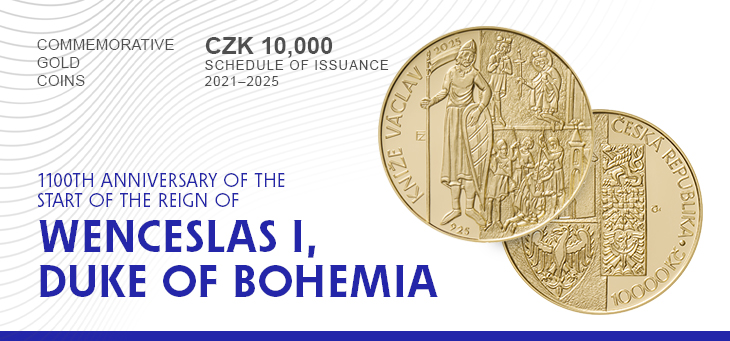
At a ceremony held today, the Czech National Bank (CNB) unveiled a new extraordinary gold CZK 10,000 coin weighing one troy ounce to mark the 1100th anniversary of the symbolic start of the reign of Wenceslas I, Duke of Bohemia.
The gold coin issued by the CNB to mark the 1100th anniversary of the likely start of the reign of Wenceslas I, Duke of Bohemia was presented today at the Archbishop’s Palace in Prague by CNB Governor Aleš Michl, together with Bank Board member Karina Kubelková. “Gold has always been a symbol of stability and security. When I joined the Bank Board, the CNB held the smallest gold reserves in its history – just eight tonnes, used mainly for coin production. We currently hold 65 tonnes and are gradually rebuilding the nation’s gold reserves. We want to have 100 tonnes by 2028 – the most in the history of the Czech Republic,” said CNB Governor Aleš Michl.
Wenceslas I, Duke of Bohemia is remembered in Czech history as a prominent ruler, the first Czech saint and, above all, the patron of the Czech lands. The CNB is marking the hypothetical start of his reign with the issuance of an extraordinary gold coin weighing one troy ounce. “Saint Wenceslas is a key figure in our history and a symbol of Czech statehood, while gold represents stability and security,” said CNB Bank Board member Karina Kubelková.
Wenceslas’s reign began somewhere between 922 and 925. While several references to his rule are documented in historical sources, Wenceslas became a true legend only after his death. “The legacy of Wenceslas has lived on in the Czech lands for more than a thousand years. I believe that this gold coin commemorating the symbolic start of his reign will appeal not only to collectors but also to the general public,” added Karina Kubelková.
The CNB is commemorating the symbolic start of Wenceslas’s reign with a CZK 10,000 coin weighing one troy ounce (31.107 g). The coin is minted from pure gold (999.9 fineness) and has a diameter of 34 mm and a thickness of 2.5 mm. A total of 7,200 coins have been minted, some in standard quality with a matt field and relief, and others in proof quality with a polished field and matt relief.
The design of the coin was chosen in an art competition. At the recommendation of an expert committee, the CNB Bank Board selected the design submitted by Zbyněk Fojtů. The obverse side of the coin features the Rotunda of St Vitus, built during the reign of Wenceslas I on the site of today’s St Vitus Cathedral, and the Přemyslid emblem – a flaming eagle. The reverse side is dominated by the figure of Wenceslas wearing his characteristic helmet, with which he is traditionally associated and frequently portrayed. The inspiration for this portrayal was a fresco in the Rotunda of St Catherine in Znojmo.
This is the second extraordinary gold coin with the highest denomination of CZK 10,000 issued during the current issuance period (2021–2025). Four years ago, the CNB issued a coin to mark the 1100th anniversary of the death of Czech saint and Wenceslas’ grandmother, Princess Ludmila. In 2024, the CNB honoured the legacy of St Wenceslas by issuing the first trade coin in the history of the Czech Republic – the gold St Wenceslas ducat. The whole schedule of issuance of coins and banknotes is available on the CNB website.
The coin’s denomination of CZK 10,000 does not equal the sale price, which is higher and reflects, among other things, the current price of gold and production costs. The coins were minted by Česká mincovna, a. s., in Jablonec nad Nisou and are available for purchase from selected contractual partners (in Czech only). The CNB does not sell numismatic material directly to the public. The coin is available for purchase from 23 September 2025.
The reign of Wenceslas I, Duke of Bohemia
The exact year Wenceslas I, Duke of Bohemia, began his reign is unknown, but it is estimated to have been between 922 and 925. Only a few events from his approximately ten-year reign are documented, such as the transfer of the remains of St Ludmila from Tetín to the Basilica of St George at Prague Castle and the construction of the Church of St Vitus. His reign is therefore known primarily through legends. His murder in Stará Boleslav proved fateful, causing a cult of Wenceslas to grow up Bohemia. He is regarded as the protector of the army and of the entire land, and as a symbol of Czech statehood. His image and story were recorded in manuscripts, paintings, sculptures and other works of art.
Petra Vlčková
CNB Spokesperson

