2025: Inflation at target and a record return on international reserves
The year 2025 was marked by low inflation, which has held close to the Czech National Bank’s (CNB) inflation target for more than two years. The central bank also achieved the highest-ever return on its international reserves: a record CZK 253 billion (a year-on-year gain of 10.3%). The gradual adjustment of the composition of the reserves is paying off – over the past three years, the CNB has achieved an accumulated profit of CZK 133 billion. As of 20 March this year, it was operating with an interim profit of CZK 95 billion. The interim result was positively affected by exchange rate movements and returns on international reserves.
“We took over the leadership of the Bank in 2022, at which point the accumulated loss stood at CZK 487 billion – the highest in history. The reason was that our assets – our forex reserves – had low expected returns compared with the cost of our liabilities. We have changed this significantly. We have substantially raised the long-term expected return on our assets. We hold more equities and gold. At the same time, we have lowered our liability costs – we have increased banks’ required minimum reserves and we have stopped paying interest on them. We have removed the root cause of this long-standing problem,” said CNB Governor Aleš Michl.
“We made a profit of CZK 55 billion in 2023 and CZK 151 billion in 2024. But you can’t generate a profit every year. In 2025 we had a loss of CZK 73 billion, even though we had a record year in terms of returns on euro- and dollar-denominated assets. In 2026, as of 20 March, we are so far in profit by CZK 95 billion. The last few months, however, have been significantly affected by movements in the koruna’s exchange rate. Our returns are in euros and dollars, while our accounting is in koruna. Last year the koruna appreciated sharply, pushing us into an accounting loss. For the three years 2023–2025, the CNB achieved an accumulated profit of CZK 133 billion. From 2023 to 20 March 2026, the accumulated profit amounted to CZK 228 billion. The key thing is that our assets are now structured to deliver a higher long-term expected return than the expected cost of our liabilities. There will be years when we are in loss, but over the long term we should be in profit. Once the accumulated loss is eliminated and a reserve fund is created, our successors will be able to transfer part of the profit to the state budget in compliance with the Act on the CNB,” the Governor explained.
International reserves dominate on the asset side of the CNB’s balance sheet. At the end of 2025, they amounted to CZK 3.6 trillion. Over the past year, they gained 10.3%, with the koruna-denominated return reaching a record CZK 253 billion. The highest-yielding asset class within the reserves in recent years has been equities, whose total annual return was CZK 163 billion. The CNB invests in equities exclusively through passive replication of stock indices. Based on a 2023 Bank Board decision, the share of equities is being gradually increased to 30% of the total reserves by 2029.
The CNB is also purchasing gold and thus strengthening the position of gold in the reserves, mainly for its diversification function. This was again the case in 2025, when rising gold prices partially offset the negative impact of valuation changes. Profit from gold investments totalled CZK 57 billion for the year as a whole. At the year-end, the CNB held almost 72 tonnes of gold. The objective is to reach 100 tonnes by 2028 – the highest level in the history of the Czech Republic.
The CNB’s 2025 financial results were significantly affected by exchange rate movements. Global markets were characterised by a weakening US dollar throughout the year. The appreciation of the koruna against the dollar (by 15%) and other reserve currencies led to an exchange rate loss of CZK 224 billion and an overall accounting loss of CZK 73 billion. Had the exchange rate remained stable throughout the year, the CNB would have posted a total profit of approximately CZK 150 billion.
On the liabilities side, interest paid to banks on their deposits remained a significant cost for the CNB, reaching CZK 100 billion in 2025. However, this is markedly less than in previous years thanks to lower interest rates and the earlier decision to stop remunerating required reserves while simultaneously increasing their volume.
In terms of operations, the CNB succeeded in maintaining low year-on-year growth in expenses. Together with personnel costs, operating expenses rose by 3.4% year on year, due in part to stabilisation of staff numbers and continued streamlining of operations.
The salaries of Bank Board members rose by an average of 4.8% in 2025, the same pace as those of CNB employees. The central bank has long emphasised transparent communication about its functioning and finances. For this reason, it is for the first time publishing data on the managerial benefits provided to Bank Board members and to senior staff reporting directly to the Bank Board. These benefits – intended for health, recreation, personal development and transport – corresponded on average to 17% of their annual net salary. Until 2024, in addition to these benefits, Board members and senior staff reporting directly to the Bank Board were entitled to the free use of a car for personal transport, including a fuel allowance. In 2025, this entitlement was replaced by a transport allowance.
Outlook
Sustainable long-term financial management remains one of the CNB’s priorities. Its aim is to repay the large loss it accumulated in the past. For this, the return on its international reserves must cover both its monetary policy costs and its operating expenses. That this strategy is working is evidenced by a decline in the accumulated loss from CZK 487 billion in 2022 to CZK 350 billion at the end of 2025. In 2026, the CNB is operating with a profit of CZK 95 billion, according to the ten-day balance sheet as of 20 March 2026. The interim result was positively affected by exchange rate movements and returns on the reserves.
The CNB will continue gradually adjusting the structure of its reserves and efficiently managing its operating costs. Experience shows that an appropriate combination of market developments and adopted measures can give rise to strong years. However, high profits cannot be automatically assumed for future periods given the natural volatility of exchange rates and markets.
In recent years, the CNB has been systematically opening up to modern technologies with the aim of boosting efficiency, reducing costs and redirecting expert capacity from routine tasks towards analytical and conceptual work. This transformation is being coordinated by the CNB Lab innovation platform, which brings together the CNB’s key activities in the fields of artificial intelligence and data analytics, digital assets and payments. In 2025, investment was focused primarily on developing analytical and data tools in the AI & Data Science module and modernising payment processes in the Payments module. The CNB continues to enhance the instant payment infrastructure, which enables transfers 24 hours a day, seven days a week.
The CNB’s profit/loss in 2022–2025 and interim result as of 20 March 2026
| Year | Profit/loss in CZK billions | Accumulated loss at year-end in CZK billions |
|---|---|---|
| 2022 | –412 | –487 |
| 2023 | +55 | –429* |
| 2024 | +151 | –277* |
| 2025 | –73 | –350 |
| Interim result as of 20 March 2026 | +95 | –255 |
* Rounded value of accumulated loss, including changes in accounting methodology.
Source: CNB
The CNB’s profit/loss in 2015–2025 and interim result in 2026
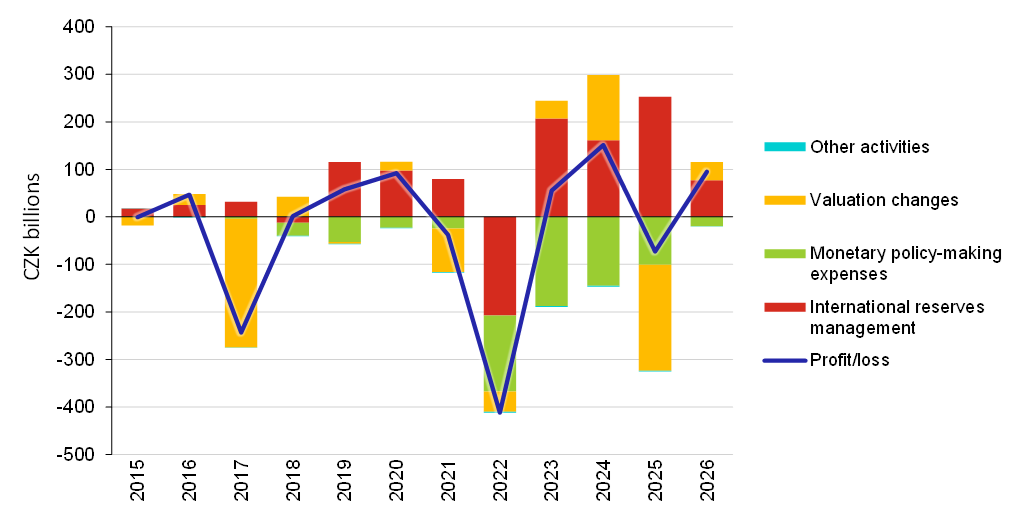
Source: CNB (for 2026 the interim result as of 20 March 2026)
Results of streamlining at the CNB in 2022–2025
| 2022 | 2023 | 2024 | 2025 | Change versus 2022 | |
|---|---|---|---|---|---|
| No. of positions at the CNB | 1,516 | 1,439 | 1,439 | 1,439 | −5.1% |
| No. of managers reporting to the Bank Board | 17 | 14 | 14 | 14 | −17.6% |
Source: CNB
The CNB’s operating expenses in 2022–2025 and expected change in 2026
| Year | Year-on-year change |
|---|---|
| 2022 | +16.3% |
| 2023* | +4.6% |
| 2024 | +1.3% |
| 2025 | +3.4% |
| Expected y-o-y change in 2026 | +4–5% |
* First budget of the current Bank Board. Source: CNB
Jakub Holas
Director of the CNB Communications Division