Commemorative banknote featuring a motif on the establishment of the Czechoslovak currency – Vilém Pospíšil
Design for production – in Czech only
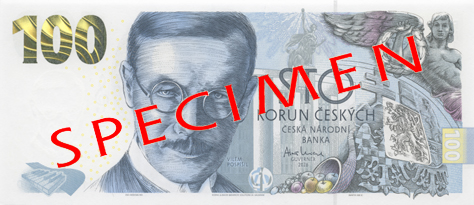
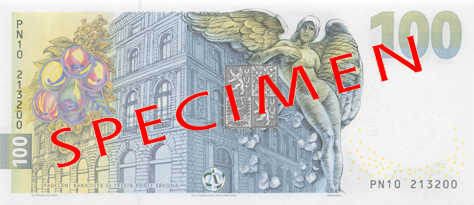
On 21 January 2026, the Czech National Bank is putting into circulation its third commemorative one-hundred-koruna banknote featuring a motif on the establishment of the Czechoslovak currency. The note is 84 mm wide and 194 mm long. Deviations of 1.5 mm in both width and length are acceptable. The banknote is printed on natural-coloured paper with a localised stepped watermark, a white line watermark and a windowed security thread. The stepped watermark is located in the unprinted margin of the banknote (the coupon) and consists of a portrait of Vilém Pospíšil. In addition to the stepped watermark featuring the portrait of Vilém Pospíšil, a white line watermark consisting of the denomination “100” and a treble clef is located towards the centre of the banknote. The 1.4 mm wide windowed security thread is embedded in the paper perpendicular to the longer side of the banknote along the entire width of the banknote – in the right half when looking at the face side of the banknote. The recurring negative microtext “1873–1942” and two musical notes are visible on the thread against the light. The banknote has a front-to-back register consisting of lines and areas in the middle lower part of the print pattern on both the face and reverse side. Against the light, the lines and areas of the front-to-back register on the two sides of the banknote join to form the stylised letters “VP”. Yellow circles are offset printed in the coupon on both the face and reverse side.
On the face side of the banknote, the left part of the print pattern features a portrait of the first Governor of the National Bank of Czechoslovakia Vilém Pospíšil. It is intaglio printed in dark blue. The text “VILÉM POSPÍŠIL” is located on the right below the portrait and is also intaglio printed in dark blue. To the right of the portrait is the headquarters building of the Czech National Bank in Prague topped by a statue of the Genius with a Lion, which is offset printed in shades of blue and grey. Located above the statue are lines of recurring positive and negative microtext containing the names of the central bank’s representatives in the years 1919–2026. A cornucopia with fruit is located on the right below the building, the middle coat of arms of the Czechoslovak Republic in the centre and a genius with a laurel wreath at the top, intaglio printed in shades of dark blue, purple and yellow. Located near the lower margin of the banknote are the name of the designer “EVA HAŠKOVÁ INV.” on the left, the name of the SPARK Flow® printer “KOENIG & BAUER BANKNOTE SOLUTIONS SA, LAUSANNE” in the middle and the name of the engraver “MARTIN SRB SC.” on the right, all intaglio printed in tiny dark blue letters. Written over the image of the Czech National Bank building in the right part of the print pattern are two lines of text describing the denomination “STO KORUN ČESKÝCH” and below them two lines with the text “ČESKÁ NÁRODNÍ BANKA”. The area of the letters of the word “STO” is filled with the recurring microtext “STO”. Below the text “ČESKÁ NÁRODNÍ BANKA” are the text “GUVERNÉR” and a facsimile of the governor’s signature. The year of issue of the banknote “2026” is situated below the text “GUVERNÉR”. In the strip near the right edge of the banknote is the number “100” in negative and the recurring microtext “100”. All these texts are intaglio printed in dark blue and yellow. The underprint of the face side of the banknote is offset printed with a fine screen in shades of blue and yellow with the recurring microtext “ČNB 100”. The denomination number “100” is screen printed using SPARK Flow® technology in shades of gold and green in the upper part of the coupon. The area of the numbers is filled with a wavy pattern. In the lower part of the coupon is a stylised fragment of a piano intaglio printed in blue. A latent image showing a dark or light number “100” when tilted is located in the fragment of a piano.
On the reverse side of the banknote, the middle of the print pattern features the corner of the former Městská spořitelna Pražská savings bank in Prague. A genius with a beehive is situated to the right of the building and a composition of fruit to the left of the building. Below the genius is the greater coat of arms of the Czech Republic and a linden wreath. The corner of the building, the genius and the coat of arms are intaglio printed in dark blue and yellow. The composition of fruit is offset printed in shades of yellow, purple, blue and green. In a strip near the left edge of the banknote is the number “100” in negative and the recurring microtext “100”. The text “PADĚLÁNÍ BANKOVEK SE TRESTÁ PODLE ZÁKONA” is situated below, running parallel to the lower edge of the banknote. Printed in tiny letters near the lower edge of the banknote are the inscription “© ČESKÁ NÁRODNÍ BANKA” on the left, the name of the printer “STÁTNÍ TISKÁRNA CENIN, STÁTNÍ PODNIK, PRAHA” in the middle and the name of the engraver “MARTIN SRB SC.” on the right. Wavy screened strips with the recurring positive and negative microtexts “VILÉM POSPÍŠIL” and “STO” are located near the lower and left edge of the print pattern. All these parts of the print pattern and the fill of the intaglio-printed contours are offset printed in shades of blue and yellow. The denomination number “100” is offset printed in shades of yellow and blue in the upper part of the coupon. The area of the numbers is filled with the recurring microtext “100”. The underprint of the banknote is offset printed with a fine screen in shades of yellow and blue with the recurring microtexts “VILÉM POSPÍŠIL” and “100”. The series mark, consisting of two capital letters and two numbers, and the six-digit banknote serial number are printed vertically near the left edge of the banknote and horizontally bottom right. Both the series mark and the banknote serial number are letterpress printed in black.