The CNB left interest rates unchanged, inflation will be close to the 2% target until the end of next year
- At its November meeting, the Bank Board left interest rates unchanged. The 2W repo rate thus remains at 3.5%. The Bank Board assessed the risks and uncertainties of the outlook for the fulfilment of the inflation target as inflationary overall.
- Inflation will be close to the 2% target until the end of next year.
- Economic growth will accelerate gradually over the outlook horizon. Economic activity will be driven by domestic demand, in particular households’ consumption expenditure.
- Consistent with the forecast is broad stability of short-term market interest rates over the next few quarters, followed by a gradual increase in rates. Monetary policy remains slightly restrictive in both the interest rate and exchange rate components.
Inflation slowed to 2.3% in September (in October, according to preliminary data, it reached 2.5%) and is expected to remain close to this level in the months ahead. A stronger koruna is fostering a decline in fuel prices and slower growth in prices of food and beverages. By contrast, core inflation is being kept at elevated levels just below 3% by growth in services prices. This growth is connected with swift wage growth due to persisting labour market tightness, and with a higher contribution of imputed rent. The latter reflects high growth in new residential property prices, supported by an improving income situation of households and by strong lending activity.
The inflation pressures will ease slightly next year. However, inflation will stay slightly above the target due to only gradually cooling wage growth and a still elevated contribution of imputed rent. The forecast expects inflation to rise slightly in 2027 as a result of the introduction of the ETS 2 emissions trading system.
The Czech economy will continue to grow in the quarters ahead. The growth will be due mainly to household consumption, driven by sizeable growth in real wages. The household saving rate is likely to remain close to current levels. Growth in investment activity in the next few quarters will be driven mainly by general government fixed investment, supported by the absorption of EU funds. Next year, private investment will take over as the main contributor, due to an economic recovery abroad. Growth in tariff barriers in global trade is dampening growth in goods and services exports. However, exports are expected to gain momentum in the course of next year on the back of a surge in external demand, boosted by an expected fiscal expansion in Germany. Increased growth in import-intensive investment and exports (see the Box) will lead to strong import growth. As a result, the contribution of foreign trade to GDP growth will be negative next year.
The exchange rate was close to CZK 24.3 to the euro in October. It was thus probably at a slightly stronger level than the equilibrium rate, partly because of global factors connected with the weakening of the dollar. The koruna can therefore be expected to depreciate slightly over the next few quarters. The exchange rate should then remain broadly stable close to CZK 24.6 to the euro.
Consistent with the forecast is broad stability of short-term market interest rates over the next few quarters, followed by a gradual increase in rates. With regard to the inflationary balance of risks, among other things, the decision adopted maintains slightly restrictive monetary conditions that will keep inflation very close to the target.
The Bank Board assessed the risks and uncertainties of the outlook for the fulfilment of the inflation target as inflationary overall. A possible acceleration in the growth of the money supply in the economy caused by lending to households and general government is an upside risk to inflation. Potential additional growth in total public sector spending would lead to a risk of fiscal policy having an even greater inflationary effect. Continued rapid wage growth related to persistent tightness in the labour market is an inflationary risk. The risk of inertia in elevated services inflation, including imputed rent, and food inflation persists. By contrast, a stronger koruna exchange rate could have an anti-inflationary effect. Increasing barriers to international trade are a downside risk to global economic activity. The weak performance of some euro area economies is an anti-inflationary risk. In the case of the German economy, this risk is only partly offset by the planned fiscal stimulus. The development of the war in Ukraine still represents an uncertainty. Rising general government debt in some developed countries and increasing sensitivity of financial markets to sovereign risk are becoming a major source of uncertainty.
Chart – Inflation will be close to the 2% target next year and increase slightly at the start of 2027
headline inflation; y-o-y in %; confidence intervals in colours
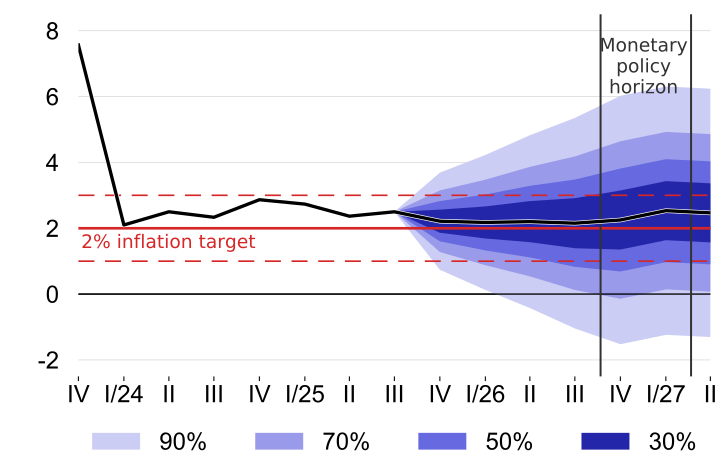
Table – Growth in domestic economic activity will be above 2%
changes compared to previous forecast in brackets
| 2025 | 2026 | 2027 | |
|---|---|---|---|
| Headline inflation | 2.5 | 2.2 | 2.5 |
| %; changes in pp | (-0.2) | (-0.1) | (0.0) |
| GDP | 2.3 | 2.4 | 2.8 |
| y-o-y in %; changes in pp | (-0.3) | (-0.2) | (-0.1) |
| Average nominal wage | 7.0 | 5.7 | 4.9 |
| y-o-y in %; changes in pp | (0.5) | (0.2) | (0.0) |
| 3M PRIBOR | (3.5) | (3.5) | (3.8) |
| %; changes in pp | (0.1) | (0.2) | (0.2) |
| Exchange rate | 24.7 | 24.6 | 24.6 |
| CZK/EUR | (-0.2) | (-0.3) | (-0.3) |