The CNB left interest rates unchanged, inflation will be below 2% this year and very close to the target next year
- At its February meeting, the Bank Board left interest rates unchanged. The 2W repo rate remains at 3.5%. The Bank Board assessed the risks and uncertainties of the outlook for the fulfilment of the inflation target as balanced overall.
- Inflation will be below 2% this year and very close to the 2% target next year.
- The economy will grow by 3% this year and next year. Economic activity will be driven mainly by domestic demand, in particular households’ consumption expenditure.
- Consistent with the forecast is broad stability of short-term market interest rates in the first half of this year, followed by a slight increase in rates. Monetary policy remains slightly restrictive.
Inflation was close to 2% over the past two years as restrictive monetary policy successfully offset domestic and foreign inflationary pressures (see Box 3). Growth in the price level slowed to 2.1% at the end of 2025. A stronger koruna is having a favourable effect, fostering a decline in fuel prices and slower growth in prices of food and beverages. By contrast, core inflation is being kept at elevated levels just below 3% by continued growth in services prices. This growth is connected with swift wage dynamics due to persisting labour market tightness, and with a higher contribution of imputed rent. The latter reflects high growth in new residential property prices, supported by an improving income situation of households and by strong lending activity. Given the prices of oil and agricultural commodities on global markets, fuel and food prices should continue to develop favourably this year. Inflation will decrease at the start of this year, due mainly to the transfer of the supported energy sources fee to the state budget. It will rise modestly in 2027 as this one-off effect fades out. However, it will remain very close to the 2% target, aided by tight monetary policy.
The Czech economy is still in the upward phase of the business cycle. It should be above its potential this year and next year, and hence have an inflationary effect. A similar interpretation of cyclical economic indicators is suggested by the upgraded Scoreboard. From a structural perspective, the Czech economy is likely to face continued challenges and opportunities in the shape of a gradual decrease in the share of industry (see Box 1) and the implementation of AI tools across sectors, which has the potential to increase labour productivity in the medium term (see Box 2). The buoyant economic growth in the quarters ahead will be due mainly to household consumption, driven by sizeable growth in real wages and an easing of fiscal policy. The household saving rate is likely to remain close to current levels. Year-on-year growth in investment activity in the next few quarters will be driven mainly by general government fixed investment, supported by the absorption of EU funds. In the second half of this year, private investment will take over as the main contributor, due to an economic recovery abroad. The domestic economy’s export performance is robust despite the difficult geopolitical situation and an only gradual recovery in its main trading partners. This year, exports will be supported by a surge in external demand, boosted by an expected fiscal expansion in Germany. An increase in import-intensive investment and exports will also induce import growth. As a result, the contribution of foreign trade to GDP growth will be roughly neutral this year and next year.
The exchange rate has been close to CZK 24.3 to the euro since the start of 2026. Given higher growth in costs in the domestic economy than abroad, the forecast expects the koruna to weaken slightly and then remain close to CZK 24.5 to the euro. Consistent with the forecast is broad stability of short-term market interest rates in the first half of this year as the effect of the previous appreciation gradually fades. This is followed by a slight increase in rates. This is due to a need to keep inflation close to the target next year, when the economy will be above its potential, import prices will begin to go up again and growth in wages and property prices will remain above average.
The Bank Board assessed the risks and uncertainties of the outlook for the fulfilment of the inflation target as balanced overall. A possible acceleration in the growth of the money supply in the economy caused by lending to households and general government is an upside risk to inflation. Potential additional growth in total public sector spending would lead to a risk of fiscal policy having an even greater inflationary effect. Continued rapid wage growth related to persistent tightness in the labour market is an additional inflationary risk. The risk of inertia in elevated services inflation, including imputed rent, persists. By contrast, a stronger koruna exchange rate could have an anti-inflationary effect. Increasing barriers to international trade are a downside risk to global economic activity. The weak performance of some euro area economies is an anti-inflationary risk. A global correction of asset prices in an environment of high government debt in some developed countries is another. The development of the war in Ukraine still represents an uncertainty.
Chart – Inflation will be below 2% this year and return very close to the target at the start of 2027
headline inflation; y-o-y in %; confidence intervals in colours
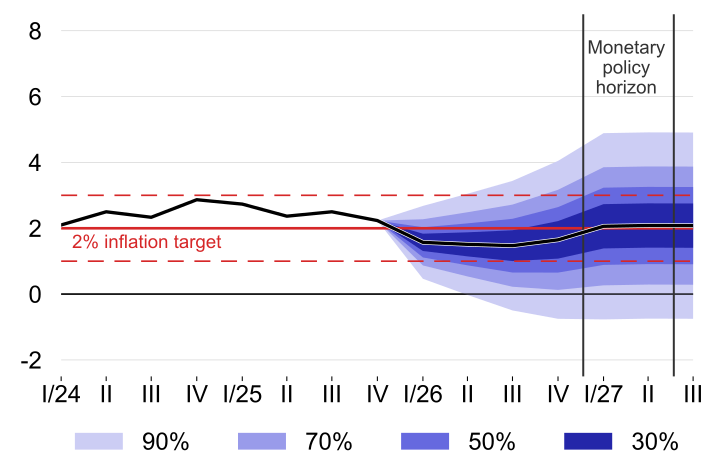
Table – Growth in domestic economic activity will be around 3% this year and next year
changes compared to previous forecast in brackets
| 2025 | 2026 | 2027 | |
|---|---|---|---|
| Headline inflation | 2.5 | 1.6 | 2.1 |
| %; changes in pp | (0.0) | (-0.6) | (-0.4) |
| GDP | 2.6 | 2.9 | 2.9 |
| y-o-y in %; changes in pp | (0.2) | (0.5) | (0.1) |
| Average nominal wage | 7.1 | 6.1 | 5.0 |
| y-o-y in %; changes in pp | (0.1) | (0.4) | (0.1) |
| 3M PRIBOR | 3.6 | 3.6 | 4.0 |
| %; changes in pp | (0.1) | (0.1) | (0.2) |
| Exchange rate | 24.7 | 24.4 | 24.5 |
| CZK/EUR | (0.0) | (-0.2) | (-0.1) |