Carbon tariffs and taxes: Economic tools for mitigating climate change
The EU Carbon Border Adjustment Mechanism (CBAM) is a climate policy tool designed to reduce greenhouse gas emissions and prevent carbon leakage. CBAM imposes a levy on imports of carbon-intensive goods in order to boost the competitiveness of domestic European producers and encourage foreign manufacturers to transition to low-carbon technologies. In 2027, the European ETS II (Emissions Trading System) is set to be launched. Media as well as academic publications discuss estimates of the impact this will have on consumer price developments, and on end customers. Once the second phase is implemented, the entire ETS system should cover up to 85% of greenhouse gas emissions in Europe. Preliminary calculations suggest that the increase in inflation will be noticeable, and an additional inflationary impulse could come in 2030, when the price cap on emission allowances is set to be removed. This article analyses the principles of carbon border tax and taxes, as well as their effects on international trade, the social sphere, and inflation.
Published in Global Economic Outlook – July 2025 (pdf, 2 MB)
Introduction
Global warming caused by greenhouse gas (GHG) emissions is one of the greatest challenges of the 21st century. Achieving the targets of the Paris Agreement will require a reduction in CO2 and other GHG emissions. One tool that has the potential to contribute to this goal is the carbon border tax. This mechanism was proposed as part of the EU’s broader strategy to achieve climate neutrality by 2050. It is a complex process with political, economic and technical dimensions.
The carbon border tax as a complement to the carbon tax
The carbon tax (introduced in the EU in 2005) applies to domestic energy-intensive production, whose carbon footprint – i.e. CO2 and other GHG emissions generated in the production process in a country or region – is priced under the EU Emissions Trading System (EU ETS; see, for example, Fakta o klimatu, 2021). However, the carbon tax and the rising price of emission allowances have incentivised EU-based producers to relocate energy-intensive production to countries with less stringent climate policies and then import the goods back into the EU. As a result, GHG emissions have moved beyond the reach of European legislation – a phenomenon known as carbon leakage. Emission-intensive industries that are covered by the EU ETS and can easily relocate production to third countries where emissions are not regulated currently receive a portion of their emission allowances free of charge so that their competitiveness relative to foreign suppliers is not undermined. However, the number of free allowances will gradually be reduced, and newly introduced carbon border taxes – which will be compliant with WTO rules[1] – will serve as an alternative means of shielding EU firms from foreign competition.
The ETS I system has been in operation in the EU since 2005. It places a price on CO2 (and other greenhouse gas) emissions from large emitters, such as major power plants, heating plants, heavy industry, and the aviation and maritime sectors. Currently, it covers approximately 38% of greenhouse gas emissions in the EU[2].
The new ETS II system is expected to introduce carbon pricing at the EU level starting in 2027 for road transport, building heating (including domestic hot water and cooking), and emissions from small energy and industrial enterprises — see e.g. EU (2023). It is projected to cover an additional 47% of EU emissions. The remaining 15% of CO2 emissions originate from agriculture and waste management. The objective is to encourage businesses and households to adopt low-emission transportation methods, improve building insulation, and make use of renewable energy sources (such as photovoltaics and heat pumps). This should lead to a 42% reduction in emissions in these sectors by 2030 compared to 2005 levels. ETS II will not apply to agriculture, the military, or rail and maritime transport. Additionally, the system allows for the exclusion of businesses and households in certain countries, provided they are already subject to a national carbon tax that exceeds the price of an emission allowance.
The ETS II system, including the setting of the allowance price, will operate separately from ETS I. While the price of allowances will be determined by the market, additional allowances will be released into circulation if the price exceeds the average over a given period or surpasses a ceiling[3] of €45 per tonne of CO2 (in constant 2020 prices) — see EU (2023) for details. These allowances will not be purchased directly by individual households or small businesses, but rather by large energy and fuel suppliers[4], who will then pass the costs on through their pricing. The total number of allowances in circulation will decrease each year, similarly to the ETS I system. If, however, energy prices[5] are exceptionally high in the run-up to implementation (i.e. in the first half of 2026), the launch of the system may be postponed from 2027 to 2028. This would occur if, for instance, the TTF gas price exceeds approximately €107 per MWh or the Brent crude oil price exceeds about $160 per barrel.
The carbon border tax thus complements the carbon tax in the EU. It is based on the principle of internalising the external costs associated with GHG emissions. The aim is to ensure that imported goods are also taxed according to their carbon footprint.[6] This helps prevent unfair competition from producers in countries with laxer climate standards. While the carbon tax does not directly affect emissions abroad and is intended primarily to incentivise domestic firms – through market mechanisms – to reduce fossil fuel consumption and invest in cleaner technologies and renewable energy sources, the carbon border tax has the potential to influence emissions generated abroad by encouraging foreign producers to cut their GHG emissions in order to avoid the tax. The carbon tax and the carbon border tax are therefore complementary tools for achieving optimal synergies in reducing global emissions.
How does the carbon border tax work?
Importers are required to declare the carbon footprint of their imports and, through CBAM certificates, pay a levy equal to what a domestic producer would pay in emission allowances for the same carbon footprint. If a carbon price has already been paid abroad, the corresponding amount is deducted from the levy. This ensures a level playing field for all market participants. EU firms are protected from competition from countries with lower emissions standards, while the incentive to relocate energy-intensive production to such countries is reduced. CBAM is compatible with WTO rules.
Timeline of the introduction of CBAM in the EU
- 2000–2010: Initial discussions on carbon border taxes emerge in response to observed carbon leakage as firms begin relocating energy-intensive production to countries with less stringent emissions regulations.
- 2019: The European Commission presents the European Green Deal, which sets the goal of achieving climate neutrality by 2050. The carbon border tax is proposed as one of the tools to help meet this objective.
- July 2021: The Commission publishes a proposal to introduce CBAM. The proposal focuses on five sectors – iron and steel, aluminium, cement, fertilisers and electricity – and contains the following key principles:
- Importers must declare the carbon footprint of imported products.
- The carbon footprint will be priced through certificates at the same level as production within the EU.
- Revenues generated by CBAM will be used to finance the EU’s green transition.
- March 2022: Following extensive consultations with industry and NGO representatives and with international partners, the European Parliament and the Council of the EU reach a provisional agreement on the introduction of CBAM.
- May 2023: CBAM is formally adopted as part of the Fit for 55 package.[7]
- 2023–2025: A transitional period is established during which importers will be required to report emissions embedded in imported products, but no levy will be collected.
- January 2026: The carbon border tax will be fully implemented and begin to be levied.
Transitional period 2023–2025
CBAM entered its transitional phase on 1 October 2023. This period is intended to allow EU businesses, non-EU producers, importers and EU authorities to gradually familiarise themselves with CBAM and begin implementing it in practice. In the initial phase, reporting applies to goods whose production is carbon-intensive and at most significant risk of carbon leakage: cement, iron and steel, aluminium, fertilisers, electricity and hydrogen. With this scope, CBAM is expected to cover more than 50% of the emissions in EU ETS covered sectors (EC, 2025a). The CBAM methodology will be continuously refined. In future, the mechanism may be extended to include downstream products. During this period, the importers concerned have to report GHG emissions embedded in their imports (direct and indirect emissions). However, they will not pay any carbon border taxes.
Full implementation from 2026
From January 2026, EU importers of goods covered by CBAM must register with national authorities, where they can also buy CBAM certificates. The price of the certificates will be calculated depending on the weekly average auction price of EU ETS allowances expressed in €/tonne of CO2 emitted. Importers will declare the emissions embedded in their imports and surrender the corresponding number of certificates. They will therefore pay the same amount for the emissions embedded in imported goods as if the goods had been produced in the EU. If they can prove that a carbon price has already been paid during the production of the imported goods, the corresponding amount can be deducted.
Impacts of introducing carbon border taxes
The carbon border tax has the potential to significantly affect the global economy and international trade. However, its specific impacts will vary considerably across different groups of countries and may be both positive and negative (see also Box 1). While CBAM may benefit the EU and other advanced economies with similar climate goals – in terms of environmental impacts and competitiveness – it poses a challenge for developing and emerging economies. The key to success will lie in international cooperation, technological support and a fair approach to ensuring that the carbon border tax contributes to global sustainability without having adverse social and economic effects.
The positive impacts for EU countries include the protection of domestic industry, the preservation of jobs and the maintenance of the competitiveness of European manufacturing. CBAM also incentivises firms to invest in clean technologies and reduce their fossil fuel consumption and GHG emissions. CBAM revenues can be used to finance the green transition or to provide compensation for at-risk sectors.
On the other hand, European firms that import carbon-intensive raw materials or semi-finished goods will face higher costs, and the implementation and running of CBAM will impose a significant administrative burden on businesses and create complex bureaucracy for public authorities. However, CBAM is not expected to have a major negative impact on industrial and consumer prices in the EU, as imports of energy-intensive products from non-EU countries account for only 4.5% of total EU imports (and just 1.2% of total Czech imports), with iron, steel and aluminium making up the largest share. The Commission estimates annual revenues from the sale of import certificates at around EUR 2.1 billion by 2030.[8] For the Czech Republic, the estimated cost of purchasing certificates is in the lower hundreds of millions of koruna per year.
Advanced economies outside the EU – such as the US, Canada and Japan – with climate goals similar to those of the EU may be motivated to accelerate their green policies in order to avoid the tax. Countries with emissions standards comparable to those in the EU may benefit from preferential trade conditions, which could boost mutual trade with the EU. However, if these countries do not have sufficiently strict emissions regulations, their exports to the EU may be disadvantaged.
Box 1 – Impacts of the EU CBAM on other countries (WB, 2023)
The World Bank provides an interactive map on its website showing the estimated impacts of CBAM on various countries around the world. For each sector affected, the map displays:
- the carbon intensity of exports from individual countries (in kg CO2/USD) relative to the EU average,
- the share of exports to the EU in total exports of a given commodity from the country,
- the relative impacts of CBAM on the country, taking into account carbon intensity and the share of exports to the EU, and finally
- the total impact of CBAM on the country when all the products concerned are considered together.
Countries whose competitiveness is expected to improve with the introduction of the EU CBAM are marked in dark green, while those whose export competitiveness is most at risk are shown in dark red.
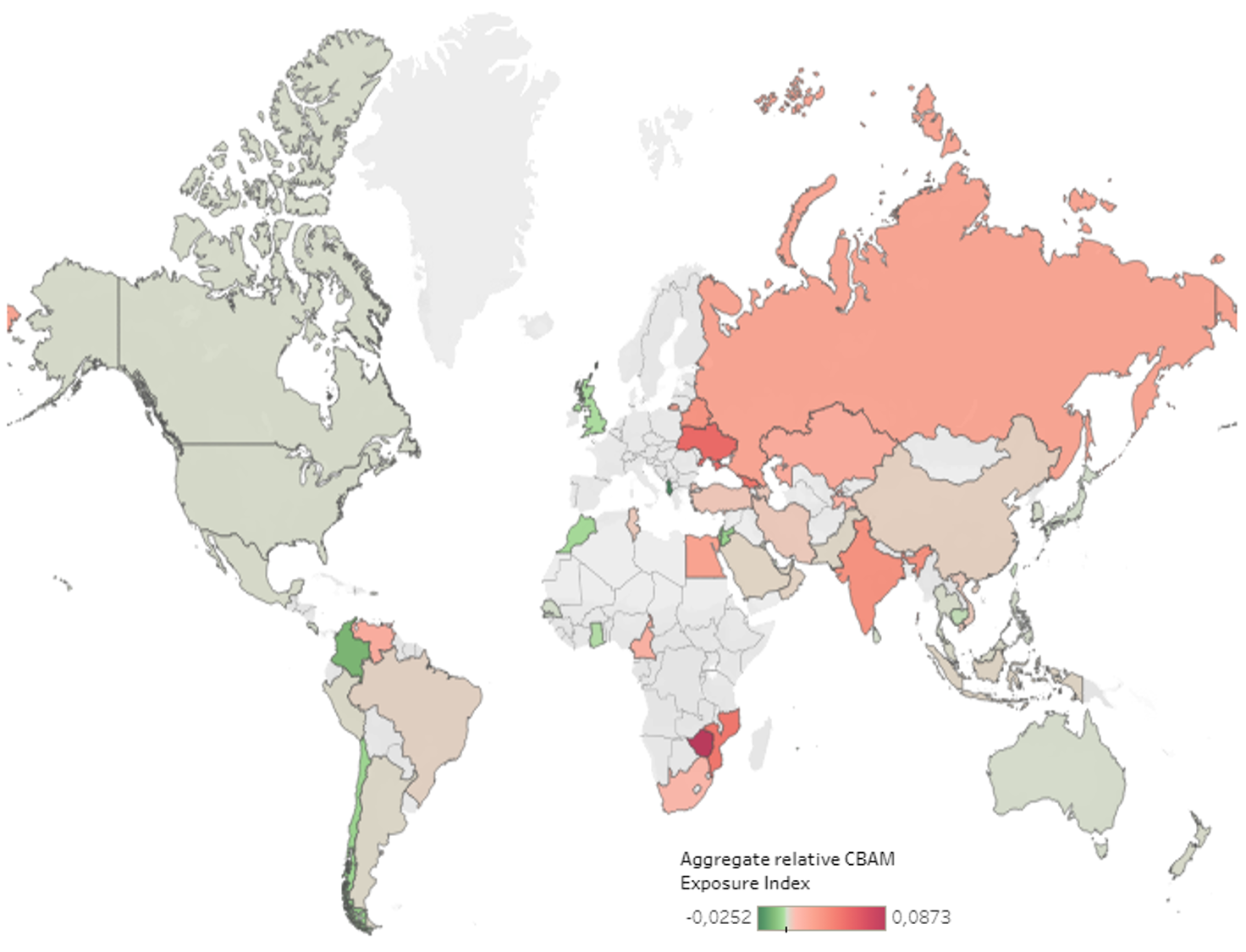
In emerging and developing economies such as China, India, and Brazil, negative effects are likely to prevail. The most affected will be countries dependent on exports of energy-intensive goods like steel, cement, or aluminum. The carbon border adjustment will raise export costs to the EU and reduce competitiveness. Some countries may lose market share, leading to revenue losses and economic strain. Many of them lack resources to invest in cleaner technologies, which hinders adaptation. The EU should provide technical and financial support to ease their transition to a low-carbon economy. Over time, the mechanism could encourage cleaner production and investment in renewables.
Countries dependent on fossil fuel exports – such as Russia and Saudi Arabia – will also face mostly negative impacts. A decline in demand for their products will reduce export revenues and may cause economic problems or even social unrest. In the long run, however, the pressure to reduce emissions may motivate these countries to diversify their economies and invest in sustainable industries.
From a global perspective, the carbon border tax could help reduce greenhouse gas emissions worldwide by encouraging countries to adopt stricter climate policies. The European CBAM may also serve as a model for other regions, contributing to the creation of global standards and harmonized climate policies. On the other hand, its introduction could trigger trade disputes within the World Trade Organization (WTO) and disadvantage developing countries, potentially widening economic inequalities between nations.
Reactions of other countries to the introduction of the EU CBAM
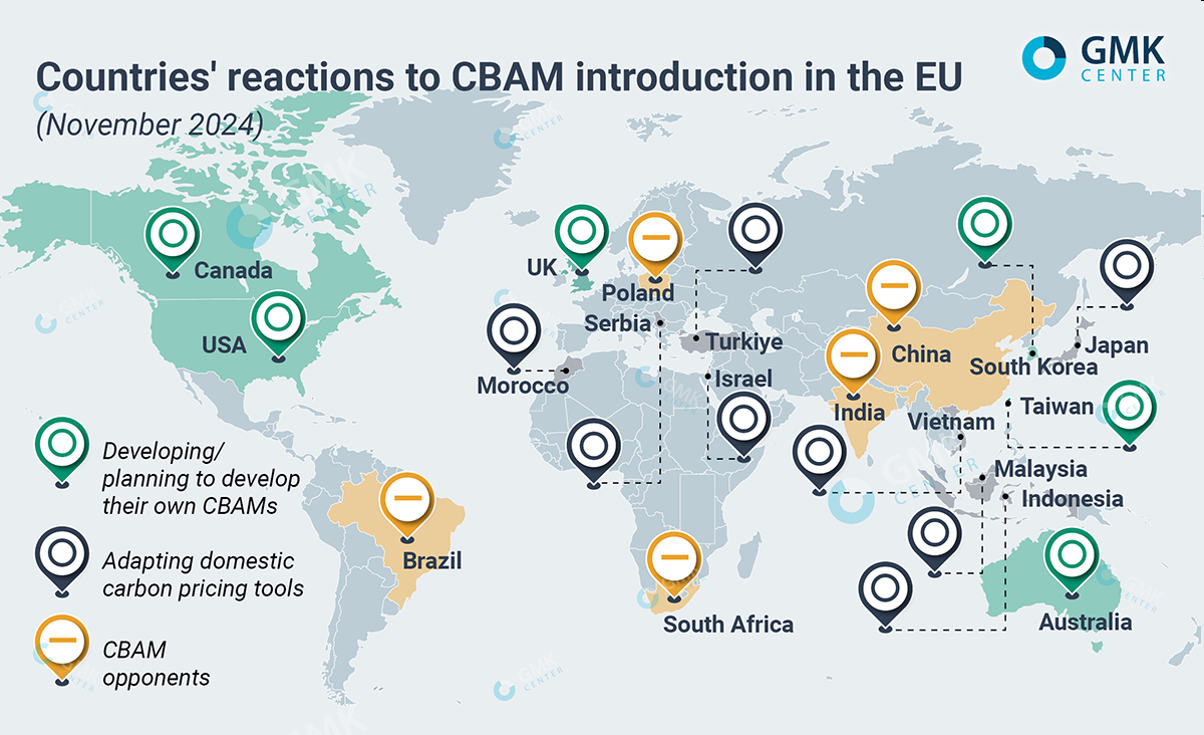
Other countries have reacted in broadly three ways to the launch of the first phase of CBAM by the EU in October 2023 (see Chart 1):
- By opposing the mechanism and arguing that it is discriminatory. The strongest opponents in this regard are Brazil, South Africa, India and China. Among European countries, Poland aligns with this group.
- By planning to develop their own CBAMs. This group includes Canada, the US, Australia, Taiwan, South Korea and the UK.[9]
- By adapting domestic carbon pricing to the EU CBAM. Countries such as Japan, Turkey, Indonesia, Israel, Serbia, Vietnam, Malaysia and Morocco are introducing their own carbon pricing tools (carbon taxes or emissions trading systems).
Chart 1 – Countries’ reactions to CBAM introduction in the EU
Mitigating the impacts on developing countries
The EU has committed to supporting developing countries in order to mitigate the impacts of CBAM on their industries. It also wants to promote the transition to green technologies and the adoption of GHG emissions pricing systems in these countries. The EU’s carbon border taxes may also have a highly negative effect on iron and steel production in Ukraine (GMK, 2025). It may be difficult for Ukrainian firms to meet the decarbonisation requirements without additional funding. The European Commission is therefore working on the introduction of exemptions to help ease the burden on Ukrainian producers.
Box 2 – Estimated Impact of ETS II Introduction on Inflation in the Czech Republic
To estimate the impact of ETS II on Czech inflation, we begin with the maximum allowance price of € 45 in 2020 prices. This ceiling is gradually increased in line with the average HICP inflation in the EU27, which reached 22.6% in 2024 compared to 2020. For the following two years, we can estimate average inflation at 2% annually. Consequently, the adjusted ETS II allowance price cap at the beginning of 2027 could be 27.6% higher than in 2020, i.e., approximately €57. Assuming an exchange rate of CZK 25 per EUR, this translates into an initial allowance price of CZK 1,425. The increase in the CZK price of individual fuels then depends on the carbon emission factor — i.e. the amount of CO2 released per unit of fuel burned. The resulting increase in the CZK price per unit of each commodity, based on the above allowance price and exchange rate, is summarized in Table 1. The calculation is based on the Fakta o klimatu (2024) carbon price calculator. To the estimated price increase in CZK, VAT at the rate of 21% must be added.
The percentage increase in price depends on the market price of the given commodity at the time ETS II is launched, while the impact on inflation is given by the current weight of the item in the consumer price index (CPI) basket. Table 1 therefore presents a modelled impact on inflation assuming the system were to be launched in May 2025, but using the estimated allowance price for the beginning of 2027 and the current exchange rate. When ETS II is actually introduced in 2027, a new weighting scheme will already be in effect (as CPI weights are updated every two years), meaning that the weights of individual components will likely differ slightly. Nevertheless, the current calculation based on today's data can still offer informative insights into the expected inflationary impact. A more detailed calculation, extending beyond Table 1, also considered propane-butane, kerosene, and LPG. However, these fuels have a negligible effect on overall inflation. In contrast, a more substantial impact of ETS II could arise from the cost of heat supply for space heating and domestic hot water (DHW) preparation. While large heating plants are already covered by the ETS I system, the extension of ETS II will newly affect small heating plants and municipal energy providers. If we assume that these smaller heat sources account for approximately half of the relevant item in the consumer basket, the inflationary impact of ETS II could increase by an additional 0.1 p. p.. Under the above assumptions, the direct (maximum) impact of ETS II on inflation can thus be estimated at approximately 0.9 to 1.0 p. p.. ETS II is also expected to affect small-scale producers of fossil-fuel-based electricity.
It can be assumed that the aforementioned inflationary impact will be spread over several months following the introduction of ETS II, as energy and fuel suppliers are likely to stock up in advance. However, the actual timeline and intensity of the impact will depend on the final legislation, which is still under development. Energy companies — particularly major gas suppliers — currently do not yet know how they will be required to purchase allowances and how exactly these costs will be reflected in end-user prices.
In addition to the one-off impact of ETS II on consumer prices through directly affected items in the consumption basket, other indirect effects must also be taken into account. These are expected to materialize more gradually, as producers of goods and providers of services begin to pass on higher input costs resulting from ETS II into final consumer prices over time. Moreover, inflation will continuously be influenced by the evolution of the allowance price, which is currently virtually impossible to predict. If the price remains at the considered ceiling, it would increase in line with EU HICP inflation until 2029. The price cap is scheduled to be abolished since 2030, which means that allowance prices may begin to rise uncontrollably, potentially introducing additional inflationary pressure.
Table 1 – Maximum Estimated Impact of ETS II Implementation on Inflation in the Czech Republic
| Price in May 2025 | Price increase (CZK) | Increase incl. VAT | Price increase (%) | Weight | Impact on inflation (p.p.) | |
| Gasoline (CZK/l) | 34.00 | 3.40 | 4.10 | 12.10 | 17.93 | 0.22 |
| Diesel (CZK/l) | 32.70 | 3.70 | 4.50 | 13.69 | 12.05 | 0.16 |
| Natural gas (CZK/MWh) | 2 382.60 | 285.00 | 344.90 | 14.47 | 16.69 | 0.24 |
| Coal (CZK/100 kg) | 887.40 | 413.30 | 500.10 | 56.35 | 4.18 | 0,24 |
Note: Prices of gasoline, diesel, and coal are based on data from the Czech Statistical Office (ČSÚ). The price of natural gas reflects the average total unit price charged by major suppliers. The inflation relevance of individual items (representatives) in the consumer basket changes over time. It starts from the fixed weight in the base period of the index, when all items are assigned an index value of 100. The weight then increases if the item's price index rises faster than the total index, and decreases if it grows more slowly.This is captured by the so-called current (running) weight, which, like the price data, refers to May 2025.
Source: CZSO, Fakta o klimatu, author’calculation
Criticism of CBAM
Besides criticism from abroad, the EU CBAM has faced strong opposition from within European industry. Representatives of the sectors affected point out that obtaining the necessary data from international suppliers is complicated and creates an excessive administrative burden. However, voices from the steel industry, which is struggling with overcapacity, warn that without CBAM, steel prices could fall further, exacerbating the situation of European producers. CBAM has also been criticised in academic circles, particularly with regard to its limited effectiveness,[10] fairness,[11] compliance with international law, and its negative impact on developing countries.
Recent developments
In response to experience gained during the transitional period and criticism from various stakeholders, the European Commission proposed several simplifications to CBAM in February 2025 (EC, 2025b):
- Individuals and SMEs who import less than 50 tonnes of CBAM goods annually are exempted from the reporting requirements and payment obligations. As a result, the number of importers affected will fall by 90%, while CBAM will still cover 99% of imported emissions.
- For importers that remain in CBAM scope, the reporting requirements – for the authorisation of declarants, the calculation of emissions and the management of financial flows – will be simplified.
- These changes will make CBAM more effective, reduce rules circumvention and simplify the work of national authorities.
- The changes also lay the groundwork for extending CBAM to other sectors in 2026.
General impacts of pricing fuels and motor fuels
The pricing of fossil fuels and motor fuels will disproportionately affect low-income households and small businesses, as they typically spend a large share of their income on energy and fuel. ETS II will not apply to heating with biomass (e.g. firewood), whereas the greatest impact is expected on coal prices (see below).
The increase in the price of different energy sources will depend on the amount of CO2 (and other greenhouse gases) released from burning a unit of each fuel, as well as on the price of emission allowances.Switching to lower-emission forms of transport and heating will help households and businesses mitigate the negative effects of ETS II implementation. Various subsidy and support schemes are available to assist both households and small enterprises in this transition.
Use of Revenues from Emission Allowance Auctions
One year before the launch of ETS II, the Social Climate Fund will be established at the EU level. Up to €65 billion will gradually be allocated to the fund, and Member States will be able to use these resources to compensate the negative effects of rising energy and fuel prices on low-income households and small businesses. To access the funding, countries must prepare a Social Climate Plan and contribute at least 25% from their own national resources. For the Czech Republic, this could mean access to more than CZK 50 billion to mitigate the impacts of ETS II.
The remaining revenues from ETS II auctions — as is already the case under ETS I — will be distributed among EU Member States. These funds should be used to support low-emission transport, and building renovations (e.g. insulation, heat pumps, biomass heating, photovoltaics, etc.). A portion of the proceeds may also be directed toward support for low-income households. According to estimates by the Czech Ministry of the Environment revenues between 2027 and 2030 could reach CZK 36–73 billion (MŽP, 2023).
Criticism of the functioning of the ETS II system
ETS II has been subject to criticism from both policymakers and experts. The allowance price cap mechanism is considered unnecessarily complex and may not deliver the intended outcome. It clearly prioritizes "market mechanism transparency" over "transparency of the final price". The one-off release of additional allowances to the market in response to adverse price developments may not bring the price back below the ceiling quickly or effectively. A simpler and potentially more effective approach would be for the EU to intervene in the market continuously — for example, adding allowances when the price reaches the cap, or withdrawing them in the event of a significant drop — in a way similar to how central banks intervene in foreign exchange markets to stabilize currency exchange rates. Due to the lack of finalized legislation and a functioning market for allowances, energy suppliers are currently unable to predict price levels, which complicates the conclusion of fixed-price contracts beyond 2026. There is also criticism of the decentralized purchasing model, under which each energy supplier is required to buy allowances individually, rather than through a centralized procurement system.
Current Developments in Europe
Since the beginning of May 2025, trading of futures contracts for ETS II allowances has been launched on the ICE exchange. However, these contracts apply only to allowances with first delivery from December 2028 onwards. The prices recorded have been significantly above the expected cap, ranging from approximately €80 to €100, depending on the maturity. Nonetheless, due to the limited trading volume, these prices offer little predictive value regarding the future market price of ETS II allowances. Starting from July 2025, ETS II allowances are also expected to be traded on the European Energy Exchange (EEX) in Leipzig. There, it should be possible to purchase futures for allowances valid from January 2027 onward.
Current situation from global perspective
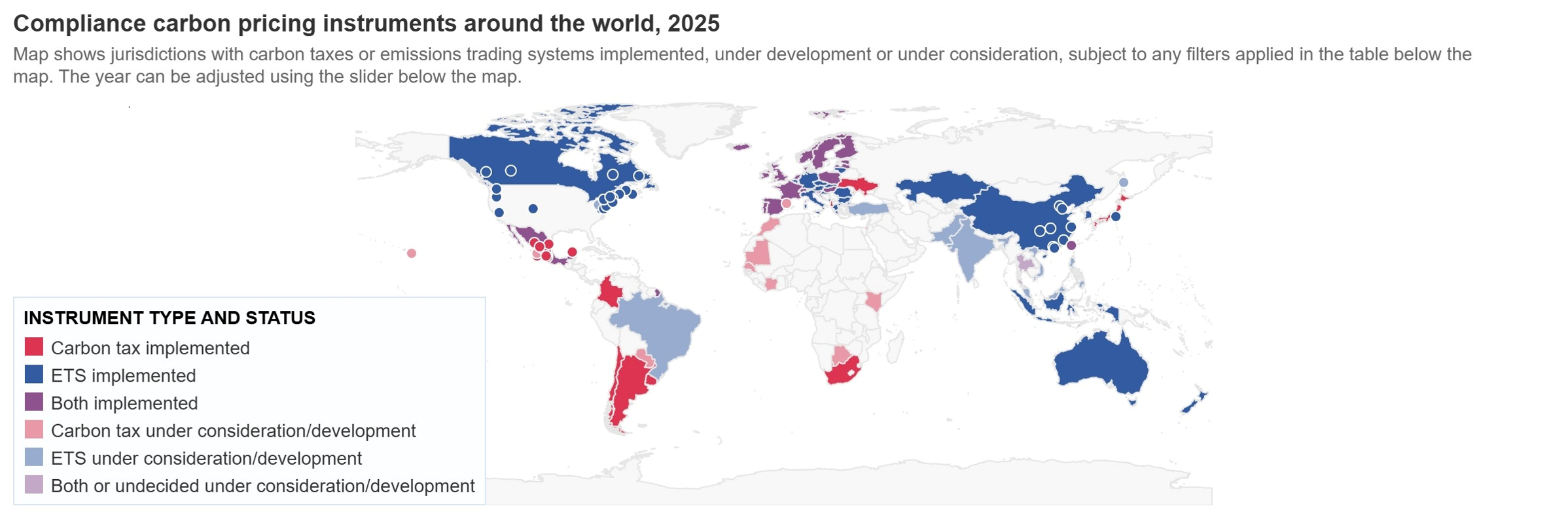
The global state of greenhouse gas emissions pricing is clearly illustrated by the interactive map of the World Bank (see Chart 2). The map displays countries according to the policy instruments used, coverage of greenhouse gas emissions, the price per tonne of CO2, government revenues from the sale of emission allowances or carbon taxes, and other relevant criteria.
Chart 2 – Carbon pricing instruments around the world
Source: https://carbonpricingdashboard.worldbank.org/compliance/instrument-detail
Currently, emissions from road transport and buildings are subject to carbon pricing in 18 countries at the national level, and in 11 cases at the subnational level. Buildings alone are priced in an additional 8 jurisdictions, while transport alone is covered in 4. The majority of these pricing schemes take the form of a carbon tax (in 25 cases), while the remaining 16 cases are implemented through emissions trading systems (ETSs). [12]
Conclusion
There are still many uncertainties surrounding the launch and operation of the ETS II system. Governments in some countries have refused to ratify the system into national legislation or are seeking to postpone or amend it[13]. Their arguments refer both to the social impacts and to what they consider unrealistic assumptions on which the system is based. If the reduction in greenhouse gas emissions from transport and building heating proceeds more slowly than the pace at which allowances are withdrawn from the market, a sharp increase in allowance prices can be expected since 2030, along with further inflationary effects.
Both the EU Emissions Trading System (EU ETS) and the Carbon Border Adjustment Mechanism (EU CBAM) aim to use market mechanisms to motivate companies inside and outside the EU to invest more in green technologies and reduce their GHG emissions. Some EU manufacturers currently receive free emission allowances to maintain their competitiveness against foreign producers. However, this does not sufficiently incentivise them to cut emissions. Starting in 2026, the number of free allowances will gradually be reduced, and carbon border taxes – which importers of energy-intensive commodities will have to pay – will help protect European industry. Even so, only part of CO2 emissions will be priced in the EU, as both the ETS and CBAM apply to only some industrial sectors at present. To make these mechanisms more effective, the EU is considering expanding the ETS in 2027 to road transport and heating of buildings (EU ETS II). It is also considering extending the scope of carbon border taxes, a move supported by some EU countries (such as France, Italy and Poland). This could be implemented in several ways:
- by extending the system to other sectors,
- by covering exports as well as imports,
- by including downstream products in imports from abroad.
The increased revenues from these measures could be used to help repay pandemic-era public debt. However, critics warn that such steps could further escalate a potential trade war with the United States (Politico, 2025). To maximise the environmental impact, it is also necessary to further simplify the CBAM, minimise the opportunities for circumvention, promote its adoption outside the EU in cooperation with other countries, and compensate developing countries for its negative effects on their competitiveness. Additionally, financial and technological support should be provided to help these countries transition to green technologies.
By Jan Hošek. The views expressed in this article are those of the author and do not necessarily reflect the official position of the Czech National Bank. Thanks to my colleagues, especially Natálie Tomanová, for valuable feedback and discussions.
Sources
Dechezlepretre, A. et al. (2025), Carbon Border Adjustments: The potential effects of the EU CBAM along the supply chain, OECD Science, Technology and Industry Working Papers, No. 2025/02, January 29, 2025, https://doi.org/10.1787/e8c3d060-en
EC (2021a): Proposal for a regulation of the European Parliament and of the Council establishing a carbon border adjustment mechanism: IMPACT ASSESSMENT REPORT, July 2021, https://eur-lex.europa.eu/resource.html?uri=cellar:be5a8c64-e558-11eb-a1a5-01aa75ed71a1.0001.02/DOC_1&format=PDF
EC (2021b): Impact Assessment Report, 14.7.2021, https://eur-lex.europa.eu/resource.html?uri=cellar:7b89687a-eec6-11eb-a71c-01aa75ed71a1.0001.01/DOC_1&format=PDF
EC (2023a): EU budget: Commission puts forward an adjusted package for the next generation of own resources, June 2023, https://ec.europa.eu/commission/presscorner/detail/en/ip_23_3328
EU (2023b): Směrnice Evropského parlamentu a Rady (EU) 2023/959, 10.5.2023, https://eur-lex.europa.eu/legal-content/CS/TXT/?uri=celex:32023L0959
EC (2025a): Carbon Border Adjustment Mechanism, March2025, https://taxation-customs.ec.europa.eu/carbon-border-adjustment-mechanism_en
EC (2025b): Commission simplifies rules on sustainability and EU investments, February 2025, https://ec.europa.eu/commission/presscorner/detail/en/ip_25_614
EWI (2021): CO2-Grenzausgleich in der EU: (Noch) kein „Level Playing Field”, October 2021, https://www.ewi.uni-koeln.de/de/aktuelles/cbam/
Fakta o klimatu (2021): Jak fungují evropské emisní povolenky?, srpen 2023, https://faktaoklimatu.cz/explainery/emisni-povolenky-ets
Fakta o klimatu (2024): Jak bude fungovat zpoplatnění emisí skleníkových plynů z dopravy a budov (tzv. ETS 2)?, 19.8.2024, https://faktaoklimatu.cz/explainery/emisni-povolenky-ets-2
GMK (2025): Losses of Ukrainian steelmakers due to CBAM, March 2025,https://gmk.center/en/news/losses-of-ukrainian-steelmakers-due-to-cbam-may-amount-to-1-6-billion-in-2030/
Keen, Michael, Parry, Ian W.H. and James Roaf (2021): Border Carbon Adjustments: Rationale, Design and Impact, IMF Working Paper, September 27, 2021, https://www.imf.org/en/Publications/WP/Issues/2021/09/24/Border-Carbon-Adjustments-Rationale-Design-and-Impact-466176
MŽP (2023): Závěrečná zpráva z hodnocení dopadů regulace, Ministerstvo životníh prostředí, 2023, https://odok.cz/portal/services/download/attachment/ALBSCYBD49Y0/
OECD (2025): What to expect from the EU Carbon Border Adjustment Mechanism?, March 2025, file:///C:/Users/U02461/Downloads/719d2ff9-en.pdf
Parry, Ian W. H. et al. (2021): Carbon Pricing: What Role for Border Carbon Adjustments?, IMF Staff Climate Notes, September 27, 2021, https://www.imf.org/en/Publications/staff-climate-notes/Issues/2021/09/24/Carbon-Pricing-What-Role-for-Border-Carbon-Adjustments-464805
Politico (2025): Big EU countries push expanded carbon border tax to help repay Covid debt, February 2025, https://www.politico.eu/article/big-eu-countries-push-expanded-carbon-border-tax-to-help-repay-covid-debt/
WB (2025): State and Trends of Carbon Pricing Dashboard, World Bank, https://carbonpricingdashboard.worldbank.org/compliance/instrument-detail
Keywords
carbon border tax, carbon tax, CBAM, ETS, ETS 2
JEL Classification
Q02, Q58, F18
[1] Imports from all WTO member countries must be subject to the same rules, and domestic products must not be given preferential treatment over imported goods. This condition is met, as the price of imported carbon equals the price paid by European producers under the EU ETS. Moreover, the WTO allows trade restrictions in the interests of environmental protection. CBAM is thus justified as an environmental – rather than a protectionist – measure.
[2] One allowance (European Emission Allowance) entitles the holder to emit one tonne of CO2 or an equivalent amount of N2O or perfluorocarbons (PFCs). Each year, the EU issues a fixed number of these allowances, with the total volume — known as the emissions cap — gradually decreasing over time. Companies participating in the system acquire allowances either through auctions (and can subsequently trade them on the market), from other companies, or they receive a certain portion of them for free. Free allocation applies in cases where companies might lose competitiveness due to increased costs from allowances, particularly compared to producers in third countries where emissions are taxed less — or not at all — or where there is a risk of production being relocated abroad (the so-called carbon leakage). However, from 2026 (with a gradual phase-in starting in 2023), the Carbon Border Adjustment Mechanism (CBAM) will come into effect. This mechanism will impose a levy on the import of carbon-intensive products into the EU, thereby creating a level playing field for domestic producers. As a result, the allocation of free allowances will be gradually reduced and will be completely phased out by 2034.
[3] This price ceiling is set in 2020 prices and is intended to be regularly indexed to EU HICP inflation. It is scheduled to be abolished since 2030.
[4] According to the impact assessment of the European Commission (EC, 2021), ETS II is expected to cover approximately 7,000 tax warehouses for oil, 1,400 regional and local gas suppliers, and 3,000 coal suppliers.
[5] The launch of the ETS II system will be postponed to the beginning of 2028 if the average TTF gas price in the first half of 2026 exceeds the average price recorded in February and March 2022 (approximately €107 per MWh), or if the average Brent crude oil price in the first half of 2026 is higher than twice its average price over the 2021–2025 period (approximately $160 per barrel).
[6] Importers are required to report the actual emissions embedded in their imports. The producer supplies data on the technology used and the unit emissions generated in the production process. Emissions are calculated according to standard EU methods, such as those applied under the EU ETS.
[7] A package of legislative proposals tabled by the European Commission in July 2021. Its main objective is to reduce GHG emissions in the EU by 55% by 2030 compared to 1990 levels.
[8] In its impact assessment (EC, 2021), the European Commission estimates that revenues from CBAM could reach approximately EUR 1.5 billion annually by 2028 and EUR 2.1 billion by 2030. Most other estimates fall within the range of EUR 1.5 billion to EUR 3.1 billion per year. OECD (2025) is alone in suggesting that CBAM could generate as much as EUR 14.7 billion yearly, assuming an emissions allowance price of EUR 80 per tonne of CO2 equivalent and unchanged trade flows. Unlike revenues from the EU ETS – the majority of which accrue to individual EU Member States – 75% of CBAM revenues will go to the common EU budget and may be used, for example, to finance climate policies, the European Green Deal or the Just Transition Fund.
[9] For example, a CBAM is already in operation in California, where it applies to a portion of imported electricity. Following the EU, the UK also intends to introduce a carbon border tax by 2027, with a scope similar to that of the EU. Australia’s federal government has recently expressed support for the possible introduction of carbon border taxes. Canada and Japan are planning similar initiatives.
[10] For example, the German EWI institute (EWI, 2021) points to the insufficient consideration of indirect emissions.
[11] CBAM only recognises direct carbon pricing tools such as carbon taxes and emissions trading systems (ETS). This means it does not take into account indirect measures such as fuel excise duties or regulatory interventions, which may have a comparable effect in reducing emissions. This approach may be perceived as discriminatory towards countries that employ different – but effective – climate policy tools.
[12] The use of revenues from carbon pricing differs significantly between countries. For example, in Austria, the government introduced a discounted nationwide public transport ticket in 2021, and since 2023 has been returning part of the collected revenues to households through the so-called climate bonus (Klimabonus). In some Canadian provinces, a portion of the revenues raised through the carbon tax is also redistributed back to households. In Switzerland, two-thirds of the proceeds from the carbon tax are used to provide discounts on health insurance premiums, while the remaining one-third is allocated to reducing the energy intensity of buildings.
[13] According to a briefing by the European Parliamentary Research Service (EPRS), 17 EU Member States have not yet implemented the inclusion of households in national emissions trading legislation, despite the deadline having passed in mid-2024. Poland, Slovakia, Estonia, and the Czech Republic have called for at least one-year postponement of the introduction of ETS II, citing concerns about the impact on consumers.