MONETARY POLICY REPORT | SPRING 2026 (box 2)
(author: Matěj Šarboch)
The Middle East conflict has pushed the price of oil above USD 100 a barrel and raised the prices of other energy products. This box analyses the sensitivity of the Czech economy to energy shocks and maps their pass-through to consumer prices using symmetric input-output tables.[1]
Higher energy prices feed into firms’ costs both directly and indirectly.[2] A surge in oil and natural gas prices thus causes prices of virtually all products to increase. Such a shock most strongly affects energy products, in particular fuel, electricity and gas, followed by, for example, food products and transport. The estimated impact on consumer prices is obtained by multiplying the overall energy intensity of products by their shares in final household consumption (see Chart 1).
Chart 1 – The sensitivity of consumer prices to energy shocks has been on a downward trend (except in 2022)
hypothetical change in (basic) prices of consumer goods following a 100% rise in oil and natural gas prices assuming no taxes or administrative measures and full cost pass-through, in %; contributions of selected products according to CZ-CPA in pp
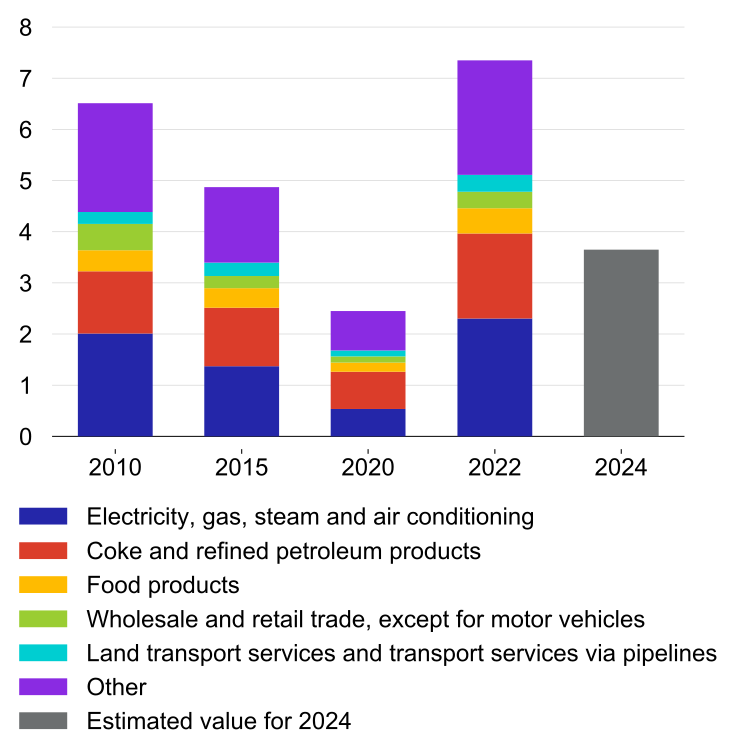
The sensitivity of the economy to oil and gas prices has mostly decreased since 2010, largely as a result of these prices falling relative to other costs. Declining oil and gas intensity (physical consumption per CZK 1 of output) has also played a role. As a result, oil and gas prices have made up less and less of total production costs and their share in the overall price of consumer goods has shrunk. The exception was 2022, when the Czech economy was hit by the energy crisis following Russia’s invasion of Ukraine, which caused the shares of oil and gas in total costs and consumption to go up. Prices later normalised again. According to an estimate for 2024, a 100% shock to oil and natural gas prices would result in a 3.6% increase in consumer prices, assuming full cost pass-through.[3]
However, this estimate is a mechanical calculation and does not represent the actual impact on consumer price inflation. First, it relies on a static model, which assumes the shock to be permanent and to have a cumulative ultimate effect. Prices respond gradually along supply chains, so the effect is spread over a longer period. Moreover, prices typically undergo a correction after a time, a factor taken into account in the energy price outlook in the current spring forecast. Second, the weights in the consumer basket used by the CZSO to calculate inflation differ from the shares in consumption in the national accounts. Third, firms in reality attempt to substitute more expensive products with cheaper alternatives or to reduce their intermediate consumption, which dampens growth in costs. At higher prices, consumers also reduce their overall demand and firms absorb part of the growth in costs by lowering their margins. In addition, the analysis abstracts from the effects of indirect taxes (VAT and excise duties) and other administrative measures that can mitigate the impact of higher energy prices. Nor does it consider the possible response of the central bank in the form of monetary tightening. Such a reaction would help reduce firms’ margins and would also foster a stronger koruna, which lowers import prices.
The results of the input-output analysis are broadly consistent with the elasticity of the g3+ model. A simulation using the CNB’s core forecasting model shows that a 100% increase in energy prices causes inflation to go up by 2.5–7 pp, depending on the central bank’s response.[4]
The analysis shows that, despite fluctuating, the sensitivity of the Czech economy to energy shocks is gradually decreasing. A rise in oil and gas prices thus has less impact on inflation and economic activity today than it did in past decades.
[1] Input-output tables describe the selling and purchasing relationships between producers and their customers (at current prices). They can display flows of final goods, intermediate products and services defined according to either sector outputs (sector × sector) or product outputs (product × product). The latter are used in this analysis. The CZSO has published symmetric input-output tables at least once every five years since 1990. However, owing to the rapidly changing structure of the economy in recent years, it has also issued them for 2013, 2018 and (most recently) 2022.
[2] Firms buy energy (electricity, gas, oil and fuel) directly for operating machinery, lighting, heating and so on, and indirectly via supplies from other sectors. The impact of a price increase for one product on another product (both direct and indirect) can be calculated from symmetric input-output tables using the Leontief input-output model. This is the approach applied in this analysis.
[3] The figure for 2024 in Chart 1 is an estimate of the total impact. It is calculated from the direct share of intermediate oil and natural gas consumption in total output, which is also available for 2024 (0.9%). As this direct effect consistently accounts for roughly 25% of the total impact on the change in consumer goods prices (in years for which symmetric tables are available), the overall impact for 2024 can also be estimated in this way.
[4] The elasticity in the CNB’s forecasting system is slightly higher than in the input-output tables, due mainly to different energy shock definitions. The input-output analysis assumes an increase in oil and gas prices only, while the CNB forecast assumes a rise in prices of all energy products.