MONETARY POLICY REPORT | WINTER 2026 (box 1)
(authors: Jan Botka, Matěj Šarboch, Radek Šnobl)
Industry has always held a key position in the Czech economy. It had been driving GDP growth since the turn of the millennium, but the strongest impulse came after the Czech Republic joined the European Union in 2004 (see Chart 1). At that time, the share of industry in the domestic economy (at chain-linked prices of 2020) began to rise markedly, peaking at almost 30% in 2011 and remaining high until 2017. Since then, however, this sector has been on the wane and economic growth has been fuelled increasingly by services, whose share has grown at the expense of industry.
Chart 1 – Industry was the driver of economic growth after EU accession, while services have taken the lead in the past decade
y-o-y percentage changes in %; contributions in percentage points; prices of 2020 (chain-linked); seasonally adjusted
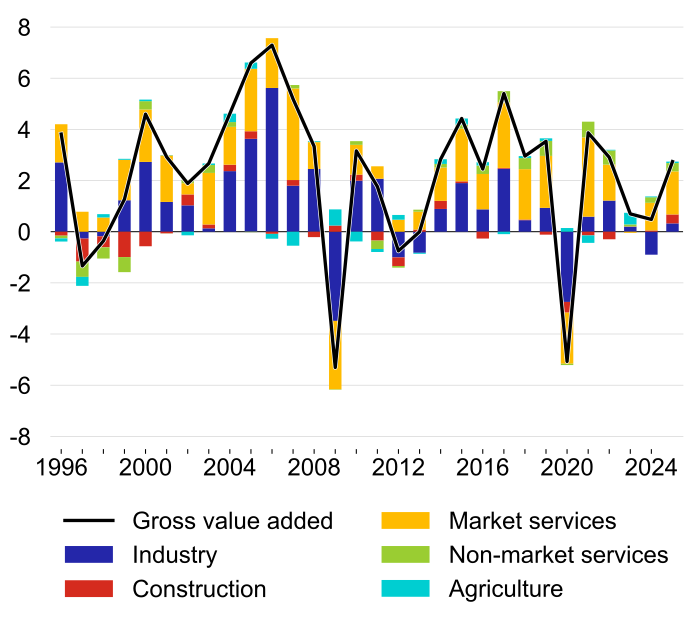
Note: The data for 2025 are calculated as average year-on-year GVA growth in the first three quarters of last year.
The Covid pandemic had an adverse effect on all sectors. However, in the years that have followed, industry has failed to get back fully to its previous growth levels and it continues to stagnate. By contrast, services (market services in particular) returned to the boom they saw in 2014–2019 almost immediately after the biggest Covid shock had subsided. The energy shock of 2022 and 2023 slowed the entire economy, but, unlike many industrial sectors, services again rebounded with no major problems. According to available data, services contributed 2 pp to economic growth in 2025, while industry added just 0.3 pp.
A more detailed sectoral breakdown shows that almost all industrial sectors performed poorly (see Chart 2). This was due largely to the energy crisis, as industry is more energy-intensive than services. In the period under review, value added fell by roughly 5% in industry while rising by 7% in market and non-market services. However, the situation was far from homogeneous; some industrial sectors also fared relatively well (e.g. mining of metal ores and manufacture of basic pharmaceutical products and pharmaceutical preparations).
Chart 2 – Industrial sectors have underperformed the rest of the economy since 2019
change in gross value added in individual sectors between 2019 and 2024 in %; prices of 2020 (chain-linked)
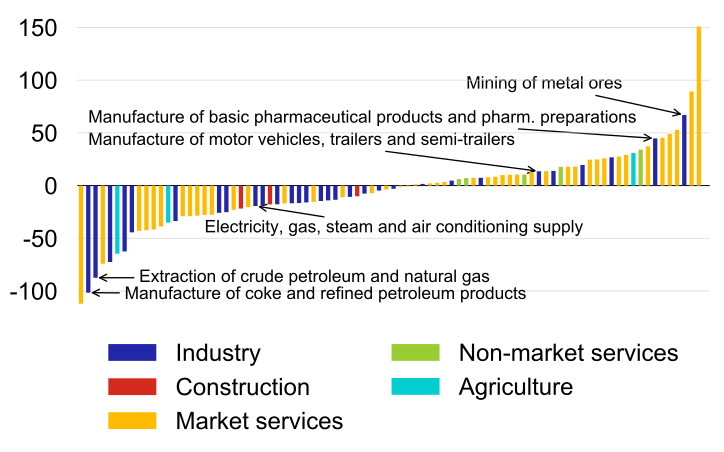
Note: When converting gross value added (the difference between production and intermediate consumption) into prices of 2020 (chain-linked), the value of production and intermediate consumption is adjusted for price developments using separate deflators. Production in constant prices can thus be lower than intermediate consumption, which explains the more than 100% decline in real gross value added in some sectors.
These industries also include the automotive sector – the Czech Republic’s flagship industry. It was significantly hampered by supply chain disruptions, but in the following years it made up for all its previous delivery shortfalls. It made a record number of cars (almost 1.5 million) in 2024 and only 0.5% less last year. Another positive is that domestic car makers have successfully switched to producing electric vehicles. Electric vehicles accounted for around 10% of the total in 2024, while last year the figure was close to 20%.
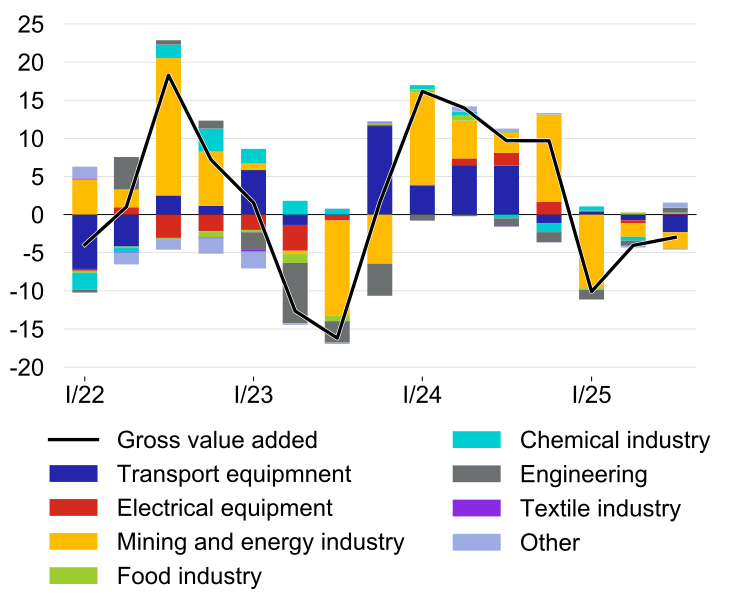
Firm-level data from report P 6-04 (available in Czech only), which contains information on more than 2,000 of the largest non-financial corporations in the Czech Republic (measured by asset size), offers a similar picture to the national accounts. However, this report may not necessarily correspond to the national accounts statistics, as it by no means covers all firms in the domestic economy. Although the indicators showed greater volatility after the Covid pandemic, a marked drop is apparent for most financial indicators of industrial companies last year (see Chart 3). Value added fell year on year across almost all sectors (see Chart 4). The largest negative contribution came from the energy industry, which had strongly supported growth in 2024. Despite record-high production, the automotive industry – which also expanded significantly for most of 2024 – did not make a positive contribution to growth last year either. A specific group consists of firms that supply at least part of their output to the defence industry. Their share in the gross value added of large non-financial corporations in the Czech Republic almost doubled in 2024 compared with the period before the outbreak of war in Ukraine.
Chart 3 – Financial indicators of industrial firms have not been very optimistic so far
y-o-y changes in %; current prices; seasonally adjusted; source: CZSO, report P 6-04
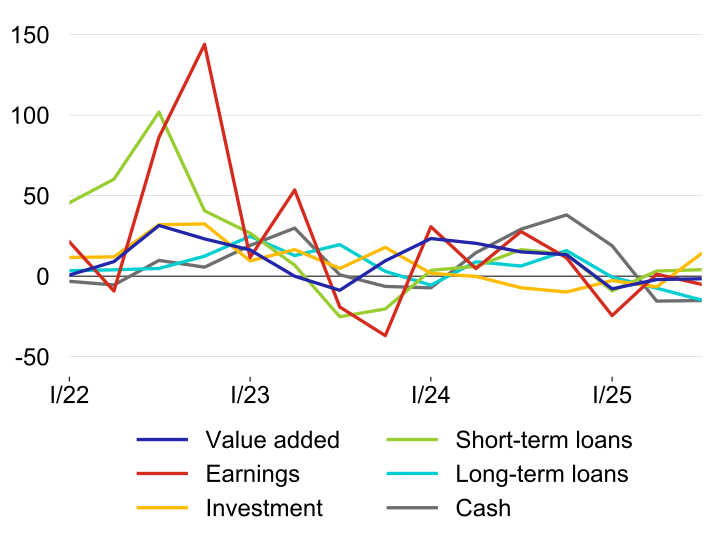
Chart 4 – Value added in industry declined last year
y-o-y changes in %; contributions in pp; adjusted using industry GVA deflator; seasonally adjusted; source: CZSO, report P 6-04
In addition to value added, other financial indicators (earnings, cash and long-term loans) have shown a downward trend in recent quarters. Only short-term loans increased last year. Investment also revived in 2025 Q3 after having declined for a year.
All this is reflected in the labour market, where employment in industry has been declining since 2019, while employee numbers in services have risen. Most of the time, these effects have acted in opposite directions, so total unemployment has not risen substantially. Last year, however, the share of unemployed persons increased relatively rapidly, reaching its highest level since 2017 (the seasonally adjusted share of unemployed persons stood at 4.7% in December).
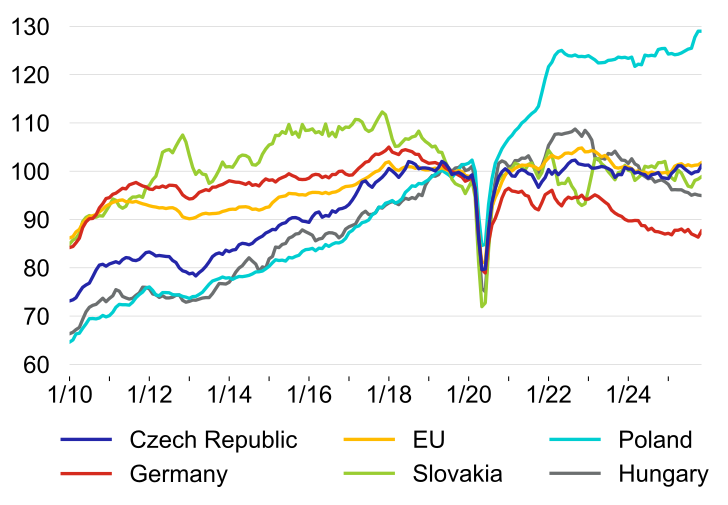
The situation in Czech industry is not unique. Industry is not performing very well in the rest of Europe either (see Chart 5). It is faring the worst in Germany, whose output in 2025 was more than 10% lower than in 2019. Like in the Czech Republic, industrial production in the EU has been stagnating on average in recent years. Industry in other Central European countries is performing comparably to, or rather worse than that in the Czech Republic. The only exception is Poland. Its industrial output continued to grow strongly after 2020 – even faster than before the pandemic. In 2022, however, it too slipped into stagnation. The Czech situation is therefore no outlier, and the performance of Czech industry depends on developments in its main trading partners, especially Germany.
Chart 5 – With the exception of Poland, industry in Central Europe is not performing well
industrial output; index: 2019 = 100, constant prices; seasonally adjusted; 3M moving averages; source: Eurostat
The European economy is slowly gaining momentum and the outlook for this year is generally positive. The latest available data for November 2025 show that growth in industrial production in Germany far exceeded market expectations. The forecast contained in the Winter 2026 MPR expects foreign economies to see an upswing in growth again this year, with Germany leading the way (German growth will accelerate from 0.3% in 2025 to 0.9% in 2026). This should further support export-oriented industrial firms in particular. The latest available data on domestic industry are also positive. Industrial production increased by 5.7% year on year in November, the fastest rate since September 2022. The PMI also reached its highest level since 2022 in December and is back in the expansion band (50.4). Growth in new orders remained subdued, but orders from abroad increased.
The assumptions of the current Winter 2026 MPR forecast imply a gradual recovery of industry. Even so, a continued gradual decline in its share in value added can be expected. The structure of the economy will continue to shift towards services, as in most advanced economies.