MONETARY POLICY REPORT | SPRING 2026 (box 1)
(authors: Tomáš Pokorný, Petr Polák)
European economies are now in a period of slower growth than that observed historically. However, this is a result not only of a cyclical slowdown, but also of deeper structural changes. While a reduction in the steady-state growth rate (long-term potential) of the domestic economy was incorporated into the g3+ model previously,[1] we now present an analogous revision for the external environment. The first part of this box describes the reasons for lowering the steady-state growth rate of our main trading partner countries in the euro area in response to their mounting structural problems; the second part shows how this revision feeds through to the steady-state growth rates of domestic exports and imports.
Steady-state growth rate of foreign economies
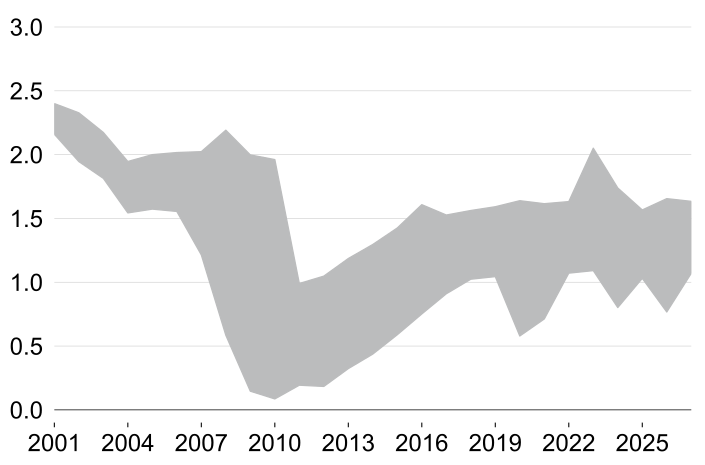
For many years, advanced euro area economies have faced a combination of structural factors (especially in the labour market) that are gradually passing through to the economy and reducing its long-term production capacity. In recent years, this has been exacerbated by several crises (the pandemic, the energy crisis, tariff wars and geopolitical tensions). The lower growth reflects a combination of several trends, including adverse demographics (ageing populations and large cohorts retiring), growing competition in global markets – particularly from China – and changes in global trade. Geopolitical risks linked to Europe’s dependence on oil and gas supplies are another factor. The transition to a low-carbon economy meanwhile entails additional costs in the short and medium term, which may make European firms less competitive in the global market. Advanced euro area countries have long benefited from migration,[2] which has supported growth in the labour force and potential output. In recent years, however, the shortage of skilled workers has intensified and the structure of migration flows has been changing. These structural trends and persistently low growth in potential output (see Chart 1) are described in many studies on the euro area and Germany in particular.[3]
Chart 1 – Euro area potential growth has been fairly stable in recent years
year on year in %; range of estimates based on historical data from European Commission, OECD and IMF
In this context, the current long-term steady-state growth rate in the CNB’s forecasting framework appears overly optimistic and needs to be revised. The estimate is based on a combination of several sources and approaches. The starting point is the World Bank model previously used in a revision of the long-term growth rate of the Czech economy.[4] This approach was supplemented by an analysis of outputs from other international institutions (ECB, OECD, IMF, ifo, Oxford Economics, Bloomberg, NIESR, World Bank and Consensus Economics), as well as by internal information and estimates from partner central banks. We placed emphasis on the historical performance of each economy and, above all, on the outlook for structural factors affecting its future growth.
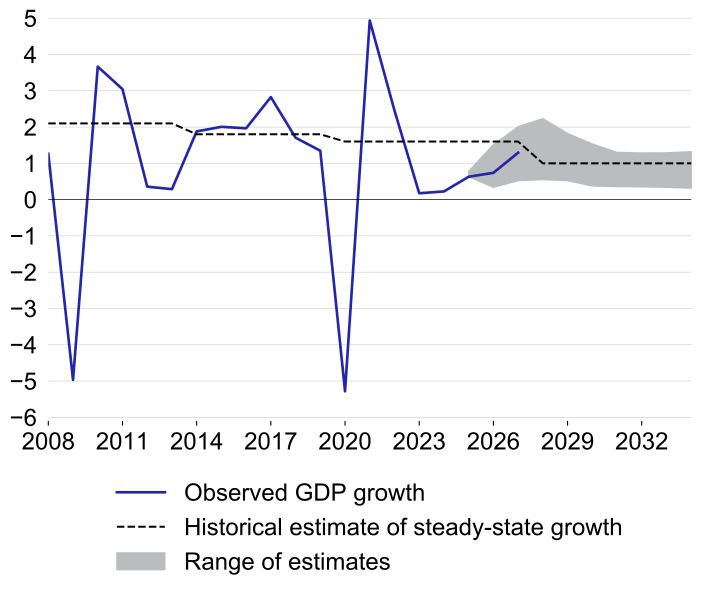
Based on these findings, the weighted steady-state year-on-year growth rate of the Czech Republic’s main euro area trading partners[5] is lowered from 1.6% to 1.0% starting with the current forecast in the Spring 2026 MPR (see Chart 2). This is due mainly to a reduction in the long-term growth rate for Germany (0.7%), whose economy shows the biggest structural difficulties. Its traditional model of an export-oriented industrial country has been significantly undermined by falling competitiveness amid high energy prices[6] and efforts to reduce emissions, as well as by population ageing.[7] From a historical perspective, this represents a continuation of the gradual downward trend in the estimated steady-state growth rate of the external environment from 2.1% year on year in 2008, when the g3/g3+ model framework was introduced at the CNB, to 1% now. The steady-state foreign growth rate was last revised in 2019; the current adjustment reflects new information and structural changes, which have intensified since then.
Chart 2 – Observed GDP growth and long-term steady-state levels set for main trading partners
year on year in %
Steady-state growth rates of domestic exports and imports
In connection with the revision of the long-term growth rate of foreign economies, the steady-state growth rate of external demand has also been adjusted. In the g3+ model, it directly determines the steady-state growth rates of domestic exports and imports. The reduction in estimated long-term growth in the effective euro area therefore feeds through to the domestic environment.
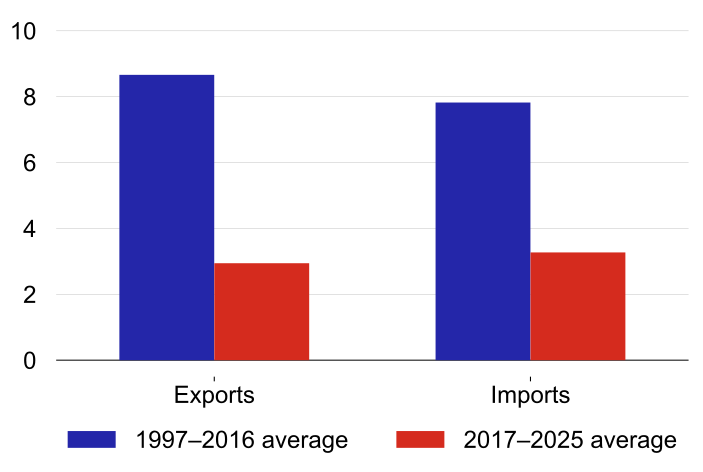
However, the data analysis indicates that it would not be appropriate to revise the domestic steady-state rates proportionately to the foreign ones. The average growth rates of exports and imports both declined to 3% in 2017–2025 compared to 1997–2016 (see Chart 3). The ratio of export growth to growth in the economies of the Czech Republic’s main trading partners suggests that domestic exports have been rising faster over the long term than implied by foreign GDP growth alone. While the average value of this ratio in 2017–2025 is lower than in previous decades, it remains well above 3. This is partly because domestic firms have succeeded in increasing their market shares in the Czech Republic’s traditional markets, while also redirecting part of their export flows towards faster-growing economies.[8] At the same time, the average export and import growth rates have recently remained broadly comparable. This supports keeping the two variables symmetrically configured.
Chart 3 – Exports and imports from a historical perspective
y-o-y changes in %
The steady-state growth rates of domestic exports and imports are both reduced from 4.8% to 3.5%. This reflects the worse long-term outlook for the economies of the Czech Republic’s traditional trading partners, while taking into account the continued ability of the Czech export sector to grow faster and adapt to changes in the market environment. The new settings thus represent a balanced compromise between the mechanical implication of the foreign revision and the data-supported resilience of Czech foreign trade.
[1] See the appendix The slowdown in the long-term potential growth of the Czech economy in the Summer 2024 MPR.
[2] For example Foreign workers: A lever for economic growth, Oscar Arce, Agostino Consolo, António Dias da Silva and Marco Weissler, ECB Blog, May 2025, and Migration into the EU: Stocktaking of recent developments and macroeconomic implications, Francesca Caselli, Huidan Lin, Frederik Toscani and Jiaxiong Yao, IMF Working Paper WP/24/211.
[3] For example Potential output in the post-crisis period, Malin Andersson, Bela Szörfi, Máté Tóth and Nico Zorell, ECB Economic Bulletin, Issue 7/2018, and Joint Economic Forecast Spring 2026: Energy price shock overshadows fiscal stimulus – Growth drivers dry up, ifo Institute, April 2026.
[4] See the cnBlog article Od produktivity ke kapitálu: rovnovážný růst české ekonomiky setrvá okolo 2,5 % i v nejbližších letech (From productivity to capital: The steady-state growth rate of the Czech economy will stay around 2.5% for the next few years – in Czech only), cnBlog, November 2025.
[5] Germany, Slovakia, France, Italy, Spain and Austria. As the largest euro area economies are part of this aggregate, developments in the effective euro area are similar to those in the euro area proper.
[6] See Impact of high energy prices on Germany’s potential output, Yushu Chen, Ting Lan, Aiko Mineshima and Jing Zhou, IMF Selected Issues Paper No. 2023/059.
[7] See Addressing skilled labour shortages in OECD Economic Surveys: Germany 2025.
[8] See the boxes Czech exports holding course amid a storm of uncertainty, Spring 2025 MPR, and Territorial changes in Czech exports, Winter 2025 MPR.