MONETARY POLICY REPORT | AUTUMN 2025 (box)
(author: Zdeněk Pikhart)
Following its market transformation in the early 1990s, the Czech economy integrated flexibly into the globalised structure of the world economy. This process was further accelerated by the country’s accession to the European Union in 2004. The openness of the economy – enabling deeper international division of labour – together with strong inflows of foreign capital, contributed significantly to the process of catch-up with advanced economies and to growth in living standards. The Czech economy’s trade integration with other countries is an important factor for macroeconomic analyses and forecasts, including the calibration of forecasting models. This box focuses on the import intensity[1] of the main expenditure components of GDP that have implications for the openness of the Czech economy based on value added.
The most commonly used measure of the openness of an economy is the ratio of exports – or imports – of goods and services to nominal GDP. Its advantage is that it is easy to calculate and captures the trade links between the domestic economy and other countries. However, this approach does not answer the question of how much of the exports are produced in the domestic economy and how much comes from abroad. It is clear that an economy with a high share of domestic production in exports will be more sensitive to external economic shocks than in the case where a larger proportion of exports comes from foreign production. In the first case, other things being equal, a decline in external demand would lead to a drop in GDP. In the second case, the decline in exports would be offset by a reduction in imports. The impact on GDP would thus be smaller, or even zero in the extreme case of 100% import intensity of exports. Economies with identical exports-to-GDP ratios may therefore exhibit different responses to domestic and external economic shocks.
This box thus presents an estimate of the import intensity of the main expenditure components of GDP from the Czech Statistical Office’s symmetric input-output tables,[2] based on which the share of exported value added is calculated. Due to the long publication cycle, data are only available up to 2022. Import intensity is broken down into direct and indirect components. Direct imports refer to the value of goods and services purchased directly from abroad or imported and sold on without significant domestic processing. Examples include imported food, clothing and electronics. Indirect imports represent the value of imported inputs (raw materials, semi-finished goods, energy, services) used by domestic producers to produce goods and services, such as bread produced domestically using imported wheat.
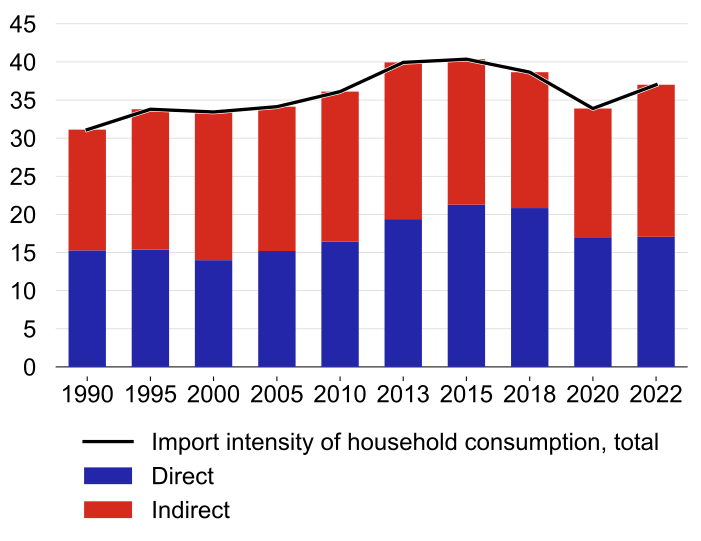
Chart 1 compares the total import intensity of the main expenditure aggregates of GDP. The import intensity of household final consumption expenditure rose gradually from 1990 to a peak of almost 40% in 2013–2015. The share of direct imports in total household consumption (see Chart 2) increased mainly for food and beverages, agricultural commodities and motor vehicles. The share of these items then declined between 2015 and 2022. After the pandemic, the overall import intensity of household consumption rose slightly again to 37% in 2022, but it no longer matched the levels observed in 2013–2015. This was due to an increase in the share of less import-intensive services in total household consumption (by almost 2 pp compared to 2015) and a decline in the shares of both durable and non-durable goods.
Chart 1 – Goods and services exports are the most import-intensive, while general government consumption is the least import-intensive
share of imports in the main expenditure components of GDP in %; source: CZSO
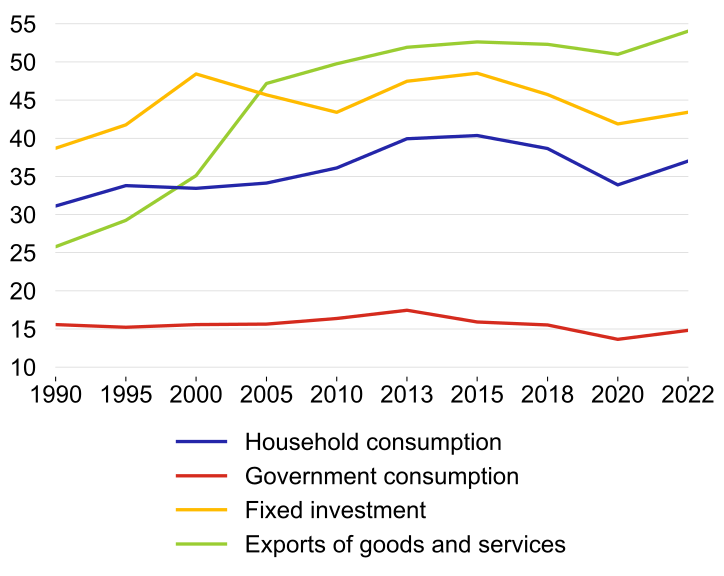
Chart 2 – The import intensity of household consumption is slightly below the pre-Covid levels
share of imports in %; source: CZSO
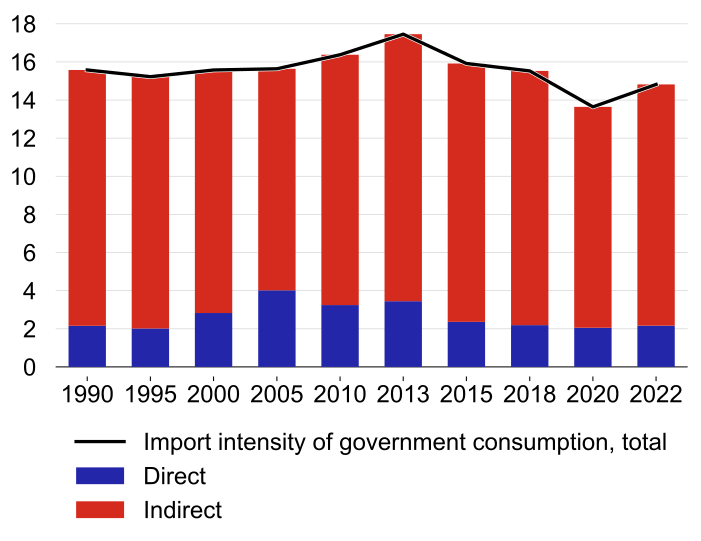
General government final consumption expenditure has long exhibited the lowest import intensity. It stood at almost 15% in 2022, with indirect imports predominating (see Chart 3). The low share of imports (relative to the other components of GDP) is largely due to the nature of this aggregate, which is the expenditure counterpart of non-market production, which, in turn, is valued using the compensation of general government employees, among other things.
Chart 3 – The import intensity of general government consumption has long been the lowest expenditure component of GDP
share of imports in %; source: CZSO
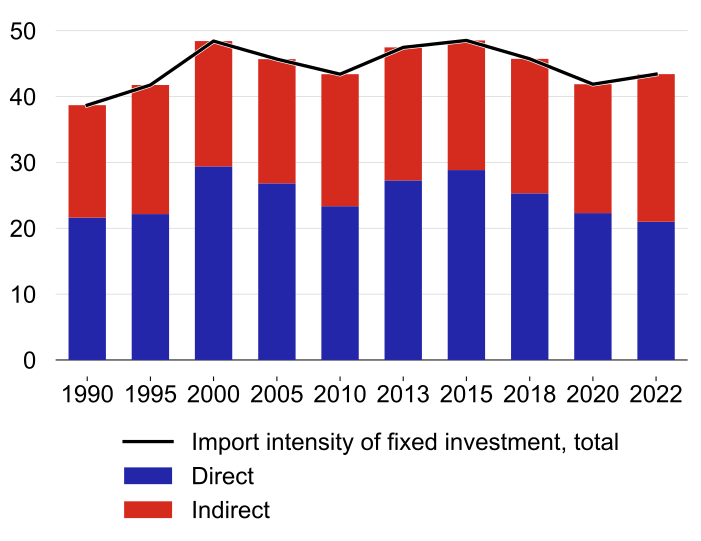
The import intensity of gross fixed capital formation has long been relatively high at more than 40%, split roughly 50/50 between its direct and indirect components (see Chart 4). However, in 2022 it was around 5 pp lower than in 2015. The reason may be an increase of 6.1 pp in the share of dwellings in total fixed investment in this period and a rise in the share of intellectual property of almost 5 pp coupled with a fall in the share of investment in machinery and equipment of just under 7 pp.
Chart 4 – The import intensity of fixed investment stayed above 40% after 1990
share of imports in %; source: CZSO
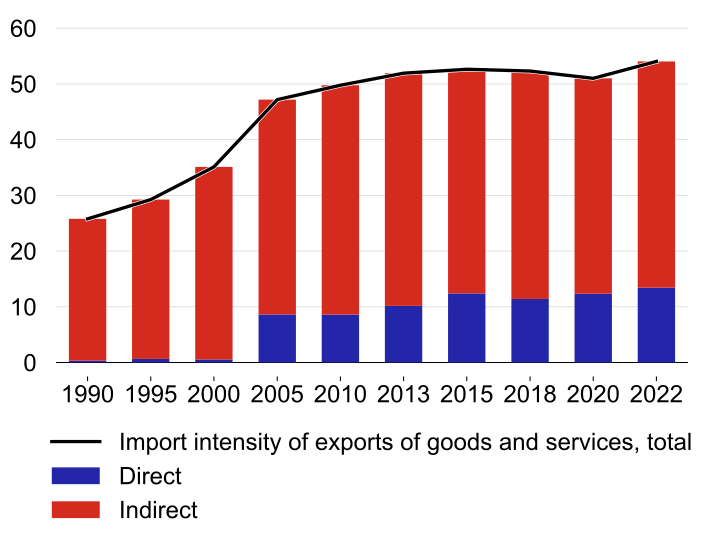
Exports of goods and services were the only expenditure aggregate whose import intensity did not see a major decline in the pandemic year 2020. In 2022, it increased further to a record 54%, with indirect imports predominating (see Chart 5). This was because the share of exports of import-intensive machinery and equipment, including motor vehicles, in total goods exports increased by around 4 pp compared to 2015. This testifies to the continuing integration of the Czech economy into global production chains. While an increase in exports of 1% of GDP would have added 0.74 pp to GDP growth in 1990, it would have been only 0.46 pp in 2022.
Chart 5 – The import intensity of exports of goods and services reached an all-time high in 2022
share of imports in %; source: CZSO
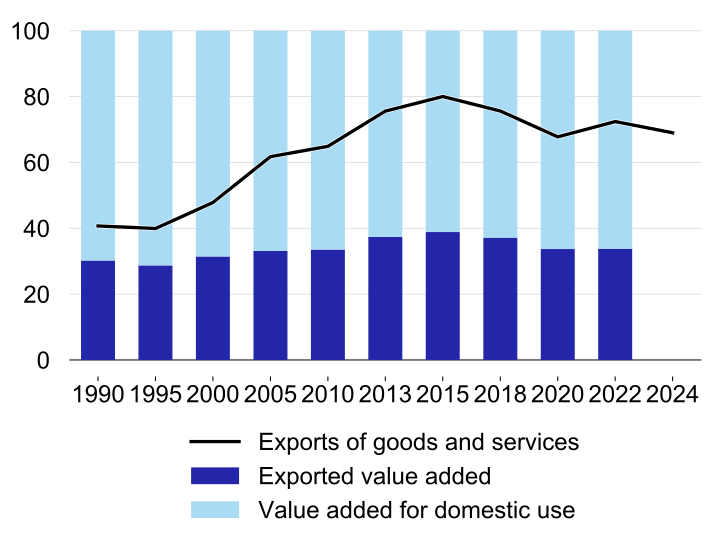
The openness of the economy as measured by the ratio of exports of goods and services to GDP doubled to 80% between 1990 and 2015 due to the integration of domestic companies into globalised trade (see Chart 6). Since then, the exports-to-GDP ratio has fallen to 69% in 2024 due to supply chain disruptions and deglobalisation trends around the world. By contrast, the share of exported value added reached almost 34% of GDP in 2022 owing to a high import intensity of exports. This means that two-thirds of domestic value added was used in the domestic economy. These shares remained relatively stable over the long term, as the twofold increase in the ratio of exports to GDP between 1990 and 2015 was accompanied by a similar rise in the import intensity of exports. From this perspective, the Czech economy is therefore as vulnerable to external demand shocks as it was in 1990.
Chart 6 – The openness of the economy in terms of exported value added is broadly stable over time
% of GDP; source: CZSO
The conclusions presented here are relevant not only for macroeconomic analyses, but also for the central bank’s monetary policy. They point to the sensitivity of the domestic economy to domestic and external factors, whether in terms of changes in external demand or import prices. These parameters are taken into account both in the existing g3+ core forecasting model and in newly developed semi-structural macroeconomic models.
[1] Import intensity indicates the percentage share of imports in a given expenditure component of GDP.
[2] The outputs from symmetrical product-product and industry-industry input-output tables are then averaged.