MONETARY POLICY REPORT | SPRING 2026 (box 3)
(author: Eva Hromádková)
Given the dominant role of mortgages in the Czech credit market, an important part of monetary policy transmission takes place via the effect of interest rates on the volume of genuinely new loans for house purchase. Over the past five years, however, amid pronounced changes in the CNB’s policy rates, another transmission channel has gained in importance – the impact of interest rates on instalments on existing loans, which are gradually being refinanced. For the purposes of this box, refinancing means both a change in the interest rate at the original bank (refixing) and the refinancing of a loan at a different bank than the original one.
This was discussed in a box in the Summer 2023 MPR, which was subsequently updated in a blog article.[1] Both analyses drew attention to the period of 2025–2028, during which a large volume of loans granted in 2020–2022 at exceptionally low interest rates with fixed-rate periods of five to ten years are to be refinanced. Meanwhile, record volumes of new loans were provided in 2024 and 2025. Owing to their short fixed terms (up to three years), these loans will also be refinanced over the same period. This box assesses the expected volume of this refinancing and its impact on the structure of household expenditure.
The main data source used in this analysis is the Survey of new loans secured by residential property (the “Survey”), which includes information on all new bank loan agreements leading to a change in the volume of loans in the economy, i.e. new loans including loan increases and loans refinanced with different institutions.[2] These individual data are complemented by “other new mortgage agreements”, i.e. loans for which the rate was refixed with the original bank without any increase in loan size (see Chart 1).[3] Other new mortgage agreements have long accounted for around 30% of all new loans. At present, their share stands at around 46%, despite still high volumes of genuinely new loans. This reflects the gradual start of a wave of refixing and refinancing of loans granted in 2020–2022.
Chart 1 – The volume of total new mortgage agreements in 2025 exceeded the 2021 level, largely due to a high share of loans refixed with the original banks
total volume of new mortgage agreements in CZK billions
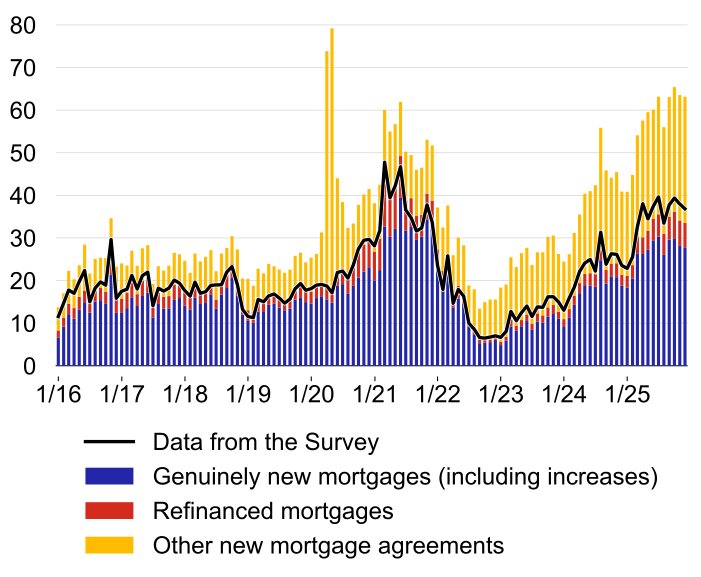
Note: In 2020, the moratorium – involving agreements to suspend instalments temporarily – was reflected in the volume of other new mortgage agreements.
This wave will be boosted over the next two years by the refinancing of loans provided in the past two years. According to data from the Survey, five years has long been the most popular fixed-rate period. It was agreed for 50% of mortgages granted in 2016–2023 (see Chart 2). Following a sharp rise in client interest rates in 2022, the average fixed-rate period began to fall, with clients not wanting to commit to high rates for a long time. Despite a marked decline in monetary policy rates over the past two years, the transmission to longer-term IRS rates and in turn to client rates on loans with longer fixed terms was significantly weaker. As a result, 94% of newly agreed loans had fixed-rate periods of three years or less in 2025.
Chart 2 – In the past two years, clients have shifted towards significantly shorter fixed-rate periods, with three years being the most frequent
share of new loans by fixed-rate period; in %
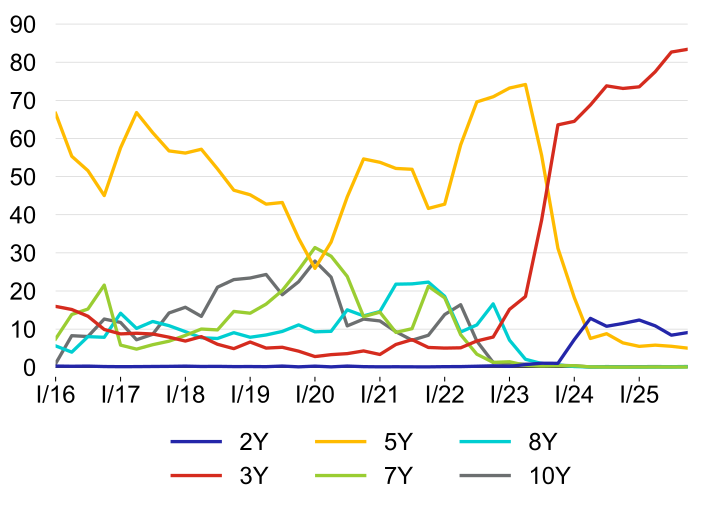
Note: The chart shows the six fixed-rate periods with the largest mortgage volumes. The rest of the fixed-rate periods currently account for 2% of all mortgage agreements.
Chart 3 shows the expected timing of future refinancing by year of origination. In 2026, fixed-rate periods will end mainly for loans granted in 2021, with total outstanding principal of around CZK 470 billion and an average current interest rate of 3.2% (see Chart 4). However, the largest volume of refinancing is expected in the following two years – around CZK 530 billion in 2027 and at least CZK 600 billion in 2028. The average current interest rate on these loans is 4.3%. The impact on monthly instalments will therefore depend largely on assumptions about the future path of interest rates. For the current quantification, the predicted client rate on refinanced mortgages is tied to the outlook for the three-year IRS rate, which is currently the most frequent reference rate for mortgage fixed-rate periods. This outlook is consistent with the CNB’s current forecast, which for this year implies an increase in short-term market interest rates in Q2.
Chart 3 – The volume of existing loans for refinancing will peak in 2026–2028
volume of loans for refinancing in CZK billions; by year of origination
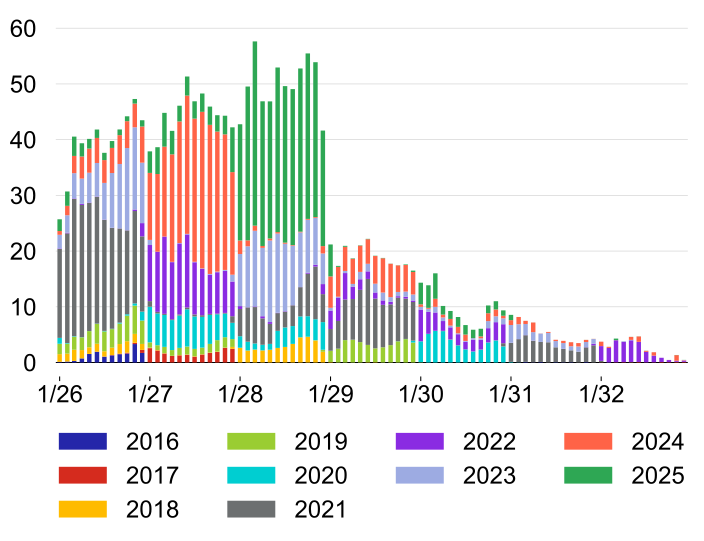
Chart 4 – In 2027 and 2028, loans will be refinanced at current interest rates just below those currently offered on the market
average interest rate in %, weighted by mortgage volumes
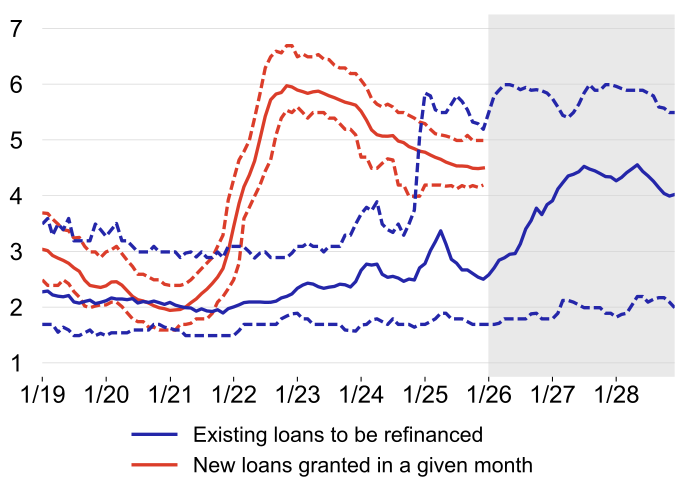
Note: The dashed lines indicate the intervals within which 90% of the observed loans fall.
The overall macroeconomic impacts of refinancing remain limited. In 2026, the estimated cumulative impact[4] on households’ debt service expenditure is around CZK 2 billion, with the volume of additional repayments gradually declining during the year. For households with mortgages, this implies an increase in instalments of approximately 15%, or around CZK 1,900 per month on average. The estimates for 2027 and 2028 are more favourable: the cumulative impact of changes in instalments on refinanced loans is estimated at around CZK 170 million and CZK 60 million respectively, corresponding to increases in instalments of roughly 4% and 3%.
The estimated macroeconomic impact in these two years is therefore low, mainly because these loans were, on average, agreed at rates only around 0.2 pp below those currently offered on the market (see Chart 4). If, however, reference rates – and subsequently client rates – were to remain, say, 1 pp above their December 2025 level over the next three years, the cumulative impact of changes in instalments would be CZK 2.6 billion in 2027 (an increase of CZK 2,300 per instalment) and CZK 3 billion in 2028 (an increase of CZK 2,800 per instalment). For individual households, this may represent an increased financial burden. From a macroeconomic perspective, however, the impact is small.
[1] For details see the box Refixation and refinancing of mortgages and their effects on household expenditure, Summer 2023 MPR, and Refixace a refinancování hypoték – nové odhady dopadu do výdaju domácností (Refixing and refinancing of mortgages – new estimates of the impact on household expenditure – in Czech only), cnBlog, May 2025.
[2] The Survey is conducted on a quarterly basis by the CNB’s Financial Stability Department and covers around one million loans provided between July 2015 and December 2025. Mortgages that were granted before 2015 and have not been refinanced to date (i.e. loans with rates fixed for more than eight years) were not included in the sample. The type of data determined the analytical approach taken: as no information is available on the parameters of the current stock of loans, we have to track the flow of new mortgage agreements over time and estimate the moment at which they will be due for refinancing based on their fixed-rate period.
[3] For the purposes of this analysis, commercial banks’ statistics are used to obtain information on the total volumes of, and average interest rates on, other new mortgage agreements. The fixing and maturity structures are approximated using individual data from the Survey for the category of loans refinanced with other banks.
[4] The change in expenditure is reflected in the total sum starting from the month of refinancing. For example, for mortgages refinanced in December, only one monthly instalment is included in the total, while for mortgages refinanced in January, twelve monthly instalments are included.