MONETARY POLICY REPORT | WINTER 2026 (box 3)
(authors: Jakub Moučka, Tomáš Pokorný, Jan Syrovátka, Tatiana Vivodíková)
The CNB’s price stability mandate involves retrospectively assessing the fulfilment of its 2% inflation target and determining the causes of any past deviations of inflation from the target. This box, regularly included in the report, contains the assessment for the last two calendar years, i.e. for 2024 and 2025.
After having spent a lengthy period in double figures, consumer price inflation returned to close to the 2% target at the start of 2024 and stayed around the target level for the rest of the period under review (see Chart 1). The CNB thus maintained price stability, which had previously been disrupted by extraordinary events – the pandemic and the energy crisis. This box uses the g3+ core forecasting model[1] to determine the key factors underlying the deviation of inflation from the target (see Chart 2).
The monetary policy rule in the g3+ model sets interest rates so as to ensure that inflation returns to the 2% target at the monetary policy horizon. The inflation outlook takes on board the forecasts for all relevant macroeconomic variables. The emphasis on the monetary policy horizon reflects the gradual transmission of interest rates to future economic developments and in turn to inflation. By concentrating on inflation at this horizon, the central bank simultaneously abstracts from short-term inflation shocks. Their impact can be controlled by monetary policy to only a minimal extent. In addition, any efforts to mitigate them quickly would cause excessive interest rate volatility, which would destabilise the economy. The monetary policy rule also includes interest rate smoothing by the central bank. Nonetheless, active monetary policy stabilises inflation at the target in the medium term. This is usually accompanied by gradual movement of interest rates towards their neutral long-run level (3%).
Chart 1 – Inflation was slightly above the CNB’s target over the past two years
consumer prices in %
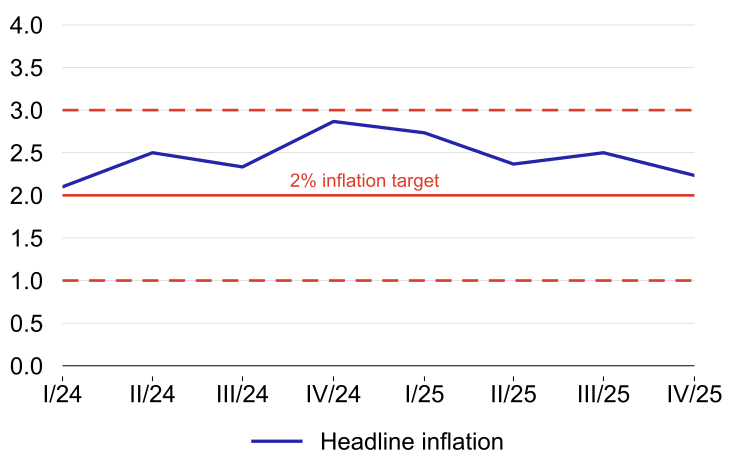
Chart 2 – Thanks to tight monetary policy, inflation was only slightly elevated over the past two years
deviation of monetary policy-relevant inflation from CNB’s 2% target; contributions in pp
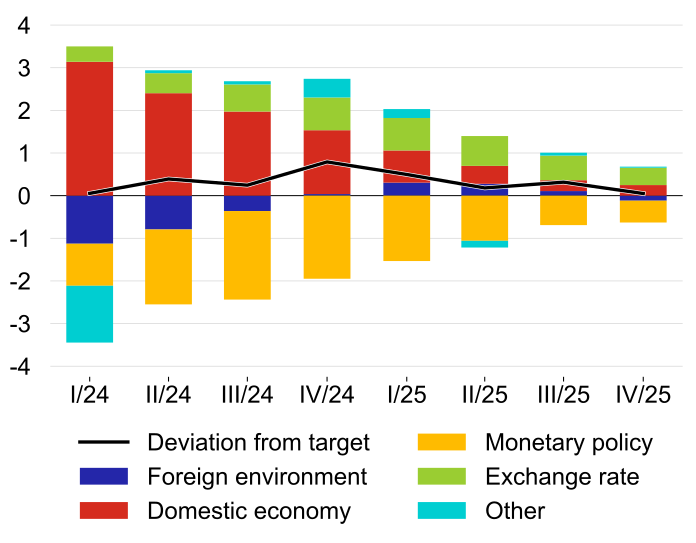
Monetary-policy relevant inflation is inflation to which monetary policy reacts in the forecast. It is defined as headline inflation adjusted for the first-round effects of changes to indirect taxes.
Developments abroad dampened inflation in 2024. The dominant factor was a decline in foreign industrial producer prices, which reduced import prices. This outweighed the mildly positive effect of tight foreign monetary policy, which fostered a weaker koruna and conversely increased import prices. In 2025, industrial producer prices fell only slightly, and the still moderately tight foreign monetary policy slightly outweighed their effect. Weak external demand reduced domestic inflation pressures a little in both years.
The domestic economy was the dominant inflationary factor in 2024, due to marked growth in Czech firms’ costs. On the one hand, this growth continued to be driven mainly by high wage growth in market sectors and weak labour productivity. On the other hand, it was constrained by narrowing profit margins in an environment of tight monetary policy, which dampened domestic demand. The inflation pressures from the domestic economy thus gradually decreased over the period under review and had only a minor positive effect in 2025.
The koruna was weaker against the euro in 2024 than implied by the interest rate differential. This contributed to higher year-on-year inflation throughout the period under review.
In 2024, the Bank Board assessed the risks and uncertainties of the outlook for the fulfilment of the inflation target mostly as modestly inflationary. The main upside risks identified were a slower decline in the elevated inflation expectations, higher-than-expected inertia in services inflation, increased wage demands in the private and public sector, potential excessive growth in total public sector spending and a potential acceleration of money creation in the economy stemming from a significant recovery in lending activity, especially on the property market. Conversely, a downturn in global economic activity and weaker German – and hence Czech – economic output were assessed as downside risks. The future monetary policy stance abroad was an uncertainty.
In 2025, the Bank Board continued to assess the risks of the outlook for the fulfilment of the inflation forecast predominantly as inflationary. Most of the previously mentioned risks persisted, and a stronger-than-forecasted exchange rate was newly identified as an anti-inflationary risk. The uncertainties were related to trade wars and the military conflicts in Ukraine and the Middle East, as well as increasing sensitivity of financial markets to rising general government debt in some developed economies.
Throughout the period, the Bank Board emphasised the need for tight monetary policy until the disinflation process had been completed. This implied a cautious approach to reducing the key interest rates, a process that had begun in December 2023 – in the case of the 2W repo rate from 7%. The CNB lowered interest rates gradually (in steps of 0.25–0.50 pp) at each monetary policy meeting (with two exceptions – in December 2024 and March 2025) until May 2025, when the 2W repo rate reached 3.5%.
Inflation was only slightly above the 2% target over the past two years. Inflation pressures came from both the domestic and foreign economies, and were largely offset by restrictive monetary policy. From this perspective, it can be said with the benefit of hindsight that the CNB’s interest rate settings were appropriate and contributed to keeping inflation close to the 2% target.
[1] The g3+ core prediction model is used to prepare the CNB’s macroeconomic forecasts. It is also employed to assess the fulfilment of previous forecasts and to determine the sources of deviations of the actual figures from the forecasts under assessment and the inflation target. For details, see The g3+ model: an upgrade of the Czech National Bank’s core forecasting framework, CNB WP 7/2020.