CNB RB 4/2026
Demographic developments affect macroeconomic variables through multiple interrelated channels. This research brief discusses the main transmission mechanisms and their implications for monetary policy, illustrating them with the case of Czechia, where population ageing and the inflow of Ukrainian refugees provide examples of both long-term demographic trends and demographic shocks.
Introduction
Demographics influence the economy. Whether they take the form of a long-term trend (e.g., population ageing) or an unexpected shock (e.g., a migration wave or a pandemic), demographic changes affect both the demand for and the supply of goods, services, labor, and capital. Consequently, at least in the short term, they influence prices, wages, and interest rates through various transmission channels.
If a central bank has full control over inflation[1], fully observes demographic developments, and understands their effects on inflation, it should be able to fulfil its mandate of maintaining price stability by offsetting any inflationary effects of demographic developments.[2] In practice, however, the high degree of uncertainty surrounding the transmission channels, their interactions, and the simultaneous occurrence of multiple demographic changes makes this task highly challenging for central banks.
The aim of this research brief is to help central bankers understand the role of demographic developments in the conduct of monetary policy and thereby support the achievement of price stability. To illustrate these mechanisms, the brief also examines long-term demographic trends and a recent demographic shock affecting Czechia. With its ageing population and war-related migration, Czechia exhibits demographic patterns similar to those observed in many other countries. Consequently, the insights presented in this brief are relevant not only for Czechia but also for a wide range of countries worldwide.
Demographic Trends: Theoretical Scheme
Chart 1 presents a simple framework for thinking about the macroeconomic effects of demographic trends from the perspective of a central bank. It identifies three basic demographic trends based on changes in the size of three population age groups: the young population (0–19), the working-age population (20–64), and the retired population (65+). Real-world demographic developments can be viewed as combinations of these basic trends, as can their macroeconomic consequences. It should be emphasized that this simplified framework abstracts from various demographic phenomena that are presumably of second-order importance (e.g., urbanization, changes in family structure, and changes in educational attainment).
Chart 1 – Three Basic Demographic Trends
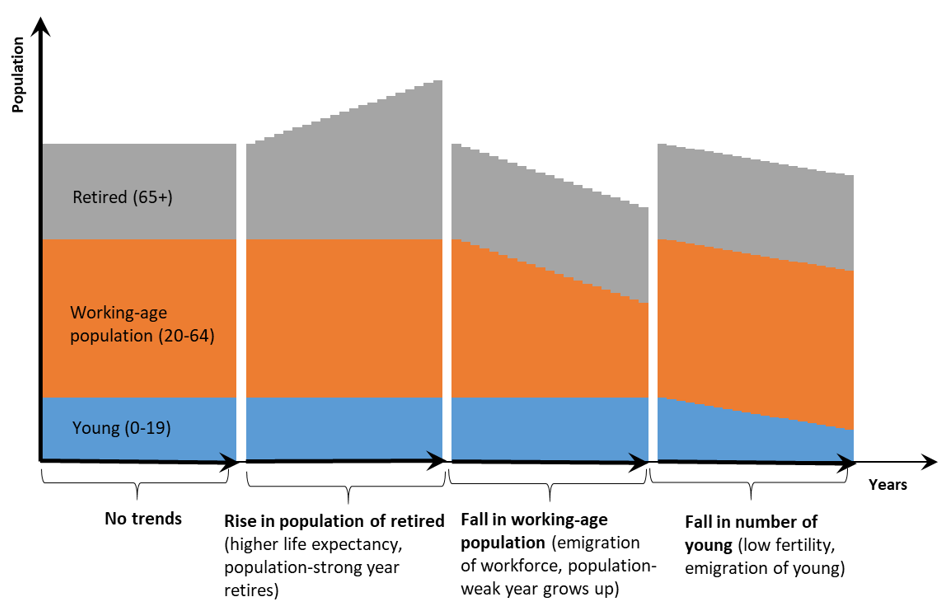
The main macroeconomic effects of these demographic trends are as follows:
- Changes in the retired population affect the real neutral interest rate (the so-called r*) through changes in saving behavior. For example, longer life expectancy increases precautionary saving among the working-age population, while large birth cohorts with high accumulated savings entering retirement also tend to increase aggregate savings. Both mechanisms put downward pressure on the real neutral interest rate.
- Changes in the working-age population affect labor supply, which in turn influences wages, production costs, and potential output. A decline in labor supply puts upward pressure on wages and reduces potential output. In addition, investment tends to decline because a smaller workforce requires less capital. This, in turn, puts downward pressure on the real neutral interest rate and further reduces potential output.
- Changes in the total population size affect aggregate demand. A larger population increases the demand for goods and services. Moreover, different age groups have different consumption patterns, altering not only the level but also the composition of aggregate demand.
- Changes in the ratio of the working-age population to the retired and young populations (who are typically economically inactive) affect government revenues and expenditures and, consequently, government debt. A decline in this ratio tends to weaken the fiscal balance through higher public spending and potentially lower tax revenues. The ultimate macroeconomic effects then depend on the fiscal policy response.
Ultimately, the macroeconomic effects of the three basic demographic trends can be summarized in terms of their impact on inflation and the real neutral interest rate. Demographic developments may generate either inflationary or deflationary pressures and may increase or decrease the neutral interest rate. The corresponding monetary policy response can then be described by the Taylor rule:
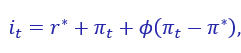
where denotes the short-term nominal interest rate, is the real neutral interest rate, denotes the inflation rate and is the inflation rate. The parameter is the central bank's response coefficient to deviations of inflation from its target.
The four groups of macroeconomic effects described above translate into inflationary pressures and monetary policy implications as follows:
- A lower real neutral interest rate (r*) is associated with a lower level of real interest rates in the economy.
- Higher wages (production costs) increase inflationary pressures and therefore call for tighter monetary policy. At the same time, lower investment demand resulting from a smaller labor force reduces the real neutral interest rate (r*). In addition, the decline in potential output, for a given level of aggregate demand, increases inflationary pressures and thus requires a tighter monetary policy stance.
- Stronger aggregate demand for goods and services increases inflationary pressures and therefore calls for tighter monetary policy.
- Higher fiscal spending tends to increase aggregate demand and inflationary pressures. If financed through higher government debt, it may also put upward pressure on the real neutral interest rate.
The overall response of an inflation-targeting central bank depends on the specific demographic trends, their direction, and their relative strength. Monetary policy responds to these developments through their effects on inflation and the real neutral interest rate. The following subsection illustrates these mechanisms using the case of Czechia, which currently exhibits a combination of demographic trends typical of many advanced economies.
Demographic Trends: Czech Case
Czechia is already an ageing society, and demographic pressures are expected to intensify over the coming decades. At the end of 2025, the population stood at 10.9 million, with almost 21% of the population (2.3 million people) aged 65 or older. This share has increased from 14% in 2005 and is projected to reach around 29% by mid-century.[3]
Chart 2 – Population of Czechia at the End of 2025
(Population by age category and by sex and age cohort)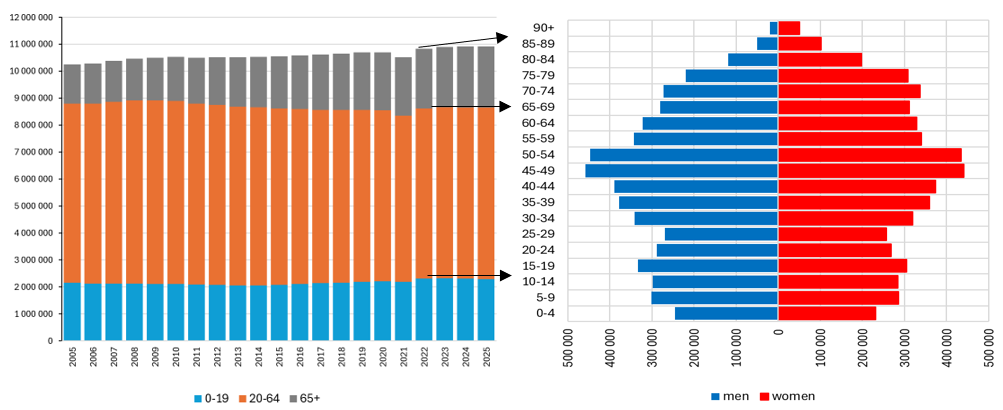
Source: Czech Statistical Office
Notes: Arrows in the left panel highlight current population trends.
Several developments are driving this trend, with rising longevity being the first. Life expectancy at birth increased from 72.9 years for men and 79.3 years for women in 2005 to 77.5 and 83.2 years, respectively, in 2025. At the same time, large post-war cohorts have entered retirement, increasing the old-age dependency ratio from 21.8 to 37.1 people aged 65 or older per 100 people of working age (Chart 2, right panel). According to demographic projections, this trend is expected to continue in the near future, leading to a steady increase in both the absolute number of elderly people and their share of the population (Chart 3).
The second major trend is declining fertility. The number of live births fell to 77.6 thousand in 2025, the lowest recorded level. Part of this decline reflects the smaller number of women of reproductive age and the postponement of childbirth. However, the total fertility rate has also declined sharply for five consecutive years, reaching 1.28 children per woman in 2025. This suggests that the decline in births is not solely a compositional effect but also reflects changes in fertility behavior. Although the fertility assumptions underlying demographic projections are more optimistic, they still imply a steady decline in the share of the population aged 0–19 in the coming years (Chart 3).[4]
Chart 3 – Population by Age Category and Projections
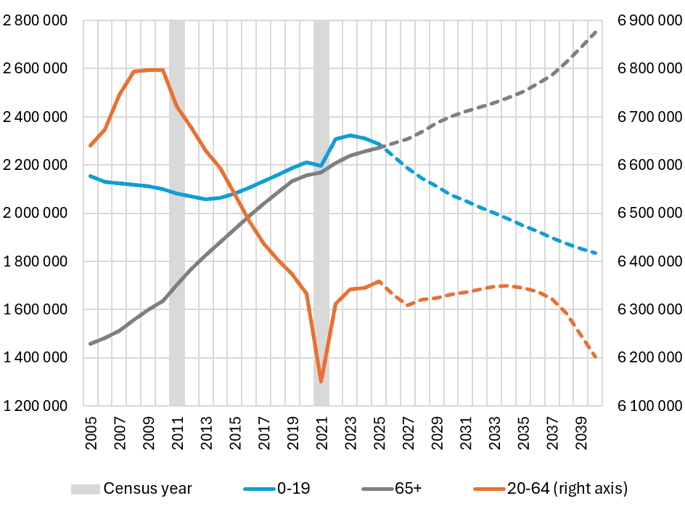
Sources: Authors calculations based on assumptions from the official Czech Statistical Office population projection.
Notes: The visible breaks in the series for the young and working-age populations reflect an administrative adjustment following the 2021 Census, mainly due to the previous underestimation of work-related emigration among young adults.
The working-age population still accounts for a relatively large share of the total population, at around 58% in 2025, and this share is expected to remain broadly stable over the next few years. However, underlying demographic pressures are already emerging. Lower inflows from younger cohorts and steady outflows into retirement (Chart 2, right panel) are currently being offset by migration. The arrival of Ukrainian refugees has more than compensated for the administrative decline recorded after the 2021 Census and has supported growth in the working-age population in recent years.
Over the next 10 to 15 years, however, demographic pressures are likely to become more pronounced as the large cohorts born in the 1970s approach retirement age, leading to a decline in the working-age population. Overall, the projection indicates that the total population of Czechia will gradually decline.
Currently, Czechia is experiencing population ageing while immigration is offsetting demographic declines in age groups below 65. As a result, the retired population is increasing (Chart 2, left panel), with the macroeconomic consequences discussed in the previous section. In particular, inflationary pressures may arise through both demand-side and fiscal channels.
A larger retired population shifts demand toward labor-intensive services, such as health care, long-term care, and other personal services. This may create persistent upward pressure on relative prices in these sectors and contribute to higher services inflation. At the same time, age-related public spending may further strengthen inflationary pressures if financed by higher public debt. Alternatively, if such spending crowds out productive public investment, it may reduce potential output and reinforce supply-side constraints.
Over the next decade, persistently low fertility is expected to gradually reduce the growth of the working-age population. If this decline is not offset by migration, later retirement, higher labor force participation, or stronger productivity growth, labor shortages may become more severe, wage pressures may intensify, and potential output growth may weaken. These supply-side constraints may, in turn, amplify inflationary pressures.
Current and projected demographic trends may imply stronger inflationary pressures and, consequently, a need for a more restrictive monetary policy stance. At the same time, these trends exert downward pressure on the neutral real interest rate through changes in saving behavior and lower investment demand. The appropriate monetary policy response ultimately depends on the relative strength of these opposing effects, which is reflected in the evolution of the nominal neutral interest rate, as it incorporates changes in both the neutral real interest rate and inflation.
Demographic Shock: Ukrainian Refugees in Czechia
In addition to long-term demographic trends, the economy may also be affected by demographic shocks. To adequately capture their macroeconomic effects, it is important to examine their characteristics. As an example, we focus on the recent demographic shock associated with the arrival of approximately 440,000 Ukrainian refugees[5] who entered Czechia following the outbreak of the war in Ukraine in 2022. A substantial share of these refugees subsequently entered the Czech labor market.[6]
This episode has the characteristics of a typical refugee-induced labor supply shock: it was unexpected and largely unrelated to economic conditions in the receiving country.[7] We examine the nature of this shock using individual-level data aggregated to the district level, focusing primarily on changes in the share of Ukrainian employees and the wage gap between Ukrainian and non-Ukrainian employees across districts.[8]
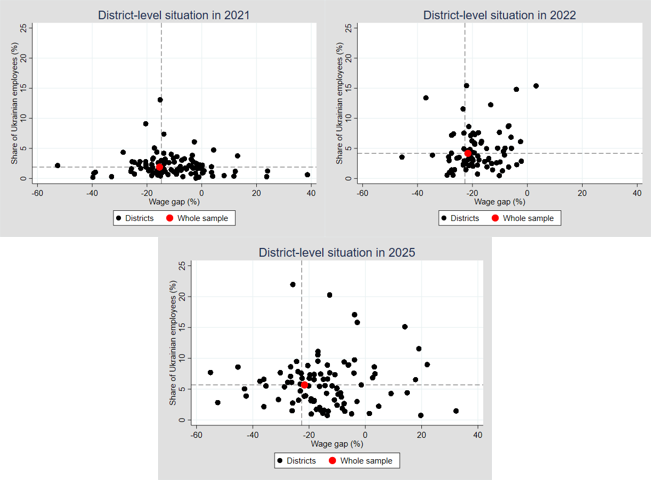
The average share of Ukrainian employees increased markedly following the outbreak of the war in 2022 and has remained nearly 3 percentage points higher since then, reflecting the inflow of Ukrainian workers into the Czech labor market (Chart 4). At the same time, the gap between the median wages of Ukrainian and non-Ukrainian employees widened, suggesting that the inflow into the labor market represented a negative shock to the average wage.
Chart 4 – Wage Gap and Share of Ukrainian Employees in Districts
Sources: Authors’ calculations based on data from the Average Earnings Information System.
Notes: The wage gap represents the difference between the median wage of Ukrainian employees in the district and the median wage of non-Ukrainian employees in the district. The dashed lines indicate the average of the district-level variable.
Since 2022, many Ukrainian refugees have decided to remain in Czechia and continue participating in the labor market. As a result, the average share of Ukrainian employees has remained close to 5%.[9] Importantly, the wage gap has persisted, indicating a high degree of persistence in the initial wage shock. At the same time, cross-district heterogeneity has increased substantially. In 2022, most districts exhibited wage gaps clustered around -20%, whereas by 2025 the distribution of wage gaps had become much more dispersed, with 13 out of 76 districts recording near-zero or even positive wage gaps.
On the one hand, some districts exhibit an even wider wage gap than in 2022. These include Prague and districts with a high concentration of automotive and supplier industries (e.g. Mladá Boleslav, Rychnov nad Kněžnou, and Jičín), where a relatively large share of Ukrainian employees work in manual occupations, such as assembly jobs, which are typically low paid.
On the other hand, several districts recorded a near-zero or even positive wage gap by 2025. These include districts surrounding Prague as well as regional industrial and commuting districts (e.g. Klatovy and Rokycany), where the share of Ukrainian employees is lower and they are employed across a broader range of occupations with more diverse wage levels.[10]
Furthermore, there is some evidence that the occupational composition of Ukrainian employees changed between 2022 and 2025. In particular, the share of Ukrainian employees working as product and equipment assemblers declined, while the share employed as mobile equipment operators, drivers, retail and wholesale sales workers, and software developers and analysts increased.[11] Nevertheless, despite the observed changes in the occupational composition of Ukrainian employees and the evolution of their wages relative to those of non-Ukrainian employees, the overall picture remains largely unchanged.
Conclusion
Demographic developments affect inflation, interest rates, and monetary policy through their effects on labor supply, aggregate demand, saving behavior, and fiscal balances. This research brief outlines the main transmission channels and illustrates them using the case of Czechia. It shows that population ageing and low fertility may strengthen inflationary pressures while lowering the neutral real interest rate. Next, it depicts a persistence in wage gap between Ukrainian and non-Ukrainian employees that mainly reflects the occupational and sectoral structure of Ukrainian employment. The overall macroeconomic effects of demographic change in Czechia are therefore ambiguous in the short term. Over the longer term, however, demographic trends are likely to strengthen inflationary pressures unless they are offset by immigration, higher labour force participation, or stronger productivity growth.
The views expressed in this article are those of the author(s) and do not necessarily represent the views of the Czech National Bank.
References
- Angrist, J. D., and A. D. Kugler (2003): “Protective or counter-productive? Labour market institutions and the effect of immigration on EU natives.” The Economic Journal, Vol. 113.
- Borjas, G. J., and J. Monras (2017): “The labor market consequences of refugee supply shocks.” Economic Policy, 32(91), 361–413.
- Brücker, H., and E. J. Jahn (2011): “Migration and wage-setting: Reassessing the labor market effects of migration.” Scandinavian Journal of Economics, 113(2), 286-317.
- Clemens, M. A., and J. Hunt (2019): “The labor market effects of refugee waves: Reconciling conflicting results.” ILR Review, 72(4), 818-857.
- Foged, M., and G. Peri (2016): “Immigrants’ effect on native workers: New analysis on longitudinal data.” American Economic Journal: Applied Economics, 8.2, 1-34.
- Lee, J. (2026): “Population ageing, transition to service economy, and effects of monetary policy.” International Journal of Central Banking, 22(1).
- MoLSA (2025): “Potvrzený trend v datech MPSV: Ukrajinci dál odvádějí státu víc, než kolik dostávají na pomoci”, available at https://mpsv.gov.cz/potvrzeny-trend-v-datech-mpsv-ukrajinci-dal-odvadeji-statu-vic-nez-kolik-dostavaji-na-pomoci.
- Wiedermann, T., Švejcar, J., Makarava, U., Nohejl, K., Krejsová, K., and D. Starý (2025): “Budoucnost českého pracovního trhu.” Boston Consulting Group, Ministry of Labour and Social Affairs, and Aspen Institute, available at https://web-assets.bcg.com/97/eb/ed5a447d4661a52e99e69b68ad68/budoucnost-ceskeho-pracovniho-trhu-verze-25-3-2025.pdf.
[1] This brief does not consider the case of fiscal dominance, in which the central bank lacks full control over inflation and demographic developments may have a substantial effect on inflation through, for example, increased spending on health care and pensions for an ageing population that is not credibly financed by future budget surpluses.
[2] Demographic changes affect not only macroeconomic aggregates but also the transmission of monetary policy. For example, the interest rate channel becomes weaker as the share of older individuals in the population increases because their consumption and saving decisions become less sensitive to interest rate changes and increasingly biased towards consumption, regardless of the monetary policy stance (Lee, 2026).
[3] https://csu.gov.cz/population-estimates-structure-and-projection
[4] The population projections in Figure 3 follow the assumptions of the official 2023 population projection (medium variant) regarding fertility, mortality, and net migration. For births, even the low-fertility variant assumes a total fertility rate of 1.45 in 2023, which is still above the most recently observed level, before declining to 1.25 by 2100.
[5] Cumulative number of Ukrainian refugees who arrived in the Czech Republic in 2022.
[6] The inflow of refugees also led to an unexpected increase in consumption and tax revenues. Here, however, we focus on its effects on the labor market.
[7] Several studies have examined previous episodes of sudden immigration in Europe. Brücker and Jahn (2011) show that immigrants typically have lower labor market participation rates than natives. Foged and Peri (2016) analyses the inflow of refugees from Bosnia during the Balkan War to Denmark and finds that, in the long run, regions experiencing high levels of immigration saw low-skilled native workers shift towards occupations requiring fewer manual tasks and more communication and cognitive skills. Evidence on the impact of refugee inflows on unemployment is less conclusive with findings ranging from negative to insignificant effect (Angrist and Kugler, 2003, Borjas and Monras, 2017, Clemens and Hunt, 2019).
[8] No increase in unemployment was observed following the arrival of Ukrainian refugees in 2022. Therefore, wages are the main focus of the analysis.
[9] Approximately 260 thousand Ukrainian refugees currently intend to stay permanently (Wiedermann et al., 2025). In June 2025, there was around 170 thousand Ukrainian refugees working in Czech economy (MoLSA, 2025).
[10] Districts with the widest gaps in 2022 have still the widest gap in 2025 and similarly for districts with near-zero and positive gaps.
[11] Our dataset does not allow to distinguish whether these employees are the refugees or the long-term staying Ukrainian natives.