CNB instant payments save businesses time and money, yet only one in five currently use QR codes at the point of sale
Almost every entrepreneur or sole trader in the Czech Republic now has access to a fast, low-cost and simple alternative to accepting payments by card, cash or invoice – instant payments. Businesses that offer this option to customers are almost always satisfied with it. It saves them time and significantly reduces card fees and cash-handling costs. However, four-fifths of small businesses do not use the option where customers can simply scan a QR code displayed at the point of sale with their mobile phone. This is mainly because they still lack sufficient information about this option.
A survey conducted by Ipsos for the Czech National Bank showed that 98% of small businesses and sole traders who allow customers to pay by QR code at the point of sale are satisfied with this option. They particularly value the immediate crediting of funds to their account, real-time visibility of payments and the fact that they do not need a payment terminal and can also avoid handling cash.
“The future lies in making payments simply and cheaply using a mobile phone via instant payments – much like today with payment cards. The difference is that payments would be made entirely without cards, solely through the CNB system. We are able to operate the instant payments system at costs that are fifty times lower than those currently incurred by people and businesses for card schemes,” said CNB Governor Aleš Michl.
The service operates through the instant payments system, which the CNB has been running since 2018 and which more and more banks have gradually joined. Customers simply scan the displayed QR code using their bank’s mobile app and confirm the payment. The funds are then credited to the business’s account within around three seconds on average, allowing the payment to be verified immediately. “Many small businesses and sole traders also welcome the fact that banks today generally charge nothing for sending or receiving instant payments, whereas accepting card payments is usually associated with fees,” said CNB spokesperson Jaroslav Krejčí, commenting on the survey results.
Although the instant payments system saves businesses and sole traders both time and money, and the last major bank joined it in 2025 – bringing availability in the Czech Republic to virtually 100% – only one in five small businesses still accept QR code payments at the point of sale.
According to the Ipsos survey, the main reasons are not concerns about security or fears that the payment will fail – instant payments are extremely secure and reliable. The biggest barrier is a lack of information. Almost a quarter of respondents cited this as the reason they do not accept QR code payments at the point of sale. Some businesses, for example, mistakenly believe that an instant payment can be cancelled for a certain (very short) period of time and therefore fear not being paid. Others include QR codes on invoices issued to customers but do not offer this payment option directly at the point of sale. This is despite some customers actively asking about this option. A quarter of small businesses that do not yet accept instant payments report encountering this at least occasionally.
Instant payments are growing in popularity
In addition to paying for goods and services in person, instant payments make everyday life easier in a range of other situations – for example when transferring money between family members or friends, when shopping online and now when making payments to state and public institutions. As a result, their popularity and overall use in the Czech Republic are rising rapidly.
Since the current CNB Bank Board took office in summer 2022, the average daily number of instant payments has tripled. In December 2025, the CNB system processed an average of 2.02 million instant payments per day, the highest figure on record. The year-on-year increase was almost 30%.
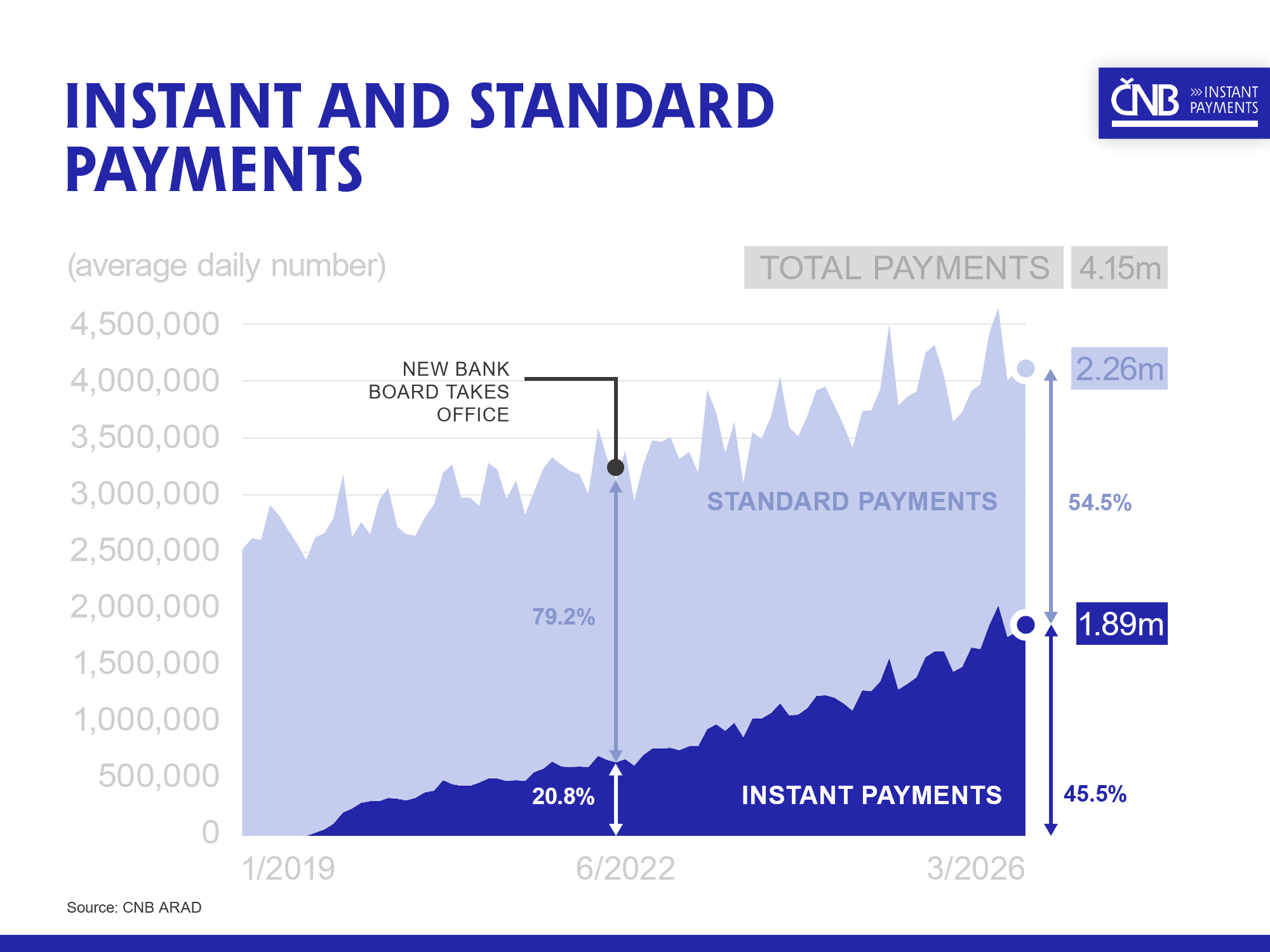
Instant payments now account for 45.5% of all interbank transfers (as of March 2026), compared with just 21% in mid-2022. Their main advantages are speed, security and availability 24/7, including weekends and public holidays.
The CNB is also continuing to expand the use of instant payments for businesses and the public. It is, for example, preparing to introduce bulk instant payments, which could facilitate processes such as wage payments. Another important milestone will be the requirement for domestic banks to accept instant payments in euro from January 2027. From July 2027, they will also be required to send euro payments on a continuous basis.
Detailed and clear information on how instant payments work, which banks offer them and the situations in which they are most useful are available on the Czech National Bank’s website.
Jaroslav Krejčí
CNB Spokesperson
Survey information: The online survey was conducted by Ipsos among a sample of 300 respondents consisting of sole traders and firms with up to five employees across the Czech Republic. Data were collected in October 2025. In addition, seven in-depth qualitative one-to-one interviews with entrepreneurs and small sole traders were conducted on the topic in September 2025.