CNB increases the countercyclical capital buffer rate to 1.5%
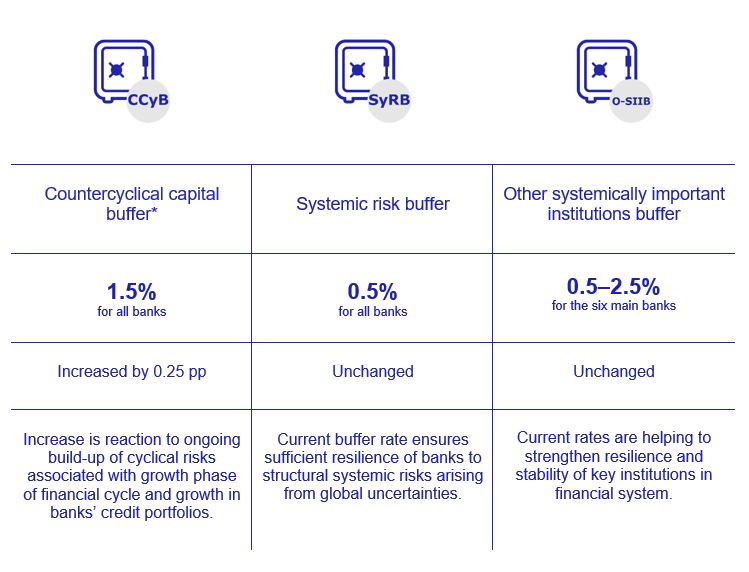
At its financial stability meeting today, the Bank Board of the Czech National Bank (CNB) decided to increase the countercyclical capital buffer rate. The decision is motivated above all by strong and broad-based lending activity, an increase in household and corporate debt and ongoing growth in apartment prices, which is contributing to a further build-up of cyclical systemic risks associated with the growth phase of the domestic financial cycle. At the same time, the Bank Board decided to leave the rules for mortgage lending and the systemic risk buffer rate unchanged.
The countercyclical capital buffer rate will increase by 25 bp to 1.5% with effect from 1 July 2027. At its meeting today, the Bank Board assessed the resilience of the banking sector in the context of domestic and global economic developments. It took into account the extent of accumulated cyclical risks in the banking sector’s balance sheet and their expected evolution. “Despite persistent global uncertainties, a further increase in cyclical risks in the domestic financial sector has been observed. This has been driven mainly by broad-based lending activity, which, according to the latest forecast, is expected to continue in the period ahead. In such an environment, we consider it necessary to slightly increase the countercyclical capital buffer rate in order to maintain the high resilience of the domestic banking sector,” said CNB Bank Board member Jakub Seidler following the Bank Board’s financial stability meeting today.
Given some of the structural characteristics of the Czech economy, adverse developments in the global economy and disruptions to international trade could translate into a deterioration in the quality of the credit portfolios of non-financial corporations and households. It therefore remains appropriate to maintain higher resilience of the banking sector using the systemic risk buffer, which has been kept at 0.5%.
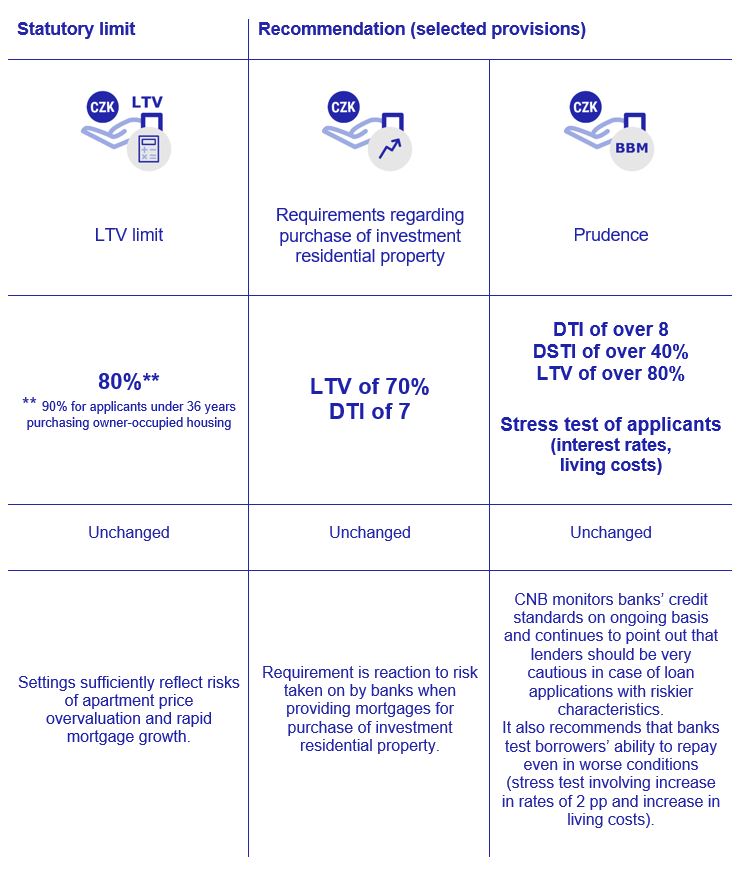
At its financial stability meeting, the Bank Board also discussed the situation on the mortgage and property markets. According to available data, both the number and the volume of new mortgages exceeded their long-term averages in 2026 Q1. Residential property prices continued to rise briskly during 2025, with year-on-year growth hovering around 10%. The Bank Board therefore considers it desirable to keep the upper limit on the LTV ratio unchanged at 80% (and 90% for applicants under 36 years). The DTI and DSTI ratios remain deactivated, as banks are not easing credit standards for mortgage loans across the board in a way that would lead to household overindebtedness. “We expect the impact of the recently introduced LTV and DTI limits on investment mortgages to start materialising, helping to curb the emergence of excessive risks in banks’ mortgage portfolios,” Jakub Seidler added.
Stress tests conducted on individual segments of the financial sector indicate their resilience to adverse economic developments, supporting the stability of the financial system as a whole. The key banking sector is well capitalised. As a whole, it passed a stress test with an adverse scenario involving a prolonged and significant decline in economic output. “The scenario reflects potential risks stemming from the current geopolitical situation and global economic developments. The profitability, capital buffers and asset quality of the banking sector create favourable conditions for absorbing the strong shocks considered in the stress test,” added Libor Holub, Executive Director of the CNB’s Financial Stability and Resolution Department.
In its Financial Stability Report, the CNB regularly assesses the soundness of the domestic financial sector and its resilience to adverse shocks. The report forms the foundation for configuring macroprudential policy tools, in particular bank capital buffers and borrower-based measures. The CNB will publish the latest Financial Stability Report – Spring 2026 on 22 June 2026. The minutes of today’s Bank Board meeting on financial stability issues, including the votes cast by the individual Bank Board members on macroprudential policy measures and also attributed arguments, will be published the same day.
Jakub Holas
Director, Communications Division
Notes for journalists:
An investment mortgage is a mortgage loan provided for the acquisition of a third or subsequent residential property and/or a buy-to-let residential property.
Financial stability has been a key objective of the Czech National Bank alongside price stability since 2013. Maintaining financial stability is defined in Act No 6/1993 Coll., on the Czech National Bank. The Act requires the CNB to set macroprudential policy by identifying, monitoring and assessing risks jeopardising the stability of the financial system and, in order to prevent or mitigate these risks, to contribute by means of its powers to the resilience of the financial system and the maintenance of financial stability. Since the second half of 2021, the CNB has had the statutory power to set upper limits on the LTV, DTI and DSTI ratios (borrower-based measures). Compliance with the limits must be legally binding in order to ensure a level playing field.
The Bank Board discusses financial stability issues twice a year – in the spring in May or June, and in the autumn in November. The aim of the Financial Stability Report is to identify near-term risks to the financial stability of the Czech Republic based on previous and expected developments in the real economy and the financial system.
The main macroprudential policy tools applied in the Czech Republic are the countercyclical capital buffer (CCyB), the capital conservation buffer (CCoB), the capital buffer for other systemically important institutions (O-SIIs) set only for systemically important banks, the systemic risk buffer (SyRB), upper limits on the LTV, DTI and DSTI credit ratios set for all mortgage lenders, and the Recommendation on the management of risks associated with the provision of consumer loans secured by residential property.
Countercyclical capital buffer (CCyB) – This instrument is aimed at increasing the resilience of the banking sector to risks associated with fluctuations in lending activity. The CCyB should enable banks to lend to households and firms even during a recession or periods of financial instability.
Systemic risk buffer (SyRB) – This buffer is intended to mitigate the potential impacts of systemic risks identified on the financial system and the real economy. If their level poses a risk to financial stability, the application of the SyRB enhances the capitalisation of the banking sector and increases its resilience to adverse shocks. At the same time, it may help reduce the growth or concentration of relevant exposures in banks’ balance sheets, although this is not its primary purpose.
Capital conservation buffer (CCoB) – This instrument is aimed at preserving a bank’s capital. Under the Act on Banks, all banks are obliged to maintain this buffer. The CCoB rate is 2.5% and does not change over time.
Capital buffer for other systemically important institutions (O-SIIs) – This instrument is aimed at mitigating risks connected with the potential destabilisation of systemically important institutions, which could have significant adverse effects on the financial system and the economy as a whole. The CNB is required to draw up a list of O-SIIs and calibrate the buffer for individual O-SIIs at least once a year.
Combined capital buffer – the sum of the capital conservation buffer (CCoB), the countercyclical capital buffer (CCyB), the systemic risk buffer (SyRB) and the capital buffer for other systemically important institutions (O‑SIIs).
LTV (loan-to-value) – the ratio of the value of a mortgage loan to the value of the collateral.
DTI (debt-to-income) – the ratio of the applicant’s total debt to their net annual income.
DSTI (debt-service-to-income) – the ratio of the sum of an applicant’s monthly repayments to their net monthly income.