An appreciating koruna pushed the CNB into loss last year, despite record-high profits on its international reserves
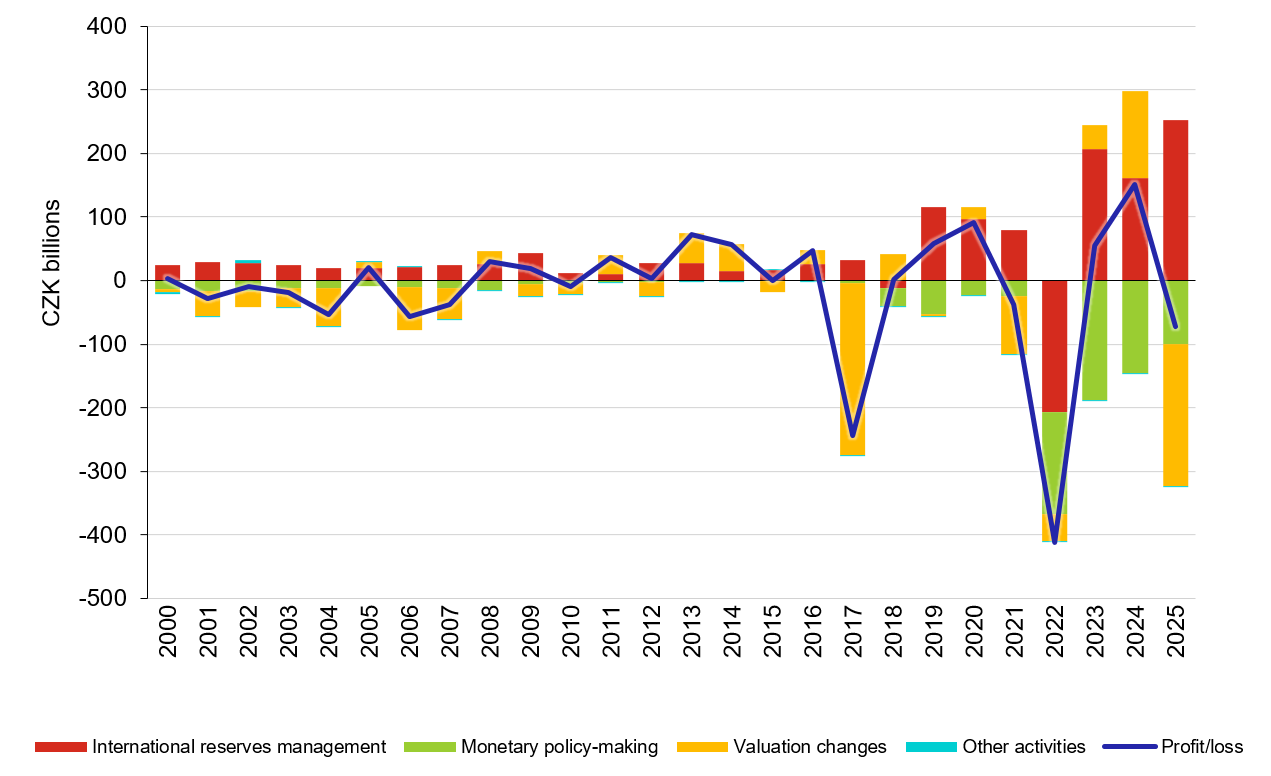
After two years of profits, the CNB recorded a loss of almost CZK 73 billion for 2025. This was mainly due to appreciation of the koruna against the main reserve currencies, particularly the US dollar (by 14.8%). However, the return on the international reserves was the highest on record, exceeding a quarter of a trillion koruna. Without the effect of the exchange rate, the central bank would have made a profit of around CZK 150 billion. In reserve currencies, the CNB’s international reserves went up in value by 10.3% in 2025, with equity portfolios gaining 21% and gold as much as 67%. These figures are preliminary and unaudited. The final results will be published at the end of March.
Table – CNB profit/loss – basic breakdown
(CZK billions)
| 2023 | 2024 | 2025* | |
|---|---|---|---|
| International reserves management | 206.65 | 160.88 | 252.75 |
| Valuation changes | 38.08 | 137.21 | -223.57 |
| Monetary policy-making | -187.46 | -144.94 | -100.25 |
| Other activities | -2.16 | -1.76 | -1.78 |
| Profit/loss | 55.11 | 151.39 | -72.85 |
Source: CNB, * preliminary results
Exchange rate movements during 2025 outweighed the substantial return on the international reserves, which was positively affected by the current Bank Board’s strategy of increasing the share of equities and buying gold on an ongoing basis. Had the koruna remained stable from the start of the year, the CNB would have made a profit of around CZK 150 billion – the returns on the reserves would have covered all its monetary policy and operating costs. The item “international reserves management” alone saw a profit of CZK 252.7 billion in 2025, the highest in the CNB’s history. The return on the international reserves in reserve currencies was 10.3%, with equity portfolios recording around 21% and gold more than 60%.
The fluctuations in the CNB’s financial result due to exchange rate movements are connected with the size of the central bank’s balance sheet, which is among the largest in the world relative to GDP as a result of measures taken during the exchange rate commitment period. Nevertheless, over the period of the current Bank Board and its adjustments to the reserves management strategy (2023–2025), the CNB has generated a total profit of CZK 133.6 billion, reducing its accumulated loss by more than one-quarter to CZK 350 billion (preliminary and unaudited result as of 31 December 2025).
Since 2022, the CNB Bank Board has implemented a series of measures[1] aiming to improve financial performance over the long term and gradually erase the accumulated loss of previous years. The goal of this strategy is for the returns on the international reserves to exceed the costs of monetary policy, any exchange rate losses, and operating expenses.
Although interest rates fell further in 2025, interest paid to banks on their deposits with the CNB remained a significant cost item. Monetary policy-making expenses amounted to CZK 100.3 billion in 2025 as a whole. Even so, this is a marked decrease compared to the past. In 2023, for example, this item stood at CZK 187 billion.
The central bank’s primary objective is to maintain price stability, regardless of the direction in which the measures taken to achieve it affect its financial performance. However, the CNB must manage its international reserves with professional care, seek ways to improve their expected returns, and in the long term endeavour to reduce the loss or, if possible, erase it completely.
Chart – The evolution of the CNB’s profit/loss
Source: CNB, * 2025 – preliminary results
Information on the CNB’s financial performance can also be found in the CNB’s ten-day balance sheet.
Jaroslav Krejčí
CNB Spokesperson
[1] On the asset side, the international reserves have been diversified by gradually increasing the shares of equities and gold. On the liabilities side, the reserve requirement parameters have been adjusted – reserve holdings ceased to be remunerated in October 2023 and the reserve ratio was increased from 2% to 4% with effect from January 2025.