The CNB left interest rates unchanged, inflation will be close to 3% in late 2026 and early 2027 and return to close to the target during 2027
- At its May meeting, the Bank Board left interest rates unchanged. The Bank Board assessed the risks and uncertainties of the outlook for the fulfilment of the inflation target as inflationary overall.
- The forecast is significantly affected by the impacts of the Middle East conflict.
- Inflation will gradually rise to the upper boundary of the tolerance band over the course of this year, and will return to the 2% target next year.
- Despite an increase in energy prices, the economy will maintain solid growth over the entire horizon. It will continue to be driven mainly by domestic demand, in particular households’ consumption expenditure and investment.
- Consistent with the forecast is a rise in short-term market interest rates in Q2. The forecast expects interest rates to decline again next year.
The Middle East conflict has hit the domestic economy in a relatively favourable position. In January, inflation was reduced below 2% by a one-off factor, namely the full transfer of the supported energy sources fee in electricity prices to the state budget. This was later joined by falling food prices. However, an increase in fuel prices at the pump in March largely used up this buffer and returned inflation to very close to the target. Core inflation is being kept near to 3% by gradual price growth in services, which reflects strong aggregate demand supported by rising wages. Households’ improving income situation and strong demand for house purchase loans are supporting property price growth, which, coupled with higher prices of construction work and materials, is reflected in a higher contribution of imputed rent. Over the rest of the year, inflation will be driven up by the impact of rising import prices on firms’ costs. By contrast, the dampening effect of food prices is likely to persist for the next few months. However, food prices will then be affected by a rise in agricultural fertiliser prices. Inflation is expected to peak at the beginning of next year and then return towards 2%, aided by tight monetary policy, an expected energy price correction and a continued slowdown in wage growth.
The Czech economy will slow somewhat this year due to the supply shock but is expected to continue in the expansionary phase of the business cycle next year, slightly exceeding its potential. The growth in the quarters ahead will be due mainly to household consumption, driven by rising real wages and moderately easy fiscal policy. The household saving rate is likely to remain close to its current level. An expected recovery in external demand, supported by fiscal expansion in Germany, will boost growth in private fixed investment. It will be accompanied this year by general government investment amid increased absorption of EU funds. Overall, foreign trade will make a slightly positive contribution to GDP growth this year and next year.
The koruna weakened temporarily due to the outbreak of the conflict in the Middle East but quickly returned to close to CZK 24.3 to the euro in April. This is the level assumed in the short-term forecast for Q2. Over the forecast horizon, the exchange rate is expected to remain broadly stable around CZK 24.4 to the euro. The koruna will be prevented from appreciating by faster growth in the costs of domestic firms compared with foreign ones. Consistent with the forecast is a rise in short-term market interest rates in Q2. Monetary policy disregards the first-round effects of the currently elevated energy prices and only considers the second-round impacts of the potential pass-through of the high prices of energy and other commodities to other price categories. The forecast expects interest rates to decline again next year.
The Bank Board assessed the risks and uncertainties of the outlook for the fulfilment of the inflation target as inflationary overall. The macroeconomic impacts of a prolonged conflict in the Middle East are a risk in the months ahead. A possible acceleration in the growth of the money supply in the economy caused by lending to households and general government is a domestic upside risk to inflation. Potential additional growth in total public sector spending would lead to a risk of fiscal policy having an even greater inflationary effect. Continued rapid wage growth related to persistent tightness in the labour market is an additional inflationary risk. The risk of inertia in elevated services inflation, including imputed rent, persists. By contrast, the weak performance of some euro area economies and a possible global correction of asset prices in an environment of increased geopolitical uncertainty and high levels of debt in some developed countries may have an anti-inflationary effect. Trade barriers and uncertainty connected with their intensity also remain a risk to global economic activity. The development of the war in Ukraine still represents an uncertainty.
Chart – Inflation will be close to 3% in late 2026 and early 2027 and return to close to the target during 2027
headline inflation; y-o-y in %; confidence intervals in colours
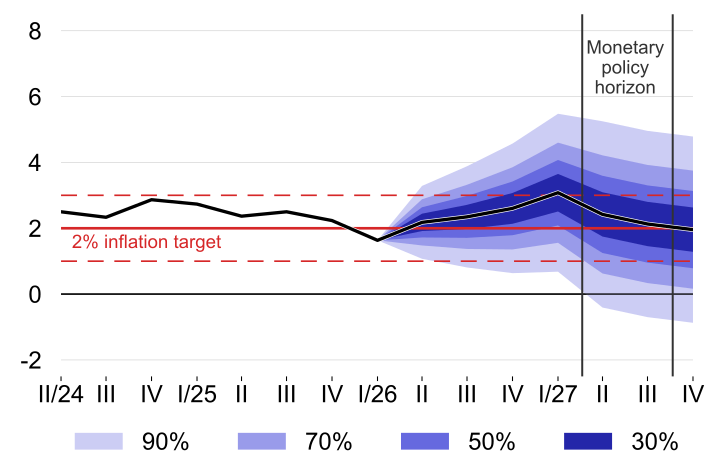
Table – Growth in domestic economic activity will slow slightly this year and pick up again next year
changes compared to previous forecast in brackets
| 2025 | 2026 | 2027 | |
|---|---|---|---|
| Headline inflation | 2.5 | 2.2 | 2.4 |
| %; changes in pp | (0.0) | (0.6) | (0.3) |
| GDP | 2.6 | 2.5 | 2.7 |
| y-o-y in %; changes in pp | (0.1) | (-0.4) | (-0.1) |
| Average nominal wage | 7.2 | 6.4 | 5.4 |
| y-o-y in %; changes in pp | (0.1) | (0.2) | (0.4) |
| 3M PRIBOR | 3.6 | 3.8 | 3.6 |
| %; changes in pp | (0.0) | (0.2) | (-0.4) |
| Exchange rate | 24.7 | 24.3 | 24.4 |
| CZK/EUR | (0.0) | (-0.1) | (-0.1) |