Financial Account of the Balance of Payments: Methodological Principles and Data Sources
The financial account of the balance of payments captures changes in financial assets and liabilities arising from transactions between residents and non-residents. In the context of the balance of payments, it thus makes it possible to analyse how external imbalances of the economy are financed and how surpluses on the current and capital accounts are reflected in the accumulation of foreign assets or in the reduction of foreign liabilities. This article summarises the methodological principles for compiling the financial account at the Czech National Bank, the main data sources, and the links to other macroeconomic statistics. Special attention is paid to the relationship between the current and financial accounts and to the revision process, an integral part of the gradual refinement of statistical outputs.
Introduction: Financial Flow Statistics in the Balance of Payments System
The financial account of the balance of payments is a key instrument for analysing an economy’s external position and how it is financed. Its proper interpretation requires a clear methodological delineation of financial flows and transactions, a strict distinction between transactional and non-transactional changes (i.e. revaluations and other volume changes), and consistent application of the residence principle and accrual accounting. A solid understanding of the underlying data sources, their processing, and their links to other macroeconomic statistics is equally important.
The balance of payments is, from a methodological perspective, designed to be fully consistent with the System of National Accounts (SNA 2008) as well as with its European implementation (ESA 2010; European Commission, 2009). It thus represents the equivalent of the “rest of the world” sector accounts within the system of national accounts. In practice, however, consistency is not always achieved, mainly due to differences in data sources and their coverage, differing estimation methods (e.g. for reinvested earnings), the timing of transaction recording, and the not entirely uniform application of the accrual principle in balance of payments statistics.
The current account balance corresponds to the balance of the external account of goods, services, and income and, after incorporating the capital account, is mirror-linked to the economy’s net lending or borrowing. The financial account then captures how this net position is realised through changes in foreign assets and liabilities.
The financial account is closely linked to the international investment position
The international investment position records the stock of external assets and liabilities arising from the accumulation of transactions, revaluations, and other changes in volume. The integration of the financial account and the international investment position makes it possible to analyse not only current capital flows, but also the long-term development of the net external position and its sensitivity to exchange-rate or price changes.
From an accounting perspective, the combined balance of the current and capital accounts must be mirrored by the balance on the financial account
A surplus on the current and capital account manifests as a net increase in foreign assets or decrease in liabilities (capital outflow), while a deficit, by contrast, appears as a decrease in foreign assets or an increase in liabilities (capital inflow). This identity follows from the principle of double-entry accounting, not from any active balancing mechanism.
In practice, however, statistical discrepancies arise, mainly through:
- imperfections in the primary data and the application of statistical significance criteria,
- inaccuracies in valuation,
- the derivation of transactions from stock data,
- the inconsistent application of the accrual and cash principles.
The interpretation of the link between the current, capital, and financial accounts therefore requires consideration of the financing structure, sectoral behaviour, and data quality.
The link between flow and stock statistics can be illustrated using the recent developments in the Czech economy. In recent years, Czechia has recorded a positive balance of trade in goods and services, and this has been the main source of its current account surplus. Export performance is also strongly driven by foreign-controlled corporations, leading to an outflow of direct investment income in the form of primary income, thereby reducing the current account surplus.
The Czech economy’s external surpluses generate resources that residents can invest abroad
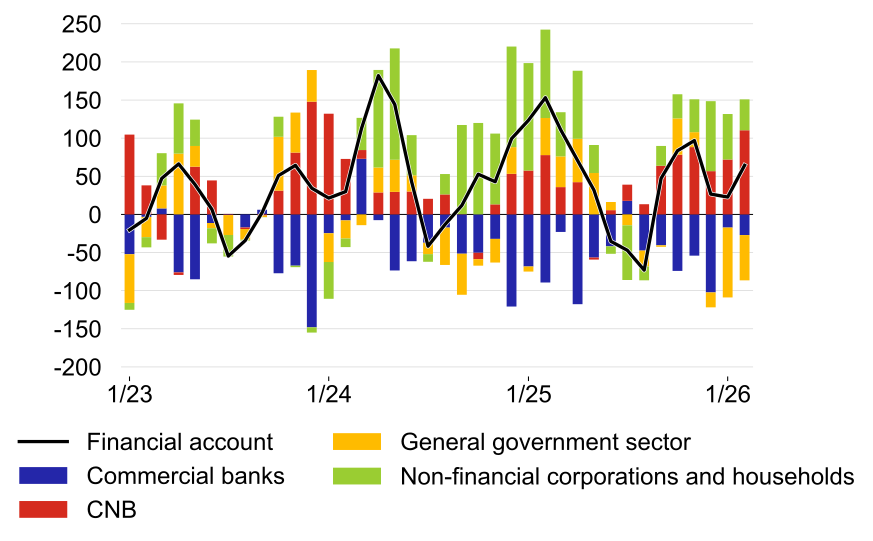
In the financial account, a net capital outflow has been observed in recent years. Chart 1, which shows financial account transactions by sector (commercial banks, the general government sector, corporations and households, and the CNB), indicates a markedly cyclical pattern and significant sectoral differentiation. The overall balance shows that, in recent years, the corporations and households sector in particular has been accumulating foreign assets, representing a capital outflow.
Chart 1 – Corporations and households determine the direction of capital flows
3-month moving totals, CZK billions
Source: CNB
The financial account cannot be viewed in isolation, but must be understood as part of an integrated system. This system links the real economy’s current transactions, the financial decisions of individual sectors, and the long-term evolution of the country’s external position. This interconnectedness is crucial for assessing the economy’s external sustainability and for informing economic policy.
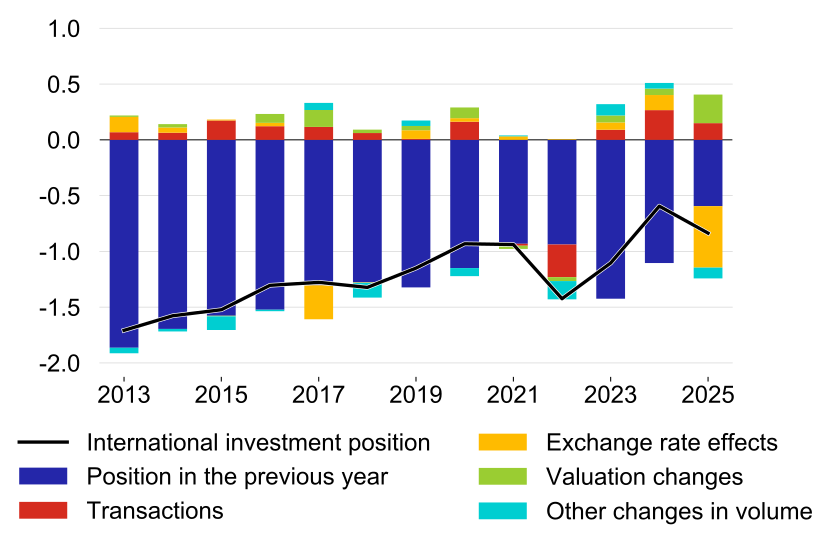
Financial flows shape the long-term profile of the international investment position. Chart 2 shows the evolution of Czechia’s international investment position and its decomposition into transactions, exchange rate and price changes, and other volume changes. Although Czechia’s net investment position has long been negative, net capital outflows and favourable valuation effects have gradually improved.
Chart 2 – The net external position is gradually moderating
Stocks and flows in CZK trillions
Source: CNB
Methodological definition of financial flows and transactions
The SNA 2008, ESA 2010 and BPM6 (International Monetary Fund, 2009) international manuals provide a systematic definition of economic flows and stocks. Flows represent the creation, transformation or extinction of value and comprise transactions, revaluations and other changes in volume. Transactions are a specific type of flow and represent an interaction between two institutional units based on mutual agreement or a legal act. By contrast, stocks express the value of assets and liabilities at a specific point in time (at the end of the reference period). Stocks change precisely as a result of flows.
The purchase of foreign shares by a resident from a non-resident is a specific example of a financial transaction. The result of such a purchase is an increase in the number of foreign shares held by the resident. In subsequent periods, this position may change further as a result of additional purchases or sales (transactions), changes in the market price of the shares (price changes), changes in the exchange rate if the shares are denominated in a foreign currency (exchange rate changes) or, for example, the issuer’s default or other events (other changes in volume). The total change in the position between two points in time is the sum of all these flows.
Each transaction is recorded in a double-entry manner:
- Purely non-financial transactions are recorded in the current or capital account of the balance of payments.
- Purely financial transactions are recorded exclusively in the financial account of the balance of payments. Overall, the financial account balance does not change, as the net increase in assets is offset by a corresponding net increase in liabilities.
- Transactions that separately record the non-financial and financial components (e.g. an export of goods matched by the creation of a receivable or the reduction of a liability).
The financial account records only changes in assets and liabilities arising from transactions between residents and non-residents, with revaluations and other changes in volume recorded separately. This distinction is crucial for analysis, as price or exchange rate changes can significantly affect the value of foreign assets without involving any new economic interaction (Chart 2). The double-entry principle is essential – each transaction carries both a credit and a debit record. The balance of payments is therefore, in methodological terms, always balanced (excluding statistical discrepancies). The current BPM6 methodology emphasises the perspective of net acquisition of financial assets (NAFA) and net incurrence of liabilities (NIL), thereby bringing it closer to the system of national accounts compared with earlier methodologies.
The financial account is compiled on an accrual basis, i.e. in the period in which the economic transaction occurs
A sectoral approach is applied – what matters is the relationship between the resident and non-resident, not the trading currency or the instrument currency (Drahozalová, A., Rybáček, V., 2025). Financial transactions therefore cannot be automatically interpreted as direct pressure on the exchange rate, even though indirect links exist (e.g. subsequent currency conversion when buying or selling securities).
In practice, for balance of payments statistics, it is not always possible to identify both parties to a transaction (the transaction-based approach, or transactor approach) mainly because of the limited availability of counterparty data. Therefore, the debtor-creditor approach is often used for geographical breakdowns. This records who the debtor and creditor are, and makes it possible to monitor how this relationship between them evolves over time. Transactions between two residents or between two non-residents involving financial instruments do not change the overall external position but only the sectoral structure of holdings. The two approaches have different analytical value: the debtor-creditor approach is suitable for analysing the financing structure, while the transactor approach makes it possible to track who conducts a transaction with whom. From the perspective of the overall financial account balance, however, the two approaches are equivalent and give the same result.
An example is a Czech corporation purchasing a foreign company from a Czech bank. Under the transactor approach, this transaction is not cross-border because it takes place between two residents, and therefore has no impact on the financial account balance. Likewise, under the debtor-creditor approach there is no change in the overall external balance because the relationship between residents and non-residents does not change. However, the transaction does affect the sectoral structure of the external position, as the foreign asset shifts from the balance sheet of the Czech bank to that of the Czech corporation.
Table 1 – Recording in the balance of payments and the international investment position by approach: examples
| Transaction type | Transactor approach | Debtor-creditor approach – Czechia’s overall external position | Debtor-creditor approach – Czechia’s sectoral external position |
|---|---|---|---|
| A Czech corporation purchases a Czech company from a Czech commercial bank | No | No | No |
| A Czech corporation purchases a foreign company from a Czech commercial bank | No | No | Yes |
| A Czech corporation purchases a Czech company from a foreign corporation | Yes | Yes | No |
| A foreign corporation purchases a foreign company from another foreign corporation | No | No | No |
| A foreign corporation purchases a Czech company from another foreign corporation | No | No | No |
| A foreign corporation purchases a Czech company from a Czech corporation | Yes | Yes | No |
Source: Prepared based on the Balance of Payments and International Investment Position Manual, sixth edition (BPM6), IMF (2009)
Data sources, the collection process and processing
The compilation of statistics on the financial flows of the balance of payments and foreign assets and liabilities of the international investment position is based on a combination of several types of data sources. The core consists of administrative data and data collected from reporting agents, which are further supplemented by estimates and follow-up calculations. A key system for data collection at the CNB is the SDAT statistical-supervisory system, which makes it possible to use information gathered primarily for supervisory purposes also for macroeconomic statistics.
Financial sector reporting forms the most important part of the input data
Data for banks, investment funds, insurance companies, pension funds and other regulated institutions are available at relatively high levels of detail, frequency and timeliness. The CNB’s institutional arrangement is an important advantage as it combines financial market supervision with macroeconomic statistics. This allows existing data sources to be used efficiently. Data from the financial intermediaries (S.125), financial auxiliaries (S.126) and captive financial institutions (S.127) sectors are less detailed, yet these sectors play a comparatively smaller role in external relations than banks and investment funds.
General government is also an important segment. The Integrated Information System of the State Treasury (IISSP) serves as the key data source, used not only for the financial account of the balance of payments and the international investment position, but also for government finance statistics. It is also an important data source, among other things, for the government’s external borrowing relationships.
The non-financial corporate sector occupies a specific position
The non-financial corporate sector is characterised by high heterogeneity, differences in entity size, and the changing organisational structure of multinational groups. At the same time, it has more limited capacity for statistical reporting than financial institutions. Accurate recording requires the systematic identification of significant units and the provision of methodological guidance to them. The legislative framework consists of the Act on the CNB and Decree No. 235/2013 Coll., which defines the range of statistically significant reporting entities and sets the reporting frequency: monthly, quarterly and annual. Data from private commercial data providers, as well as the regular exchange of microdata with the Czech Statistical Office, are also important.
From both a methodological and organisational perspective, data collection for the household sector (S.14) is the most demanding. From the perspective of financial account assets, the most significant items are direct foreign investments by natural persons with holdings above 10%, often referred to as “foreign investments of Czech billionaires”. The identification of these units relies on both publicly accessible sources (annual reports, wealth rankings) and European statistical registers (the European Group Register). To protect personal data, only public information is used and statistical confidentiality rules are strictly applied.
Growing demand from international institutions (Eurostat, the ECB and the IMF) for higher data granularity is significant trend
The level of detail in the output statistics depends on the corresponding granularity of the input data, which increases the demands placed on both reporting units and statistical compilers. The structure of the data branches is defined by the SDMX standard, while individual institutions specify the range of dimensions required (e.g. countries, creditor and debtor sectors, instrument and currency).
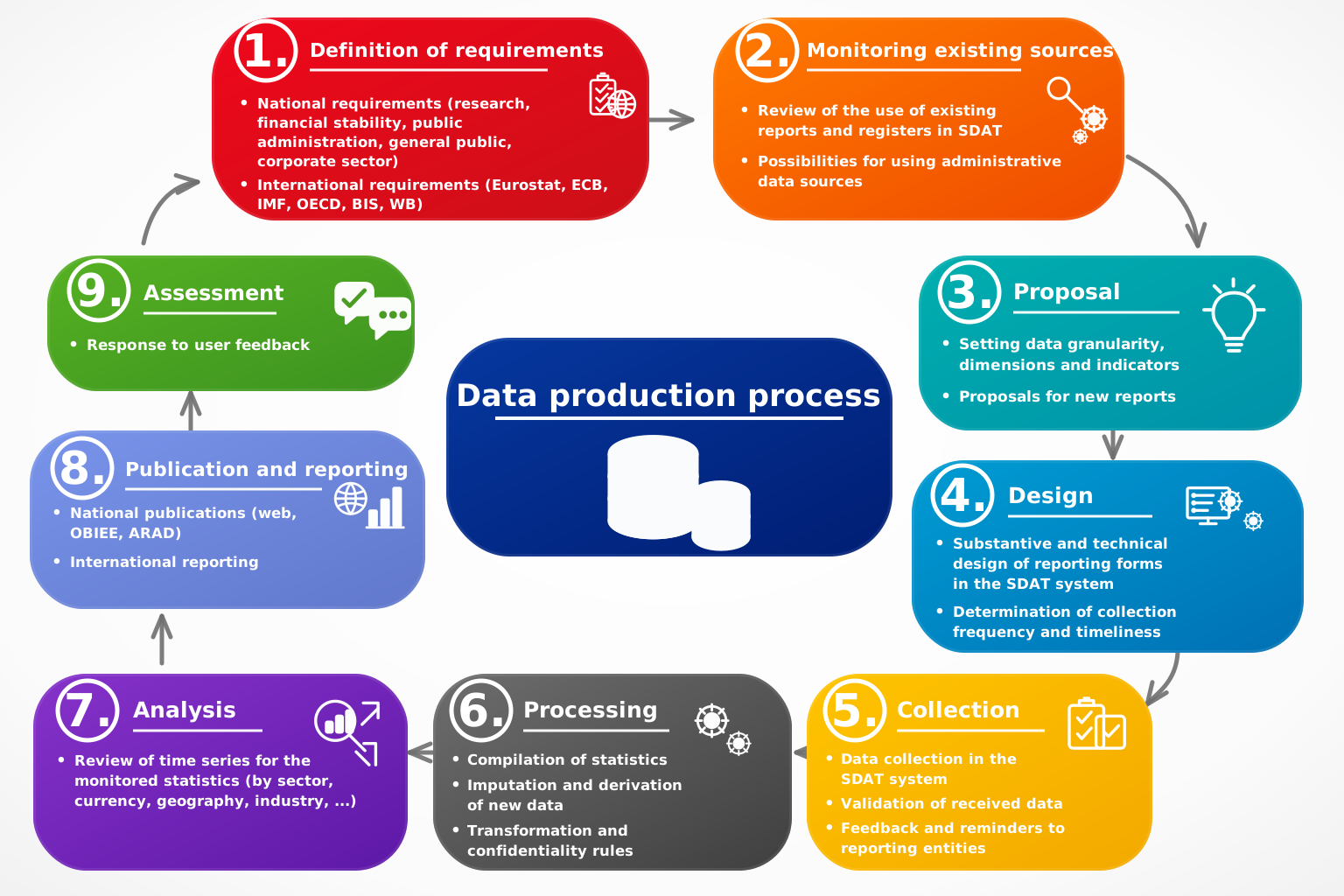
Extensive follow-up processing takes place between the input data and the final statistics. In particular, this includes:
- imputations and estimates for missing or non-responding units,
- estimates of holdings of securities issued by residents under foreign law, based on the residual principle,
- linking the data to national and international registers,
- the derivation of transactions and income flows from stock data,
- detailed verification of the correct coding of countries, currencies and sectors.
Chart 3 – Statistical data life cycle
Source: Generated by AI based on UN (2015)
The financial account is divided into five main functional categories: direct investment, portfolio investment, financial derivatives, other investment and reserve assets
Foreign direct investment (FDI) is monitored at the CNB using annual reports, which around 5,000 reporting entities are contacted to complete. These reports contain detailed information on ownership links, intra-group loans and the associated interest and dividend flows. The annual data are used to revise monthly and quarterly estimates and to produce detailed breakdowns by country and industry. Monthly and quarterly reports are also important, serving not only for direct investment statistics but also providing input for other external statistics. Looking ahead, the use of AI tools is being explored, including for identifying the external relationships of selected corporations and for acquiring administrative data.
Data collection for portfolio investment follows a security-by-security approach, capturing each instrument individually using its unique security identifier. The data are integrated into the securities holdings database containing all holder-issuer relationships, not only cross-border links. The possibility of harmonisation with quarterly financial accounts is an advantage. The database is populated through direct reporting by financial institutions and indirect reporting via investment firms (custodians). For natural persons, the data are aggregated to ensure personal data protection. Transactions, revaluations and income flows are derived from stock data, and the identity between changes in positions and the sum of transactions and other flows must hold.
Financial derivatives comprise over-the-counter derivatives and exchange instruments (except for selected CNB reserve operations).
Other investment consists mainly of loans, deposits and trade credits.
Reserve assets are liquid foreign currency instruments issued by non-residents and held as part of the CNB’s international reserves. The data are based on the CNB’s balance sheet and specialised statements. The reserves are also reported to the IMF (International Monetary Fund) under SDDS Plus (Special Data Dissemination Standard Plus).
Differences in collection frequency (monthly, quarterly, annual) and respondent heterogeneity are a natural source of statistical uncertainty. This is reflected in the errors and omissions item. At the same time, strict statistical confidentiality rules must be observed to prevent the backward identification of individual reporting units.
The CNB’s statistics are being prepared for the implementation of the new seventh edition of the Balance of Payments and International Investment Position Manual (BPM7)
BPM7 emphasises the integrated treatment of positions, transactions and other flows, refines sectoral classifications, and introduces new areas such as ESG (Environmental, Social, Governance) attributes of debt securities, cryptoassets and emission allowances. It also revises the definition of reserve assets, for example in relation to collateral in repo operations.
The entire system of financial account data sources thus constitutes a complex, multi-layered framework. It combines administrative data, reporting systems, registers and estimates to ensure a consistent and internationally comparable recording of the Czech economy’s financial relations with the rest of the world.
Data revisions: frequency, types and rationale
Balance of payments data undergo a systematic revision process. Preliminary monthly estimates are refined when quarterly data are released, and final annual figures are closed roughly 15 months after the end of the reference year. In addition to routine revisions, major (benchmark) revisions are carried out at longer intervals to reflect methodological changes, new data sources and the implementation of updated international manuals.
Revisions do not represent a flaw in statistics; rather, they are a natural part of the process of refining data
Routine revisions reflect the replacement of estimates with more complete information, whereas benchmark revisions may lead to adjustments of longer time series and are often coordinated at the international level. Within the EU, they follow a harmonised revision policy that promotes consistency between the national accounts and the balance of payments. Emphasis is placed on internal and cross-domain consistency and on the transparent communication of changes. The revision process thus strengthens the credibility of the statistics and enhances their usefulness for analysis and economic policy.
Conclusion
The financial account of the balance of payments provides a comprehensive framework for recording the financial relations of an economy with the rest of the world. Its methodological principles, data sources and links to the national accounts and the international investment position make it possible to monitor capital flows. Although balance identities hold by definition, their empirical fulfilment depends on the quality of input data, the application of methodology, and the revision process.
The growing complexity of international financial transactions and the emergence of new instruments, including crypto-assets, are increasing the demands on statistical processing. At the same time, however, they broaden analytical possibilities. The integrated concept of flows, stocks and other changes thus makes it possible to assess not only how financial assets and liabilities change in relations between residents and non-residents, but also the long-term sustainability of the external position and the economy’s sensitivity to external shocks, which is essential for macroeconomic analysis and economic policy-making.
The views presented in this article are those of the authors and do not necessarily reflect the official position of the Czech National Bank. We thank Igor Krejčí, Zdeněk Pikhart, Václav Rybáček, Petr Sklenář and Adriana Wałoszková (all CNB) for their valuable comments and suggestions.
References
European Commission (2013). European System of Accounts (ESA 2010). Luxembourg: Publications Office of the European Union.
International Monetary Fund (2009). Balance of Payments and International Investment Position Manual, Sixth Edition (BPM6). Washington, D.C.: IMF. System of National Accounts, SNA 2008.
United Nations Statistics Division. Generic Statistical Business Process Model (GSBPM). New York: United Nations, 2015.
Drahozalová, A. and Rybáček, V. (2025). Making Sense of Exchange Rate Pressures in Macroeconomic Statistics. Statistics: Statistics and Economy Journal, 105(1), pp. 25–44.
Hronová, S., Sixta, J., Fischer, J. and Hindls, R. (2019). National Accounting: From Production to Wealth. Prague: C. H. Beck.
Vejmělek, J. and Žďárek, V. et al. (2013). Macroeconomic Analysis: From Theory to Application. Prague: Wolters Kluwer.