Family first: Can the ownership of Czech exporters explain their resilience in a stagnating Europe?
Recent years should have been a perfect storm for Czech industrial exporters: the energy crisis, stagnating German demand and the rise of Chinese competition. Yet even in such adverse headwinds, Czech exports accelerated and increased their share of the global market. What was behind this? Paradoxically, the economic slowdown in key export destinations also played a role. Demand for Czech products there fell less than demand for competing products. This resilience may be due to the strong ownership links of Czech corporations within multinational production chains.
Czechia as the unexpected winner of Europe’s slowdown
The European economy is facing a deep crisis in the functioning of its model. The energy shock has raised production costs, the war in Ukraine has shaken geopolitical certainties, and competition from China has intensified pressure on traditional European producers. Germany, long regarded as the engine of European industry, is struggling with subdued demand and structural problems. As a result, there are growing concerns that Europe is losing competitiveness — and with it its place in global trade.
The Czech Republic, however, is among the economies that should have been hit hardest by these shocks. Its share of industry in GDP is the highest in the EU, production is energy-intensive, and almost one-third of its exports go to slowing Germany. Moreover, the product structure of Czech exports to the European market is more similar to that of Chinese exports to Europe than in any other EU country. This overlap means that Czech exports are exposed to strong price and technological competition. Intuitively, one would therefore expect Czechia to have been among the “losers” on global markets in recent years.
The data, however, point to the opposite trend: Czech industrial exports have performed surprisingly well in European comparison over the last three years (Chart 1). This favourable development is not limited to comparison with Czechia’s closest trading partners. Czech export growth also outpaced the global average, contributing positively to an increase in Czechia’s share of global trade. In this article, we therefore look at the factors that have influenced Czech export performance in recent years.[1]
Chart 1 – Czechia outperformed its main trading partners in exports of industrial goods
exports of industrial goods (SITC 5–8) of Czechia and selected trading partners, 12-month cumulative sum, index, December 2022 = 100
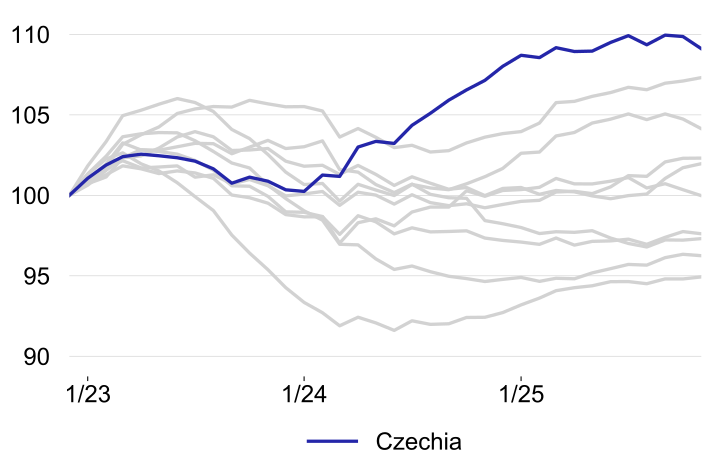
Note: Selected trading partners include Austria, France, Germany, Hungary, Italy, the Netherlands, Poland, Slovakia and Spain.
Source: Eurostat, own calculation
Market share growth can reflect structure or performance
Czechia’s share of the global export market increased in the unfavourable European climate of 2022–2024. To interpret this development correctly, however, it is necessary to distinguish between two sources of this growth. A gain in market share may reflect specialisation in the “right” products and markets, or better performance than competitors in the same markets. To separate these effects, we use a shift-share decomposition following Cheptea et al. (2014)[2], which decomposes the change in market share into structural and performance components.
The structural component comprises two effects: sectoral and market. Since global demand for individual products evolves differently, the sectoral effect helps determine whether a country specialises in products that are currently in demand. The market effect, by contrast, reflects the geographical structure of exports, i.e. whether domestic exports are directed to faster- or slower-growing foreign markets.
For example, if a country specialises in the production of low-carbon products, it may benefit from rapidly growing global demand during the green transition. In the decomposition of market share changes, this is reflected in a positive sectoral effect. By contrast, an orientation towards export destinations with stagnating economies is reflected in a negative market effect. These structural effects thus describe how a country’s share of world exports changes “automatically” as a result of its export specialisation.
However, several countries export the same products to the same markets and compete with one another. While structural effects describe how market share would evolve if exporters’ competitiveness remained unchanged, the performance effect captures the deviation of actual developments from this “automatic” scenario. If a country’s market share grows faster than would be implied by its export structure alone, the performance effect is positive and signals an improvement in the competitiveness of that country’s firms on global markets.[3]
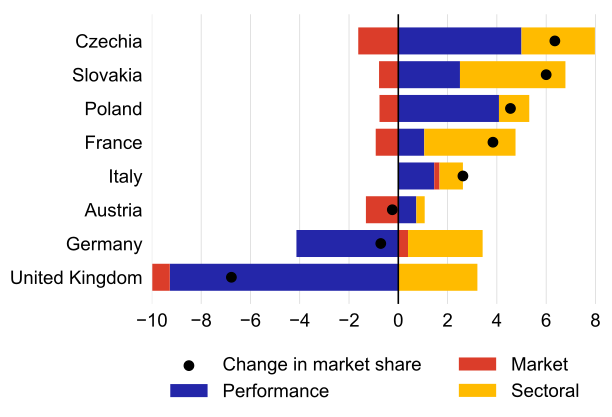
Chart 2 – The growth in Czechia’s market share was driven mainly by the increasing competitiveness of Czech firms
change in market share in %, contributions in pp, Czechia and its seven main export markets, 2022–2024
Source: BACI database, own calculation
Paradox: How Germany’s weakness contributed to Czechia’s success
Czechia’s market share increased by around 6% in 2022–2024, the most among the countries compared. The sectoral and performance effects made positive contributions, while the market effect was negative (Chart 2).[4]
From the sectoral perspective, supply chain disruptions that had affected exporters of motor vehicles, machinery and other electrical equipment in 2021–2022 faded (Chart 3). The sectoral effect has therefore contributed significantly positively since 2023 in Czechia and in other economies specialised in these production segments. However, the recovery of the automotive industry alone does not explain the actual scale of growth in Czech exports in this sector. A marked improvement in the quality of cars produced in Czechia, which are highly popular on the European market, helped strengthen Czechia’s position on foreign markets.[5] Amid recovering demand for cars, Czech exporters were therefore able to increase their sales more than their competitors. This growth beyond the mere cyclical recovery contributes to the positive performance effect (blue bar).
Chart 3 – The impact of subdued German demand on Czechia’s market share was offset by global growth in demand for new cars
change in Czechia’s market share in %, contributions in pp, 2022–2024
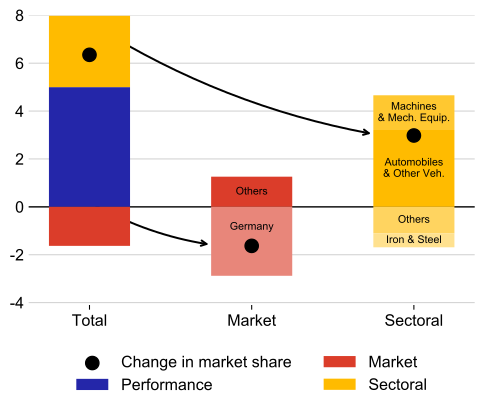
Note: The “market” bar further decomposes the market effect for Czechia and shows how demand from individual countries contrib-uted to the change in Czechia’s market share. The “sector” bar decomposes the sectoral effect and shows how developments in global demand for specific products translated into the change in Czechia’s market share.
Source: BACI database, own calculations
The negative contribution of the geographical orientation of Czech exports reflects the stagnating German economy. Although this affected most European countries, the impact on Czechia was stronger, as Germany accounts for almost 30% of its exports. Here too, however, the actual impact depends on how individual countries managed to cope with subdued German demand. While the effect of Germany itself as the “sick man of Europe” reduced Czechia’s market share by around 3 pp (Chart 3), Czech firms performed much better than their competitors on the stagnating German market: the share of Czech exports on the German market increased by almost 10%. The growing competitiveness of Czech firms on the German market thus worked against the “automatic” effect of weak German demand, again reflected in the positive performance effect (contributing to the blue bar).
Blood is thicker than water — and this also applies to corporations
The opposing effects described above were not limited to Germany. In a period of subdued European demand, Czech exporters managed to increase their market share in most of their main export destinations.[6]
Chart 4 – Czechia’s largest trading partners are the main investors in its manufacturing industry
FDI position in Czechia by ultimate ownership, NACE C, sample of 77 countries, 2023
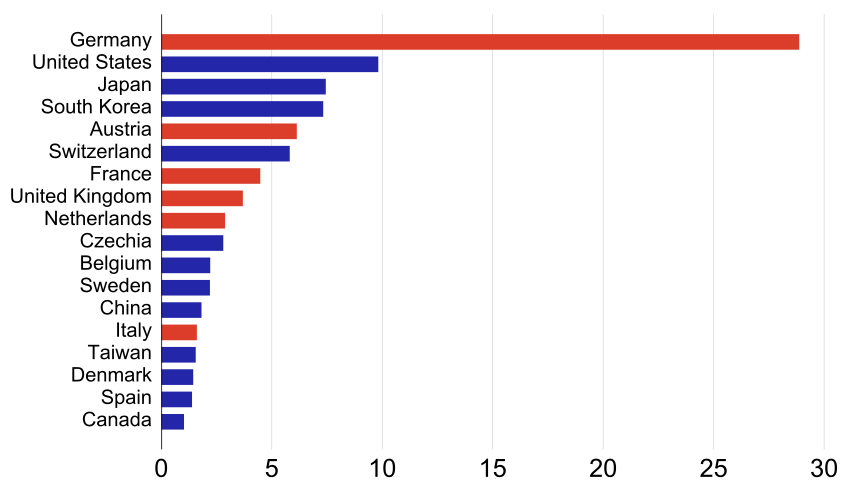
Note: Countries accounting for the largest shares of Czechia’s foreign trade are marked in red (excluding Slovakia and Poland).
Source: CNB, own calculations
One possible explanation may be the strong ownership integration of Czech corporations into multinational production chains. The academic literature shows that trade between parent companies and their foreign affiliates tends to be less sensitive to demand declines during economic slowdowns than trade between independent firms (Bernard et al., 2009; Leitner et al., 2016). Firms integrated into vertical value chains are more likely to reduce purchases from external suppliers during slowdowns or economic crises, while intra-company links remain relatively stable. Trade within multinational groups may therefore be less “cyclical” than transactions between independent firms. Countries with stronger cross-border ownership links may thus be less vulnerable to weakening foreign demand.
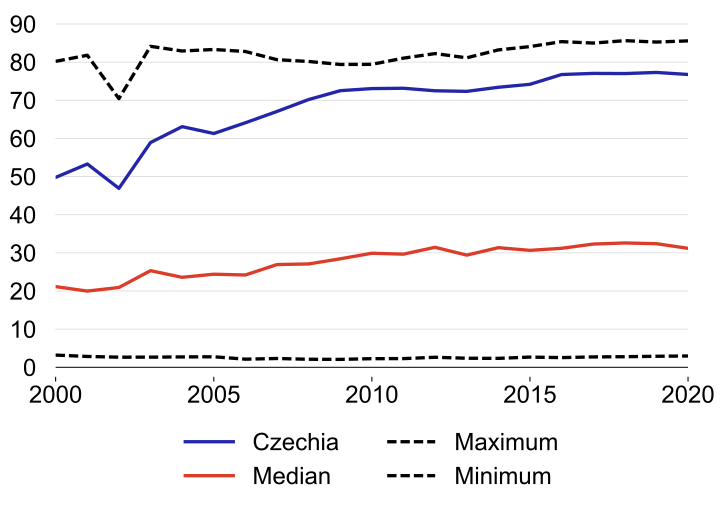
Foreign ownership of corporations is characteristic of Czechia. At the end of 2024, the FDI position in Czechia stood at 65% of GDP, well above the EU average.[7] If we focus only on FDI in manufacturing, Czechia’s exposure is even higher by international comparison. Moreover, Czechia’s largest European investors in manufacturing include precisely the countries to which most Czech exports subsequently go (Chart 4)[8]. Foreign-controlled corporations account for more than three-quarters of total domestic exports (Chart 5). Of the 77 countries monitored, only Romania, Hungary and Slovakia record a higher share.
Chart 5 – More than three-quarters of Czech exports are generated by foreign-controlled firms
share of foreign-owned firms in total exports, NACE C, sample of 77 countries
Source: AMNE database, own calculations
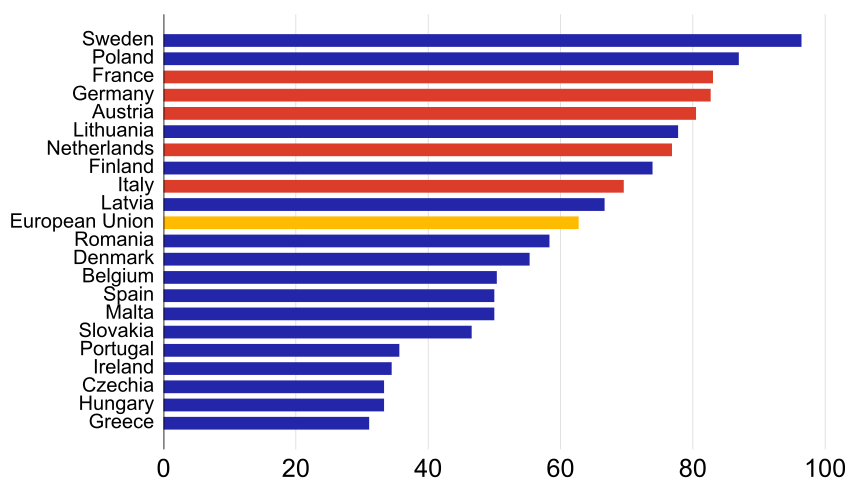
To better understand the resilience of Czech exports, we would need to know the volume of intra-company trade or the position of foreign-controlled Czech corporations in the value chain. However, intra-company data are available for only a very limited sample of countries, and it is difficult to identify the exact motivation behind firms’ expansion into foreign markets. Some indication of Czechia’s involvement in vertical intra-company trade is provided by Eurostat’s survey on global value chains (GVCs). These cover the full range of cross-border activities needed to bring a product or service from initial design through the various stages of production and distribution to final consumers. When sourcing production inputs from abroad, firms may use external suppliers (outsourcing) or carry out these activities within the corporate group (insourcing). Chart 6 shows that the share of firms using intra-company trade to secure foreign inputs is highest precisely in countries with a strong ownership presence in Czechia.
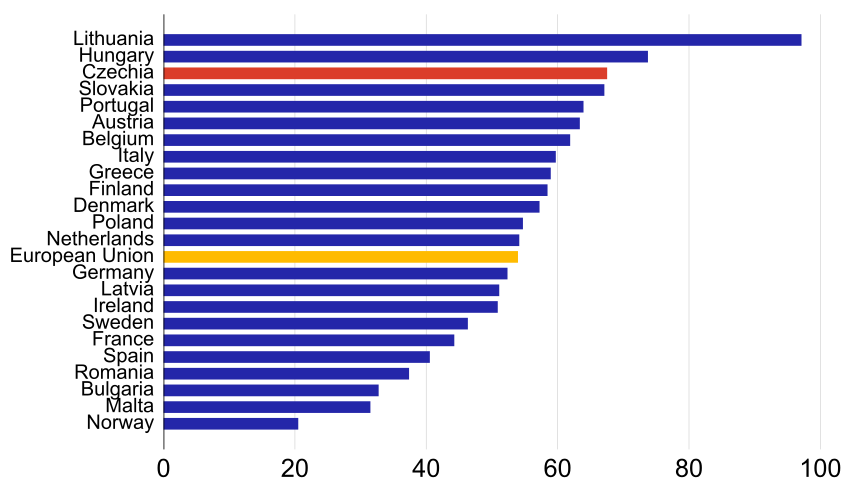
Strong integration is also evident on the output side. The share of firms supplying their products to other EU countries as part of a broader production process spread across several countries is among the highest in Czechia (Chart 7). Czech corporations thus often act as an intermediate link in European production chains, with their output entering further stages of processing or assembly abroad.
Chart 6 – Countries with a strong ownership presence in Czechia typically secure production inputs through intra-company trade
share of firms insourcing the production of foreign inputs in total sourcing, 2023
Note: Countries accounting for the largest shares of Czechia’s foreign trade and with a significant FDI position in Czechia are marked in red. Data for the United Kingdom are not available.
Source: Eurostat, own calculations
Chart 7 – Czechia has a high share of firms integrated into global value chains
share of firms supplying goods to the EU within GVCs, industry and construction sector, 2023
Source: Eurostat, own calculations
Healthy daughters of the sick man
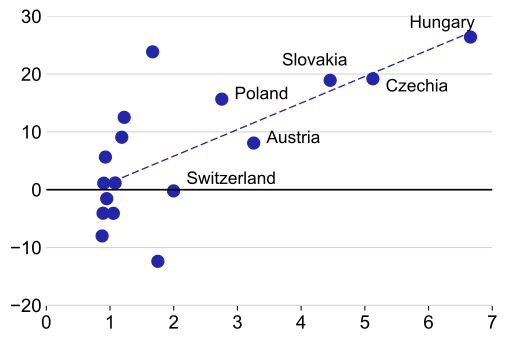
The importance of foreign ownership for export resilience can again be illustrated using the example of Germany. Chart 8 shows the relationship between the degree of German capital involvement in individual countries’ manufacturing industries and the resilience of their exports to Germany. Countries with a significant presence of German investment in manufacturing recorded more favourable developments in their share of German imports of intermediate goods during the period of weakness in the German economy. In countries with a low degree of German ownership, this relationship is less clear, as other factors may prevail.
In other words, economies whose firms are more strongly linked to German parent companies were relatively better able to maintain their position on the German market in an environment of weaker demand. This relationship suggests that ownership links may dampen the impact of a cyclical slowdown.
Chart 8 – Suppliers from countries with strong German capital involvement are more successful on the German market
x-axis: German FDI abroad in manufacturing (position, share of destination country GDP, 2023); y-axis: change in market share in trade in intermediate goods in Germany (in %, 2022–2023), R2 = 0.5
Note: The FDI threshold for including individual countries was set at 0.9% of GDP.
Source: Comtrade and Bundesbank, authors’ calculations
The views presented in this article are those of the author and do not necessarily reflect the official position of the Czech National Bank.
Literature
Bernard, A. B., Jensen, J. B., Redding, S. J., & Schott, P. K. (2009). The Margins of US Trade. The American Economic Review, 99(2), 487–493.
Drahozalová, A. (2024). More than Competitiveness: What Drives Countries’ Export Market Shares? Balance of Payments Report, Czech National Bank.
Drahozalová, A., Novotný, F., & Wałoszková, A. (2025). Czech exports holding course amid a storm of uncertainty. Monetary Policy Report – Spring 2025 (Box 1), Czech National Bank.
Cheptea, A., Fontagne, L., & Zignago, S. (2014). European Export Performance. Review of World Economics. 150, 25-58.
Leitner, S. M., Marcias, M., Mirza, D., Pindyuk, O., Siedschlag, I., Stehrer, R., Stöllinger, R., & Studnicka, Z. (2016). The Evolving Composition of Intra-EU Trade (wiiw Research Report No. 414). The Vienna Institute for International Economic Studies (wiiw).
[1] Most international databases are available with a time lag, so the following analysis is based on data for 2023–2024. However, the identified trends are long-term in nature, so the conclusions can also be applied to 2025.
[2] Compared with the traditional constant market share (CMS) approach, the method of Cheptea et al. is econometric: it works with the growth of individual bilateral flows at the year–exporter–importer–product level and uses a regression model to separately identify the exporter, import market and exported product effects. As a result, the performance effect is not merely a residual, but a directly estimated variable, and the results do not depend on the order of decomposition.
[3] While in the short term a positive contribution of the performance effect can be interpreted as higher competitiveness, whether price- or technology-based, over the long term this interpretation is distorted by the convergence of emerging economies. This was discussed in more detail in article VI.3 in the 2024 Balance of Payments Report: More than Competitiveness: What Lies Behind Countries’ Export Market Shares?
[4] Changes in market shares are calculated on the intensive margin, which captures changes in exports of already existing products to already existing markets and therefore does not correspond exactly to the actual growth in market share. The differences from the actual values are small, however, as most trade relationships are already established in advanced economies (Cheptea et al., 2014)
[5] This topic was discussed in the box “Czech exports holding course amid a storm of uncertainty” in the Spring 2025 Monetary Policy Report.
[6] Among Czechia’s major export destinations, its market share declined only in the USA, Slovakia and Spain.
[7] Excluding countries such as Luxembourg, the Netherlands, Cyprus, Malta and others, where FDI is high relative to GDP owing to their role in tax optimisation.
[8] Although direct investment from the USA, Japan and Korea is significant, it is probably mostly horizontal in nature, i.e. aimed primarily at serving the European market rather than integrating Czech production into these countries’ production chains. This is also consistent with the relatively lower volume of mutual trade.