The CNB increased interest rates, inflation will rise at the start of next year but will then start to decline thanks to tight monetary policy
- At its November meeting, the Bank Board increased interest rates by 0.25 pp. The two-week repo rate is set at 4%. The Bank Board assessed the risks and uncertainties of the outlook for the fulfilment of the inflation target as inflationary overall.
- Inflation will temporarily rise at the start of next year but will then start to decline thanks to tight monetary policy. It will return to close to the 2% target in early 2028.
- Economic growth will accelerate in the next two years due to a renewed positive contribution of net exports amid still strong domestic demand.
- Consistent with the forecast is a rise in short-term market interest rates.
Annual inflation hovered slightly below the target during the summer but increased to 2.5% in September, mainly on the back of a sharp rise in fuel prices caused by the ongoing conflict in the Middle East. Inflation continued to be dampened by falling food prices. However, food prices will start to climb over the outlook horizon due to a poor harvest in Europe and rising prices of production inputs. Strong growth in unit labour costs and rising imputed rent are reflected in elevated core inflation. Within imputed rent, growth in prices of new property is slowing markedly, but prices of construction work and materials continue to rise at above-average rates. This year, inflation is being reduced by the full transfer of the supported energy sources fee to the state budget. With this administrative effect fading and retail gas and electricity prices expected to increase, inflation will rise to just below 4% at the start of next year. The pass-through of the high energy prices to other prices will be dampened by restrictive monetary policy, which will help inflation return to close to the target at the start of 2028. In 2028, inflation will remain slightly above 2% due to the introduction of the ETS2 emissions trading system.
The growth of the Czech economy slowed in the first half of the year. At the beginning of the year, GDP growth was dampened by a negative contribution from net exports, which was replaced in Q2 by a year-on-year decline in inventories. These factors are expected to fade away next year and economic growth should gradually gather pace, as the expenditure structure continues to show solid growth in domestic demand supported by robust lending. The growth in the quarters ahead will thus be due mainly to household consumption, driven by rising real wages and easy fiscal policy. An expected economic recovery abroad, supported by fiscal expansion in Germany, will keep private fixed investment growing at a brisk rate. General government investment is also rising more strongly this year thanks to increased take-up of EU funds. Foreign trade will make a slightly positive contribution to GDP growth in the years ahead. The economy will therefore gradually move above its potential over the forecast horizon.
After appreciating slightly in late August, the exchange rate returned close to CZK 24.3 to the euro. The forecast expects the same value for Q4. The koruna will remain broadly stable over the next two years. Its appreciation will be held back by faster growth in the costs of domestic producers relative to foreign producers. Consistent with the forecast is a rise in short-term market interest rates. The increase in inflation next year requires a tightening of monetary policy. Its restrictive effect is reinforced by a rise in the longer end of the yield curve (see Box 1 for details).
The Bank Board assessed the risks and uncertainties of the outlook for the fulfilment of the inflation target as inflationary overall. Persistence of core inflation is a risk in the coming months. It is reflected above all in elevated services inflation, including housing prices. A possible acceleration in the growth of the money supply in the economy caused by increased lending to households and general government is another domestic upside risk to inflation. A possible year-on-year increase in the public finance deficit would lead to a risk of fiscal policy having an even greater inflationary effect. Continued rapid wage growth related to persistent tightness in the labour market is an additional inflationary risk.
Chart – Inflation will be above 3% for most of next year and return to close to the 2% target during 2028
headline inflation; y-o-y in %; confidence intervals in colours
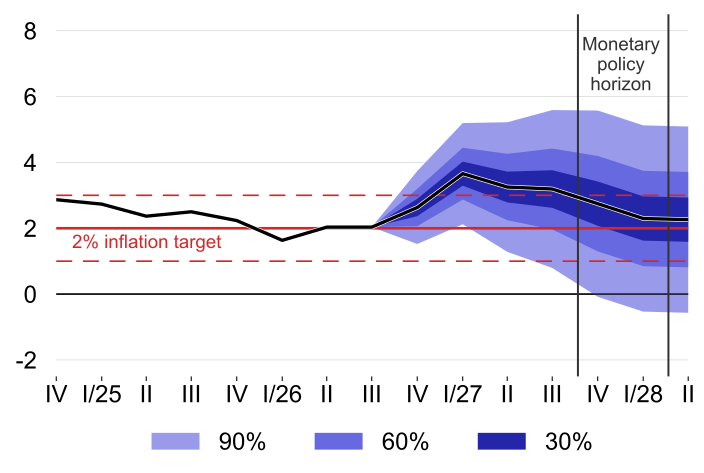
Table – Growth in domestic economic activity will be around 2.5% over the next two years
changes compared to previous forecast in brackets
| 2026 | 2027 | 2028 | |
|---|---|---|---|
| Headline inflation | 2.1 | 3.2 | 2.3 |
| %; changes in pp | (0.1) | (0.7) | (-0.1) |
| GDP | 1.7 | 2.5 | 2.5 |
| y-o-y in %; changes in pp | (-0.5) | (-0.2) | (-0.1) |
| Average nominal wage | 6.2 | 5.9 | 5.3 |
| y-o-y in %; changes in pp | (-1.1) | (0.2) | (0.1) |
| 3M PRIBOR | 3.9 | 4.1 | 3.6 |
| %; changes in pp | (0.1) | (0.2) | (-0.1) |
| Exchange rate | 24.3 | 24.3 | 24.2 |
| CZK/EUR | (0.0) | (-0.2) | (-0.1) |