MONETARY POLICY REPORT | AUTUMN 2026 (box 1)
(authors: Branislav Saxa, Jan Syrovátka)
At the start of this year, domestic FRA interest rates were still indicating a modest decline in rates, and in the euro area and the USA the market was also speculating on the ECB and the Fed easing monetary policy. However, inflationary and geopolitical risks associated with the conflict in the Middle East completely reversed expectations. This shift was reflected primarily in medium-term and long-term interest rates, with short-term maturities less affected.
PRIBOR rates initially rose only slightly in response to the outbreak of the conflict. In early March 2026, however, domestic and foreign interest rates with longer maturities (above one year) rose by as much as 1 pp within a few days as the attack on Iran and the closure of the Strait of Hormuz drove up oil prices and reignited concerns about higher inflation. As a result, the market reassessed the outlook for the monetary policies of central banks, which began to communicate “higher for longer” policies. Investors also factored in the possibility of widening public deficits due to the financing of military operations and fiscal measures aimed at mitigating the impact of high energy prices. Market uncertainty regarding the future configuration of tariffs on goods imports into the US meanwhile remained elevated. Financial markets saw declines in prices of some assets, while the VSTOXX (EU) and VIX (US) equity-market implied volatility indices remained above the calm zone threshold for several weeks. Following negotiations between the US and Iran, which could have led to a more durable peace settlement, conditions in financial markets gradually stabilised despite several waves of escalation of the military conflict. Nevertheless, interest rates did not return to their end-February levels, as even a prompt end to the conflict and reopening of the Strait of Hormuz could not have been expected to return commodity prices rapidly to their pre-war levels. The market assumes that the global inflationary shock will gradually pass through to the economy, requiring central banks to maintain a greater degree of restriction. Most of them (including the CNB, the ECB and the Fed) have already raised their policy rates and have not ruled out further action should the energy shock persist.
Another factor behind the increase in long-term interest rates is global indebtedness and the rising cost of servicing debt. Part of this consists of non-financial corporate debt, which has risen particularly among technology firms in recent years. It has become considerably more expensive to refinance older debt, as much of it originated during the period of exceptionally low (or even negative) interest rates around 2016. High interest payments place an additional burden on fiscal deficits and therefore represent a significant risk to the public finances of economies around the world. Governments frequently face a lack of social demand for fiscal consolidation, while investors may seek a higher risk premium.
The relationship between domestic and foreign interest rate swap (IRS) rates has long been very close (see Chart 1). Twenty-day changes in ten-year koruna and euro IRS rates are highly correlated, while changes in five-year IRS rates exhibit a somewhat weaker correlation. The correlation is lower for daily changes in IRS rates, although even here it has averaged around 0.5 over the past decade. As maturities lengthen, expectations regarding the CNB’s future monetary policy stance naturally become less important, while the linkage between Czech and foreign rates becomes stronger.
Chart 1 – The correlation between changes in koruna and euro IRS rates is relatively high
rolling correlation in 1,000-day windows; date corresponds to most recent observation; source: Bloomberg, CNB calculation
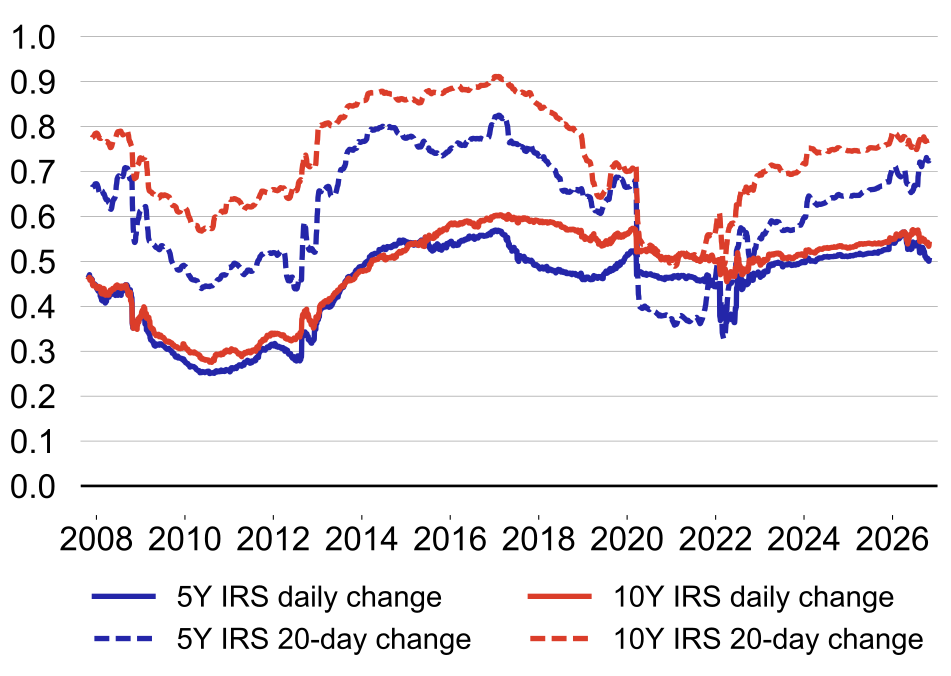
Note: 20-day changes in IRS rates are calculated as the difference between the rates observed 20 trading days apart.
Chart 2 shows that domestic IRS rates have risen by as much as 1.2 pp since the start of this year, broadly in line with rates abroad. Long-term financing conditions have therefore tightened beyond the scope of central banks’ monetary policy measures. The slope of the yield curve has meanwhile changed little and remains positive.
Chart 2 – IRS yield curves have moved higher since the outbreak of the war in Iran
%; source: Bloomberg
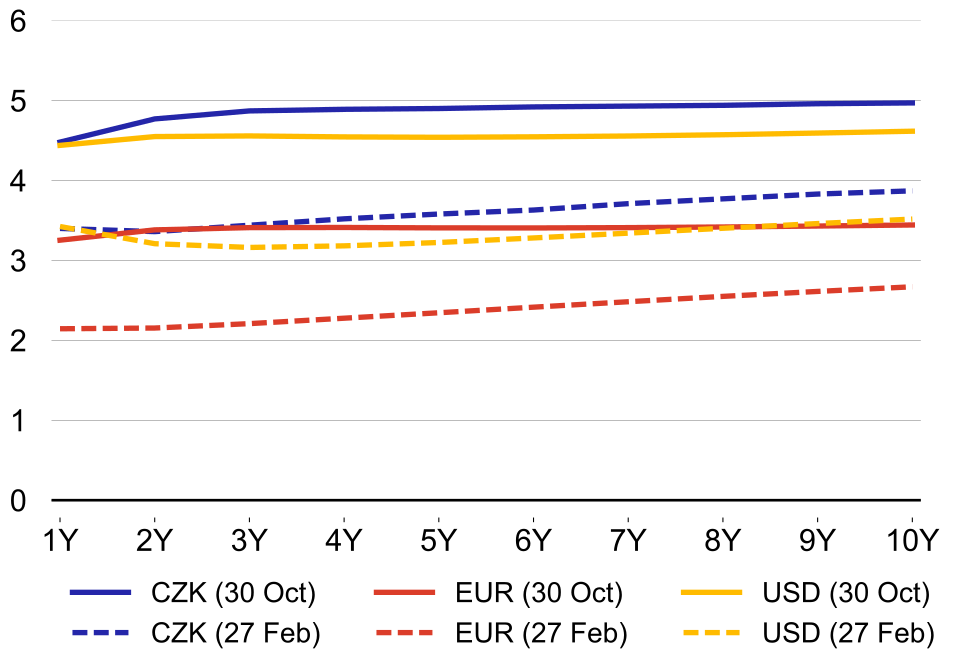
Note: IRS rates are used for CZK and EUR, and SOFR rates for USD
Elevated long-term rates have a modest dampening effect on economic activity. For example, one study[1] for the USA estimates that a 1 pp increase in long-term rates caused by a rise in the term premium may reduce the output gap by approximately 0.75 to 1 pp. For the Czech economy, the effect is likely to be smaller, but the pass-through from monetary policy and market rates to client rates is relatively rapid.[2] Client rates on most koruna-denominated loans to non-financial corporations (around 57% of the total) are contractually linked to PRIBOR rates. A large part of the interest rate transmission channel is therefore already captured through the forecast for short-term rates. Changes in market rates are thus reflected in client rates almost instantly. Longer-term market rates nonetheless influence lending rates on the portion of loans to non-financial corporations that carry fixed interest rates. The average rate on all corporate loans has risen by 0.7 pp since the beginning of the year, reaching 5.6% in September. This is putting an additional drag on investment activity in particular.
Housing loans are affected more strongly by longer-term interest rates. In recent years, the most common reference rate for new mortgages has been the three-year IRS rate, whereas five-year maturities had previously been dominant. Changes in market interest rates are reflected in mortgage rates rather more gradually than in corporate lending rates; however, IRS rates have risen more sharply this year than PRIBOR rates. The average mortgage rate has risen by 0.6 pp since the start of the year, reaching 5.2%. Empirical evidence for the euro area[3] suggests that the direct impact of this channel on consumption is relatively weak. The core forecasting model captures the effect of the additional tightening only partially. Accordingly, beyond the standard model mechanisms, the forecast incorporates an expert estimate of a stronger dampening effect of higher long-term rates on investment, while only a modest impact is assumed for consumption.
The current level of longer-term interest rates of around 5% is not unusual historically (see Chart 3). However, such levels have typically been observed when the two-week repo rate has been higher. As in 2022, when longer-term rates last exceeded their current levels, elevated rates at the longer end of the curve are now helping to dampen inflation. Higher mortgage rates are reducing demand for housing loans. According to the Bank Lending Survey, a large proportion of banks expect demand for housing loans to drop further in Q4. This is fostering slower growth in property prices, which affects headline inflation both directly and indirectly.
Chart 3 – Despite their current rise, domestic IRS rates remain below previous peaks
%; end-of-month levels for 2W repo rate, monthly averages for IRS rates; source: CNB
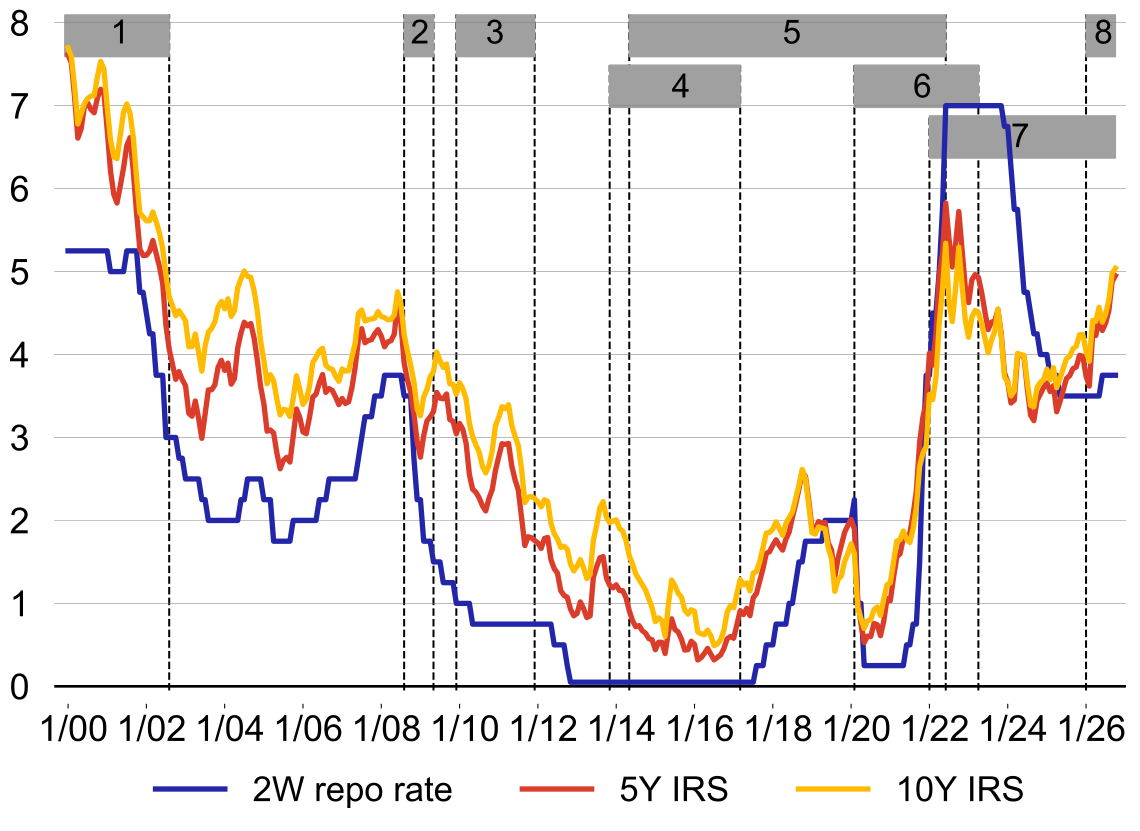
Note: The shaded areas denote the following periods:
1 Dot-com bubble
2 Financial crisis
3 Euro area debt crisis
4 CNB exchange rate floor
5 Negative rates in euro area
6 COVID-19
7 Russia’s invasion of Ukraine
8 US attack on Iran
[1] Kiley, M. T. (2014): The aggregate demand effects of short- and long-term interest rates, International Journal of Central Banking, Volume 10, Issue 4.
[2] For details see the box How do banks and their clients react to changes in the CNB’s interest rates in the Summer 2026 MPR.
[3] Baptista, P., M. Dossche, A. Hannon, D. Henricot, O. Kouvavas, D. Malacrino and L. Zimmermann (2025): The transmission of monetary policy: From mortgage rates to consumption, ECB Economic Bulletin, Issue 4/2025.