CNB leaves the countercyclical capital buffer rate and mortgage lending rules unchanged
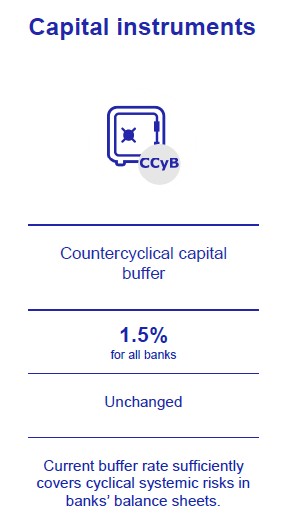
At its financial stability meeting on 25 November, the Bank Board of the Czech National Bank (CNB) decided to keep the countercyclical capital buffer rate at its current level of 1.5%. It also left the rules for mortgage lending unchanged. Although systemic risks remain elevated, their further build-up is slowing. The Bank Board therefore assessed the current macroprudential policy settings as sufficient.
The financial cycle moved further into the growth phase during 2026. However, the latest data indicate a slowdown in the pace of new lending to households and more moderate growth in residential property prices. The elevated levels of some indicators still reflect the exceptionally strong lending activity recorded in the first half of the year. The further build-up of cyclical risks is expected to ease gradually. “The financial cycle remains at an elevated level, but growth in new lending is now slowing and this trend should continue owing to tighter financial conditions. Also taking into account the banking sector’s high resilience, we consider the current countercyclical capital buffer rate to be appropriate,” said CNB Bank Board member Jakub Seidler.
Looking ahead, the Bank Board stands ready to adjust the countercyclical capital buffer rate in either direction if necessary. If lending growth or household and corporate debt were to increase again, the Bank Board stands ready to raise the rate. Conversely, in the event of a significant deterioration in the economic situation and the materialisation of cyclical credit losses, it may lower the buffer rate.
The Bank Board also discussed developments in the mortgage and property markets. In the first half of the year, there was evidence of frontloading ahead of the tightening of conditions for investment mortgages and the increase in interest rates. Lending activity slowed in 2026 Q3. At the same time, banks are not easing credit standards, and the recommendation on investment mortgages is being reflected in more favourable risk characteristics of new loans.
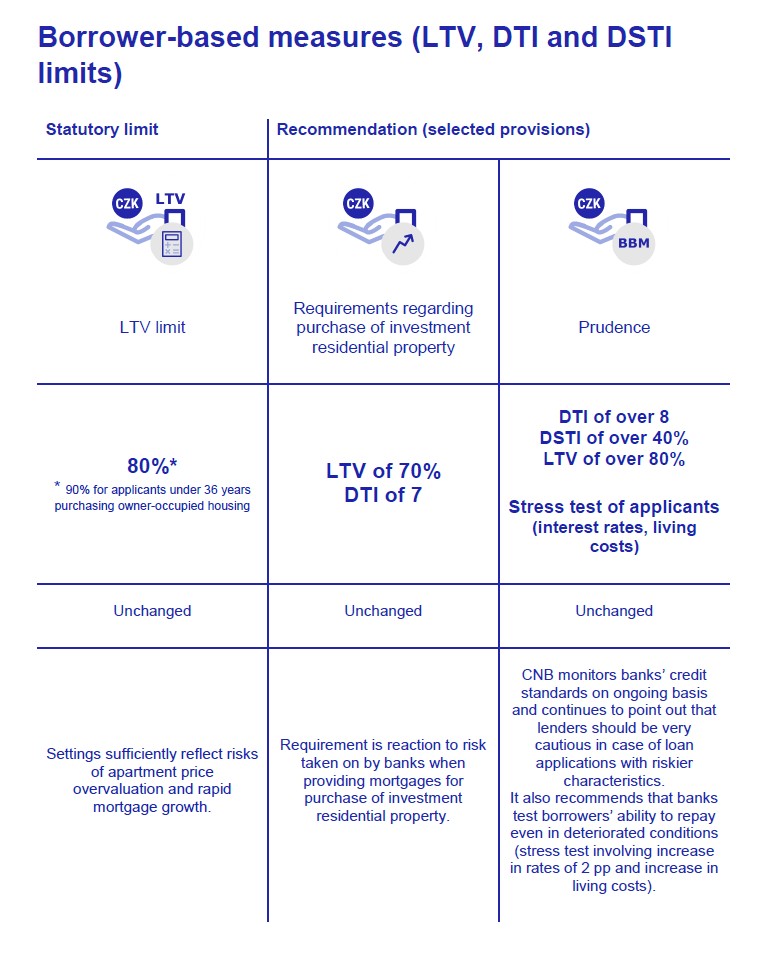
The Bank Board therefore kept the upper limit on the LTV ratio at 80% (90% for applicants under 36 years financing owner-occupied housing). The upper DTI and DSTI limits remain deactivated. The recommended LTV limit of 70% and DTI limit of 7 for investment mortgages also remain unchanged. “The Bank Board considers the current rules for mortgage lending to be sufficient. Risks in the mortgage and property markets remain elevated but are gradually easing. The recommendation regarding investment mortgages has had the effect we expected and has reduced the provision of mortgages with the riskiest characteristics,” added Jakub Seidler.
The banking sector remains well capitalised, profitable and liquid, while the quality of its credit portfolios remains favourable. The macro stress test confirmed the banking sector’s ability to absorb even a deep and prolonged economic downturn, albeit at the cost of using part of its capital buffers. “The stress test results confirm the high resilience of the Czech banking sector and its ability to absorb even very severe shocks,” said Libor Holub, Executive Director of the CNB’s Financial Stability and Resolution Department.
In its Financial Stability Report, the CNB regularly assesses the soundness of the domestic financial sector and its resilience to adverse shocks. The report provides the basis for calibrating macroprudential policy tools, in particular bank capital buffers and borrower-based measures. The CNB will publish the latest Financial Stability Report – Autumn 2026 on Monday, 14 December 2026. The minutes of today’s Bank Board meeting on financial stability issues will be published the same day.
Jakub Holas
Director, Communications Division
Notes for journalists:
An investment mortgage is a mortgage loan provided for the acquisition of a third or subsequent residential property and/or a buy-to-let residential property.
Financial stability has been a key objective of the Czech National Bank alongside price stability since 2013. Maintaining financial stability is defined in Act No 6/1993 Coll., on the Czech National Bank. The Act requires the CNB to set macroprudential policy by identifying, monitoring and assessing risks jeopardising the stability of the financial system and, in order to prevent or mitigate these risks, to contribute by means of its powers to the resilience of the financial system and the maintenance of financial stability. Since the second half of 2021, the CNB has had the statutory power to set upper limits on the LTV, DTI and DSTI ratios (borrower-based measures). Compliance with the limits must be legally binding in order to ensure a level playing field in the market.
The Bank Board discusses financial stability issues twice a year – in the spring in May or June, and in the autumn in November. The aim of the Financial Stability Report is to identify near-term risks to the financial stability of the Czech Republic based on previous and expected developments in the real economy and the financial system.
The main macroprudential policy tools applied in the Czech Republic are the countercyclical capital buffer (CCyB), the capital conservation buffer (CCoB), the capital buffer for other systemically important institutions (O-SIIs) set only for systemically important banks, the systemic risk buffer (SyRB), the upper limits on the LTV, DTI and DSTI credit ratios set for all mortgage lenders, and the Recommendation on the management of risks associated with the provision of consumer loans secured by residential property.
Countercyclical capital buffer (CCyB) – This instrument is aimed at increasing the resilience of the banking sector to risks associated with fluctuations in lending activity. The CCyB should enable banks to lend to households and firms even during a recession or periods of financial instability.
Systemic risk buffer (SyRB) – This buffer is intended to mitigate the potential impacts of systemic risks identified on the financial system and the real economy. If their level poses a risk to financial stability, the application of the SyRB enhances the capitalisation of the banking sector and increases its resilience to adverse shocks. At the same time, it may help reduce the growth or concentration of relevant exposures in banks’ balance sheets, although this is not its primary purpose.
Capital conservation buffer (CCoB) – This instrument is aimed at preserving a bank’s capital. Under the Act on Banks, all banks are obliged to maintain this buffer. The CCoB rate is 2.5% and does not change over time.
Capital buffer for other systemically important institutions (O-SIIs) – This instrument is aimed at mitigating risks connected with the potential destabilisation of systemically important institutions, which could have significant adverse effects on the financial system and the economy as a whole. The CNB is required to draw up a list of O-SIIs and calibrate the buffer for individual O-SIIs at least once a year.
Combined capital buffer – the sum of the capital conservation buffer (CCoB), the countercyclical capital buffer (CCyB), the systemic risk buffer (SyRB) and the capital buffer for other systemically important institutions (O-SIIs).
LTV (loan-to-value) – the ratio of the value of a mortgage loan to the value of the collateral.
DTI (debt-to-income) – the ratio of the applicant’s total debt to their net annual income.
DSTI (debt-service-to-income) – the ratio of the sum of an applicant’s monthly repayments to their net monthly income.