The CNB left interest rates unchanged, inflation will temporarily rise to 3% at the start of next year and then return to close to the target
- At its August meeting, the Bank Board left interest rates unchanged. The 2W repo rate remains at 3.75%. The Bank Board assessed the risks and uncertainties of the outlook for the fulfilment of the inflation target as inflationary overall.
- Inflation will be close to the 2% inflation target this year. It will temporarily rise to 3% at the start of next year. Inflation will then return to close to the target, aided by tight monetary policy.
- Economic growth will slow slightly this year and pick up again next year due to a renewed positive contribution of net exports and strong domestic demand.
- Consistent with the forecast is broad stability of short-term market interest rates.
Annual inflation fell markedly to 1.5% in June, returning to levels last seen just before the outbreak of the conflict in the Middle East. Double-digit growth in fuel prices is still evident within inflation, although it declined noticeably in June due to a correction in oil prices on global markets. In May and June, inflation was dampened by a drop in food prices. Core inflation is being kept near to 3% by rising services prices. The labour market remains tight, generating significantly higher growth in real compensation of employees than in labour productivity. Wage growth in the historical context is discussed in Box 1. The contribution of imputed rent to core inflation is also elevated, owing to growth in property prices, construction work prices and material costs. Throughout this year, inflation is being reduced by the one-off effect of the full transfer of the supported energy sources fee in electricity prices to the state budget. This effect will fade out next year. Food prices and retail energy prices will also start to rise again. As a result, inflation will go up to close to 3% at the start of next year. It will then return to close to the target, aided by restrictive monetary policy. In 2028, the introduction of the ETS2 emissions trading system will nudge up inflation temporarily.
The growth of the Czech economy will slow slightly this year and fluctuate around 2.5% in the following years. The growth in the quarters ahead will be due mainly to household consumption, driven by rising real wages and a positive fiscal impulse. An expected recovery in external demand, supported by fiscal expansion in Germany, will boost growth in private fixed investment. General government investment will also rise this year amid increased take-up of EU funds. The recovery in domestic demand is linked with strong bank lending. The strongest growth is being recorded by consumer credit, which is discussed in Box 3. Foreign trade is dampening GDP growth this year due to exceptionally high import growth, but in the years ahead it will make a positive contribution to growth in economic activity. The economy will be close to its potential over the entire forecast horizon.
After appreciating slightly in late May and early June, the exchange rate stabilised close to CZK 24.2 to the euro. This is the level assumed in the short-term forecast for Q3. Over the forecast horizon, faster growth in the costs of domestic firms compared with foreign ones will outweigh the exchange rate’s tendency to appreciate due to convergence of the Czech economy. The koruna will therefore weaken slightly to close to CZK 24.4 to the euro. Consistent with the forecast is broad stability of short-term market interest rates. Despite the current favourable price developments, the outlook for the period ahead requires monetary policy to remain restrictive.
The Bank Board assessed the risks and uncertainties of the outlook for the fulfilment of the inflation target as inflationary overall. Persistence of core inflation is a risk in the coming months. It is reflected above all in elevated services inflation, including housing prices. A possible acceleration in the growth of the money supply in the economy caused by lending to households and general government is another domestic upside risk to inflation. A possible year-on-year increase in the public finance deficit would lead to a risk of fiscal policy having an even greater inflationary effect. Continued rapid wage growth related to persistent tightness in the labour market is an additional inflationary risk. The Bank Board will continue to closely monitor the macroeconomic impacts of the conflict in the Middle East. For the Bank Board, it is important to prevent the impacts of the conflict to date from passing through to elevated inflation expectations in the Czech Republic. By contrast, the weak performance of some euro area economies and a possible global correction of asset prices in an environment of increased geopolitical uncertainty and high levels of debt in some developed countries may have an anti-inflationary effect. Trade barriers and uncertainty connected with their intensity also remain a risk to global economic activity. The development of the war in Ukraine still represents an uncertainty.
Chart – Inflation will be slightly above the inflation target over almost the entire forecast horizon
headline inflation; y-o-y in %; confidence intervals in colours
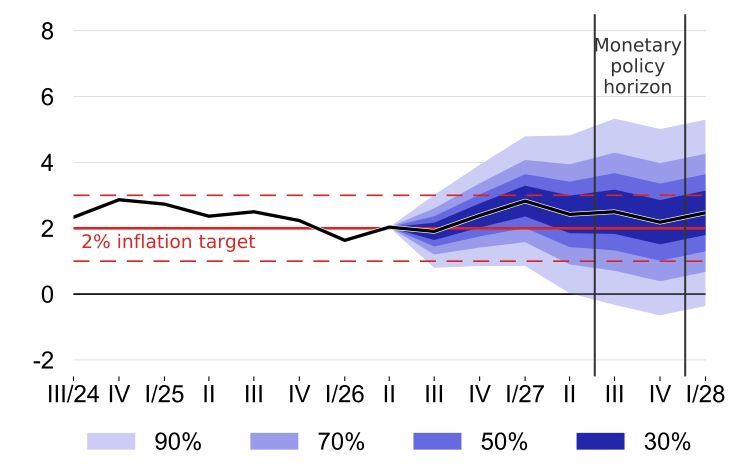
Table – Growth in domestic economic activity will fluctuate around 2.5% in the years ahead
changes compared to previous forecast in brackets
| 2026 | 2027 | 2027 | |
|---|---|---|---|
| Headline inflation | 2.0 | 2.5 | 2.4 |
| %; changes in pp | (-0.2) | (0.1) | - |
| GDP | 2.2 | 2.7 | 2.5 |
| y-o-y in %; changes in pp | (-0.3) | (0.0) | - |
| Average nominal wage | 7.3 | 5.7 | 5.2 |
| y-o-y in %; changes in pp | (0.9) | (0.3) | - |
| 3M PRIBOR | 3.7 | 3.9 | 3.7 |
| %; changes in pp | (-0.1) | (0.3) | - |
| Exchange rate | 24.3 | 24.4 | 24.3 |
| CZK/EUR | (-0.1) | (0.0) | - |