
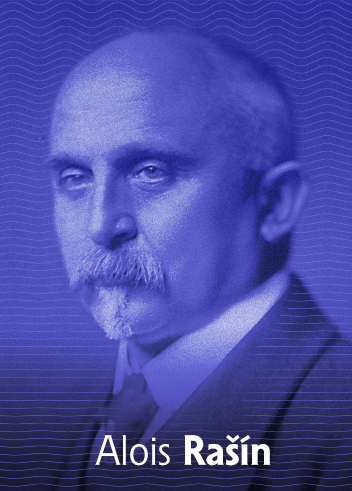
Alois Rašín
(18 October 1867 – 18 February 1923)
Czechoslovak politician and minister of finance 1918–1919 and 1922–1923
Alois Rašín became active in politics while still a student at the Faculty of Law of the Czech Charles-Ferdinand University in Prague, emerging as one of the leaders of the student progressivist movement. In 1894, he was arrested and then sentenced to two years’ imprisonment in a show trial against the Omladina youth movement. After the progressivist movement split, he became involved in the political constitutional movement. In 1899, he co-founded the Czech Constitutional Party which had strong anti-Habsburg leanings. He later left the party and aligned himself with the National Liberal Party (Young Czech Party). At that time, he also headed a successful law practice and developed an interest in economic and financial issues. Shortly after joining the National Liberal Party in 1907, Rašín became one of its most popular speakers and, in 1911, was elected as its deputy to the Council of the Empire. At that time, he also became managing editor of the party’s daily newspaper Národní listy.
Soon after the outbreak of World War I, he joined the Maffie organisation and, as one of the leading figures of the anti-Austrian resistance, was arrested again in 1915 and sentenced to death for treason and espionage in June 1916. A year later, in January 1917, the sentence was commuted to ten years’ imprisonment, which he served at Möllersdorf prison. Six months later, he was granted a full amnesty. After his release from prison, Rašín became active in Czech politics again and helped merge several Czech political parties into the Czech Constitutional Democratic Party (later the Czechoslovak National Democratic Party). Soon afterwards, he also became a member of the National Committee and played a significant role in preparing the establishment of the new state.
As a member of the presidium of the National Committee, Rašín was among the organisers of the anti-Austrian coup on 28 October 1918 and drafted the first law of the new Czechoslovak state. He served as minister of finance in the first Czechoslovak government. In this post, he initiated, among other things, the successful separation of the Czechoslovak currency from the Austro-Hungarian currency and sought to give it a sound and solid foundation through his economic measures. In the area of monetary policy, he advocated radical deflation and supported a balanced budget and government austerity measures. On 5 January 1923, during his second mandate as minister, an attempt was made on his life. He succumbed to his injuries a month later and died on 18 February 1923.